 Popular
Demographics of Saratoga, WY
Affluence Level in Saratoga, WY
A middle-class area roughly in line with national averages across income, home values, education, and employment.
People of Saratoga, WY
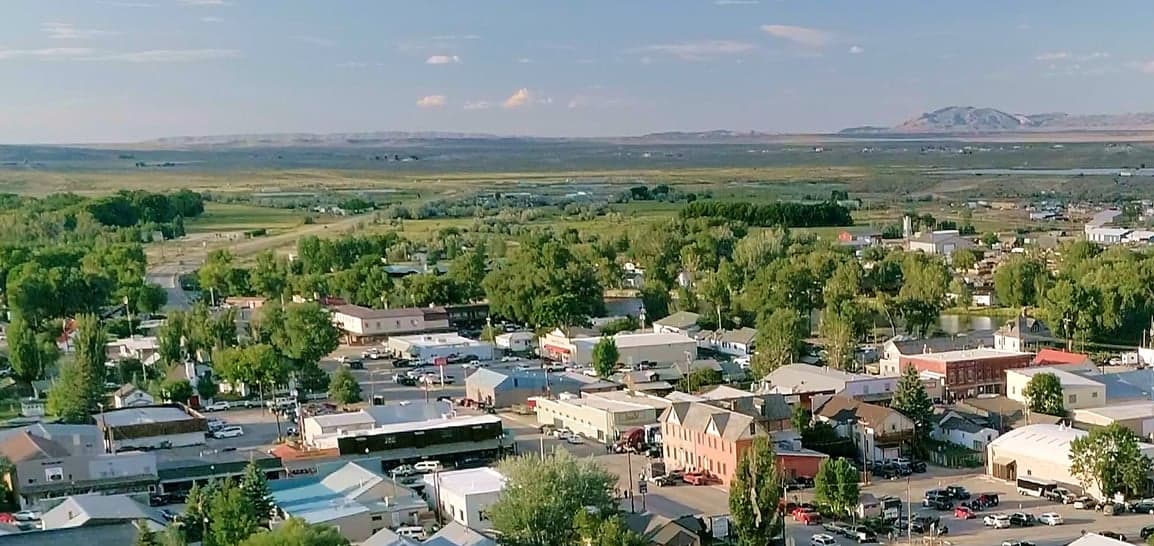
The people of Saratoga, Wyoming, today number roughly 1,864 residents, forming a tight-knit, predominantly white community with a strong Western ranching and outdoor-recreation identity. The city’s character is defined by its low population density, a median age slightly above the national average, and a workforce rooted in tourism, energy extraction, and small-scale agriculture. With 89.1% of the population identifying as white and only 1.6% foreign-born, Saratoga remains one of the least ethnically diverse towns in Carbon County, a place where generational families and recent domestic in-migrants coexist in a landscape of hot springs and high plains.
How the city was settled and grew
Saratoga’s founding population arrived in the late 19th century, drawn not by land grants but by the Union Pacific Railroad’s push through southern Wyoming and the promise of free-range cattle grazing. The town was officially platted in 1881, and its first wave of settlers—primarily Anglo-American ranchers and railroad workers from the Midwest and Great Plains—built homes in what is now the Historic Downtown District, centered along First and Second Streets. These early residents established the town as a shipping point for livestock, and by the 1900s, the discovery of mineral hot springs spurred a second wave of health-seekers and tourism entrepreneurs. The Hobbs Addition neighborhood, platted in the 1910s, absorbed many of these newcomers, offering modest lots for workers at the nearby Carbon County coal mines and the Saratoga Inn resort. A third wave arrived during the 1940s and 1950s, when the construction of the Seminoe Dam and the expansion of the Medicine Bow National Forest brought federal employees and seasonal laborers; these families settled largely in the West Side area, west of the North Platte River, which remains a mix of mid-century ranch houses and newer modular homes.
Modern era (post-1965)
After the 1965 Hart-Cellar Act, Saratoga saw virtually no immigration-driven diversification. The foreign-born population today sits at just 1.6%, and the town’s racial composition has remained overwhelmingly white—89.1%—with no significant influx from Asia, the Indian subcontinent, or the Middle East. The Hispanic share, at 5.0%, is the only notable minority presence, and it is concentrated in the Riverbend Mobile Home Park and a handful of rental properties along Highway 130, where seasonal workers in the oil and gas fields and the tourism industry have settled since the 1990s. Domestic in-migration, however, has been the primary demographic driver since the 1970s. Retirees and second-home buyers from Colorado and California began purchasing properties in the Platte Valley Estates subdivision (developed in the 1980s), drawn by the town’s low property taxes and access to the Saratoga National Fish Hatchery. Meanwhile, younger families moving for jobs at the nearby Sinclair Refinery or the Carbon County School District have gravitated toward the East Side neighborhoods, where newer single-family homes were built in the 2000s. The college-educated share—35.2%—reflects this in-migration of professionals, though the town lacks a four-year university and relies on remote work and local government employment to retain them.
The future
Saratoga’s population is projected to remain stable or decline slightly over the next decade, mirroring Carbon County’s broader trend of rural outmigration among younger adults. The town is not tribalizing into distinct ethnic enclaves—its small size and low diversity make that unlikely—but it is experiencing a subtle economic divide. The Historic Downtown District is increasingly dominated by vacation rentals and boutique shops, pricing out long-term renters, while the West Side and Riverbend areas house a growing share of service-sector workers and retirees on fixed incomes. The Hispanic community, though small, is plateauing rather than expanding, as oil-and-gas cycles have slowed since 2020. No significant growth is expected from East/Southeast Asian or Indian-subcontinent populations, given the absence of employer-sponsored migration pathways. The next 10-20 years will likely see Saratoga become older, whiter, and more economically stratified between property-owning newcomers and wage-dependent locals.
For someone moving in now, Saratoga offers a stable, low-crime environment with a strong sense of place, but it is a community that is slowly aging and consolidating rather than diversifying or expanding. New residents will find a town where social networks are built through church, school, and volunteer fire department involvement, and where the demographic future points toward preservation of the status quo rather than transformation.

* Values derived from national, state, county, city and local statistics and may differ in a specific area. Last updated: 2026-04-21T10:52:40.000Z
Narrative content on this page is AI-generated and may contain mistakes. Verify any details that matter before acting on them.
ReloMaps may earn a commission from affiliate links at no extra cost to you.

