Photo: Wikipedia
Demographics of Schererville, IN
Affluence Level in Schererville, IN
A middle-class area roughly in line with national averages across income, home values, education, and employment.
People of Schererville, IN
The people of Schererville, Indiana, today form a predominantly white, middle-class suburban community of 29,627 residents, marked by a notable Hispanic minority (15.0%) and smaller Black (8.2%) and East/Southeast Asian (3.1%) populations. The city’s identity is shaped by its evolution from a quiet farming crossroads into a bedroom community for the Chicago metro area, with a foreign-born share of just 3.4%—well below the national average. Distinctive markers include a strong Catholic heritage, a family-oriented atmosphere, and a population that is slightly more college-educated (33.7%) than the state average but still heavily rooted in blue-collar and professional commuter lifestyles. The city feels stable and established, with little of the rapid churn seen in newer exurbs.
How the city was settled and grew
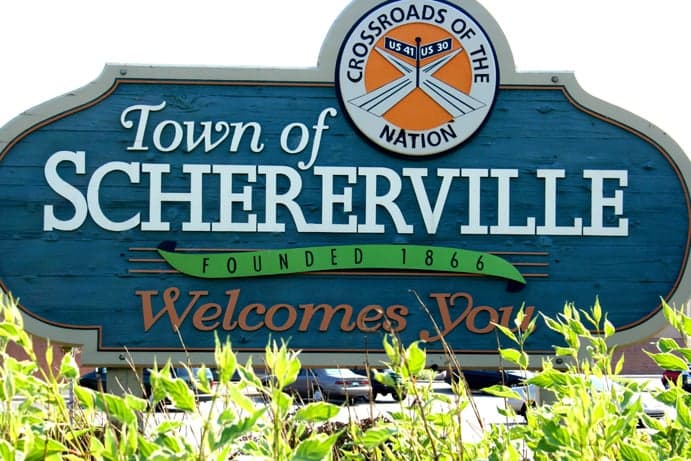
Schererville’s human history begins in the 1830s, when German and Dutch immigrant farmers were drawn to the fertile, flat land of northwestern Indiana by the federal land-grant system. The town was formally platted in 1866 by Nicholas Scherer, a German-born merchant, who established a small commercial core along what is now U.S. Route 30. The earliest settlers clustered in what is now the Historic Downtown Schererville district, building simple frame houses and a handful of churches—most notably St. John the Evangelist Catholic Church, founded by German Catholics in 1869. A second wave of Dutch Reformed families arrived in the 1870s and 1880s, settling the Dutch Ridge area east of the downtown, where they established dairy farms and a small school. The population remained under 500 through 1900, sustained by agriculture and the railroad that connected Schererville to Chicago’s livestock markets. No major industrial boom occurred; growth was slow and organic, with the original German and Dutch families forming the demographic bedrock that persists in many of the city’s older neighborhoods today.
Modern era (post-1965)
The post-1965 era transformed Schererville from a rural hamlet into a sprawling suburb. The Immigration and Nationality Act of 1965 had little direct effect here—the foreign-born share remains low—but the completion of the I-80/94 corridor in the 1960s triggered a wave of domestic in-migration. White families from Chicago’s South Side and northwest Indiana’s industrial cities (Gary, Hammond, East Chicago) moved eastward seeking newer housing and lower crime rates. This suburbanization filled the Lakes of the Four Seasons subdivision (a large, planned community in the city’s southwest) and the Brookwood Estates neighborhood in the north, both developed between 1970 and 1990. The Hispanic population began growing in the 1990s, driven by Mexican and Puerto Rican families moving from Chicago’s Pilsen and Humboldt Park neighborhoods; they concentrated in the Pheasant Run area and along the U.S. 30 commercial strip. The Black population, which was negligible before 1980, grew to 8.2% by 2020, largely through secondary migration from Gary and East Chicago into the Woodland Hills subdivision. The East/Southeast Asian community (3.1%) is smaller and more dispersed, with Filipino and Vietnamese families settling in the Schererville Townhomes complex and newer developments near the St. John border. The Indian-subcontinent population remains tiny at 0.2%, concentrated among a handful of professionals in the medical and tech sectors.
The future
Schererville’s population is likely to continue its gradual diversification, but at a slower pace than the broader Chicago region. The white share (69.6%) is declining slowly as older German and Dutch residents age out and younger families move in, but the city lacks the large immigrant gateway infrastructure—ethnic grocery stores, language services, dense apartment stock—that drives rapid change in places like nearby Hammond or East Chicago. The Hispanic share (15.0%) is the fastest-growing segment, projected to reach 18-20% by 2035, driven by natural increase and continued migration from Chicago. The Black population appears stable, with little new in-migration from Gary. The East/Southeast Asian community is plateauing, as many second-generation families move to larger Asian hubs in Naperville or Schaumburg. The city is not tribalizing into distinct ethnic enclaves; rather, it is homogenizing into a broadly middle-class, English-dominant suburb where ethnic differences are muted by shared school districts and homeowner association norms. New housing developments—such as the Prairie Crossing subdivision near the south edge—are attracting a mix of white and Hispanic buyers, but few new immigrants.
For someone moving in now, Schererville is becoming a stable, moderately diverse suburb where the old German-Dutch character is fading but not gone, and where the future looks more like a typical Midwestern exurb than a melting pot. The city offers good schools, low crime, and a commuter-friendly location, but little ethnic dynamism or cultural variety. It is a place for families seeking predictability, not for those looking for rapid demographic change or a vibrant immigrant community.

* Values derived from national, state, county, city and local statistics and may differ in a specific area. Last updated: 2026-04-22T09:57:23.000Z
Narrative content on this page is AI-generated and may contain mistakes. Verify any details that matter before acting on them.
ReloMaps may earn a commission from affiliate links at no extra cost to you.

