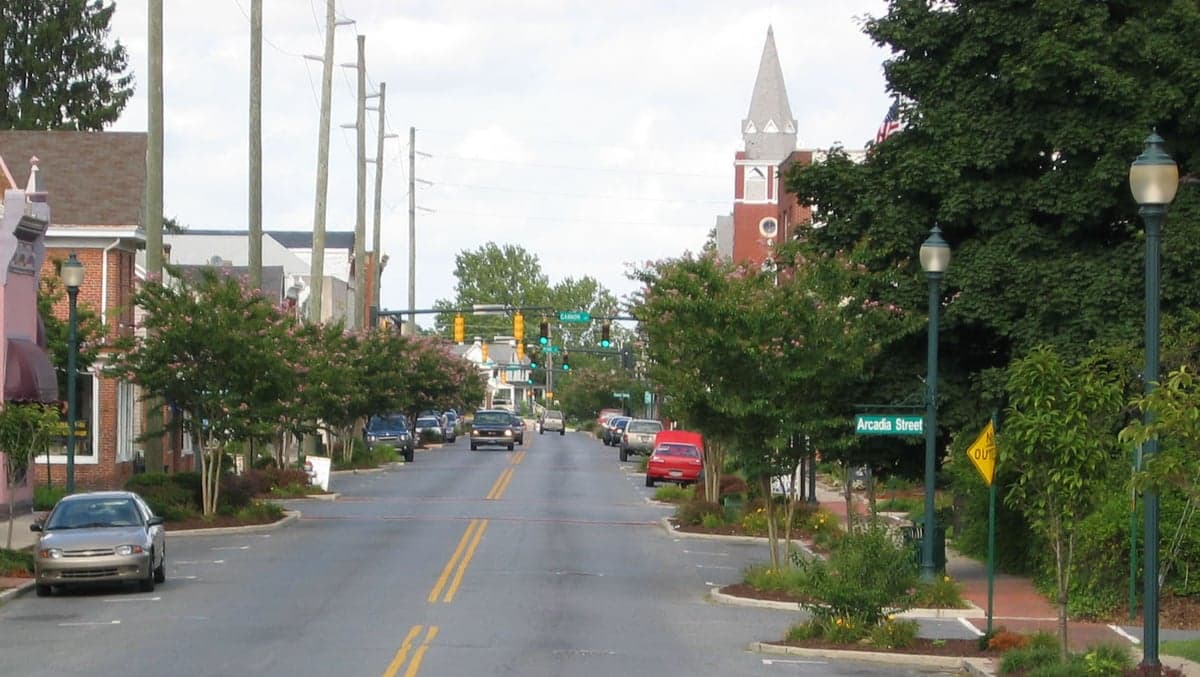
Photo: Wikipedia
Personal Sovereignty in Seaford, DE
Viable for self-reliance. Generally workable, though some barriers may limit total independence.
What does Personal Sovereignty tell us?
Personal Sovereignty measures your capacity for self-reliance and independence with minimal government friction. Higher scores mean fewer barriers between you and the way you want to live... but it assumes you have the space you need and good neighbors.
What does this tell us?
Personal Sovereignty measures your capacity for self-reliance and independence with minimal government friction. Higher scores mean fewer barriers between you and the way you want to live... but it assumes you have the space you need and good neighbors.
State Policy
Energy independence: Importer (2% of energy produced in-state)
Personal Liberty
Homesteading

Personal Liberty Analysis
Seaford, Delaware, offers a mixed bag for those prioritizing personal sovereignty, with a state-level environment that leans interventionist in some areas while leaving meaningful room for self-reliance at the local level. For conservative-leaning individuals and families who value autonomy—whether in financial decisions, self-defense, or raising children—Seaford provides a lower-cost, slower-paced alternative to the Mid-Atlantic's more regulated enclaves, but it is not a libertarian free zone. The key is understanding where Delaware's state apparatus imposes constraints and where Seaford's rural character and local governance allow for genuine independence.
Tax burden and regulatory posture: what it costs to live freely
Delaware's tax structure is a notable advantage for sovereignty-minded residents. The state has no sales tax, which means every purchase you make—from bulk ammo to homestead supplies—keeps more money in your pocket. Property taxes in Sussex County, where Seaford sits, are among the lowest in the Northeast, typically ranging from 0.5% to 0.7% of assessed value. A $300,000 home might carry an annual tax bill of only $1,800 to $2,100. This low burden directly supports financial independence, allowing you to allocate funds toward preparedness, land improvements, or savings rather than government overhead. However, Delaware's income tax is progressive, topping out at 6.6% for high earners, which is moderate but not negligible. On the regulatory front, Delaware is not a "business-friendly" state in the way Texas or Florida are; its corporate laws favor large entities, and the state has a relatively active regulatory apparatus. For a small-scale homesteader or sole proprietor, the permitting and zoning processes in Seaford are generally straightforward, but you will encounter state-level oversight on environmental and building codes. The overall posture is one of low direct taxation but moderate regulatory friction—a trade-off that favors those who can navigate paperwork but penalizes those seeking total freedom from government touchpoints.
Self-defense and gun law specifics: what you can carry and where
Delaware's gun laws have tightened in recent years, which is a significant concern for those prioritizing the right to self-defense. The state now requires a permit to purchase a handgun, a background check for all firearm sales (including private transfers), and a concealed carry license that involves a training course and a fee. In 2024, Delaware also passed a ban on "assault weapons" and large-capacity magazines, though this is currently subject to legal challenges. For a prepper or survivalist, this means you cannot legally own certain modern sporting rifles or standard-capacity magazines without facing potential prosecution. Open carry is legal without a permit, but it may draw unwanted attention in Seaford's more populated areas. On the positive side, Seaford is in Sussex County, where the sheriff's office has historically been more supportive of Second Amendment rights than in New Castle County. The local gun culture is strong, with several ranges and gun shops in the area, and property owners can generally defend their homes with deadly force under Delaware's Castle Doctrine. However, the state's "duty to retreat" outside the home (unless you are in your vehicle or workplace) is a limitation. For those who view self-defense as a non-negotiable right, Seaford is a compromise: you can own firearms, but the state imposes significant hurdles and restrictions that would be unacceptable in freer states like New Hampshire or Idaho.
Self-reliance and homesteading viability: lot sizes, zoning, and off-grid feasibility
Seaford's rural character is its strongest asset for those pursuing self-reliance. The city itself is small, but the surrounding areas of Sussex County offer affordable land with minimal zoning restrictions. You can find lots of 1 to 5 acres within a 15-minute drive of downtown, with prices ranging from $10,000 to $30,000 per acre—far cheaper than anything in the Northeast corridor. Zoning in unincorporated areas is generally permissive for agricultural use, including raising chickens, goats, and even small livestock. However, the city of Seaford has more restrictive ordinances, so if you want a true homestead, look outside the municipal limits. Off-grid feasibility is mixed. Delaware has no state-level ban on rainwater collection, but local well and septic regulations are enforced. Solar panels are allowed, but net metering policies are not as favorable as in some western states. The biggest constraint is the lack of abundant natural water sources; the area is not arid, but you will need a drilled well (costing $5,000–$10,000) for true independence. For a prepper, the land is workable but requires upfront investment in infrastructure. The growing season is long enough for substantial gardening, and the proximity to the Chesapeake Bay and Atlantic Ocean provides fishing and foraging opportunities. Overall, Seaford offers a viable but not effortless path to homesteading, with the main hurdles being initial setup costs and local permitting for wells and septic systems.
Personal liberties: parental rights, medical autonomy, speech, and property
Delaware's record on parental rights is concerning for those who view family autonomy as foundational. The state has mandatory vaccination requirements for school attendance, with limited opt-out provisions (medical exemptions only, no religious or philosophical exemptions). This means parents who wish to homeschool or avoid state-mandated medical interventions face bureaucratic resistance. Homeschooling is legal but requires annual notification and some record-keeping; it is not as deregulated as in states like Indiana or Alaska. On medical autonomy, Delaware has not enacted broad emergency powers that override individual choice, but the state's public health apparatus is active and has shown willingness to mandate during crises. Free speech protections are standard under the First Amendment, but Delaware has a "hate crime" law that enhances penalties for certain speech-adjacent actions, which some view as chilling. Property rights are relatively strong; eminent domain is not aggressively used, and zoning disputes are handled at the local level. For a conservative family, the biggest friction points are school vaccine mandates and the lack of robust parental opt-out rights. If you are willing to homeschool or live outside the public school system, these constraints are manageable. The local community in Seaford is generally traditional and supportive of personal liberty, with churches and civic groups that reinforce conservative values.
In the broader landscape of personal sovereignty, Seaford ranks as a moderate option—better than the heavily regulated Northeast corridor but far from the freest states in the Mountain West or South. The low property taxes and affordable land are genuine advantages for building a self-reliant life, but Delaware's gun laws, vaccine mandates, and moderate regulatory posture mean you cannot fully escape government overreach. For a survivalist or prepper who values financial independence and rural space, Seaford is a practical choice if you are willing to work within the system. For those seeking absolute autonomy—no permits, no restrictions, no state interference—you would need to look further south or west. Seaford offers a strategic compromise: enough freedom to build a resilient life, but not enough to ignore the state's presence.

* Values derived from national, state, county, city and local statistics and may differ in a specific area. Last updated: 2026-04-29T23:40:57.000Z
Narrative content on this page is AI-generated and may contain mistakes. Verify any details that matter before acting on them.
ReloMaps may earn a commission from affiliate links at no extra cost to you.

