
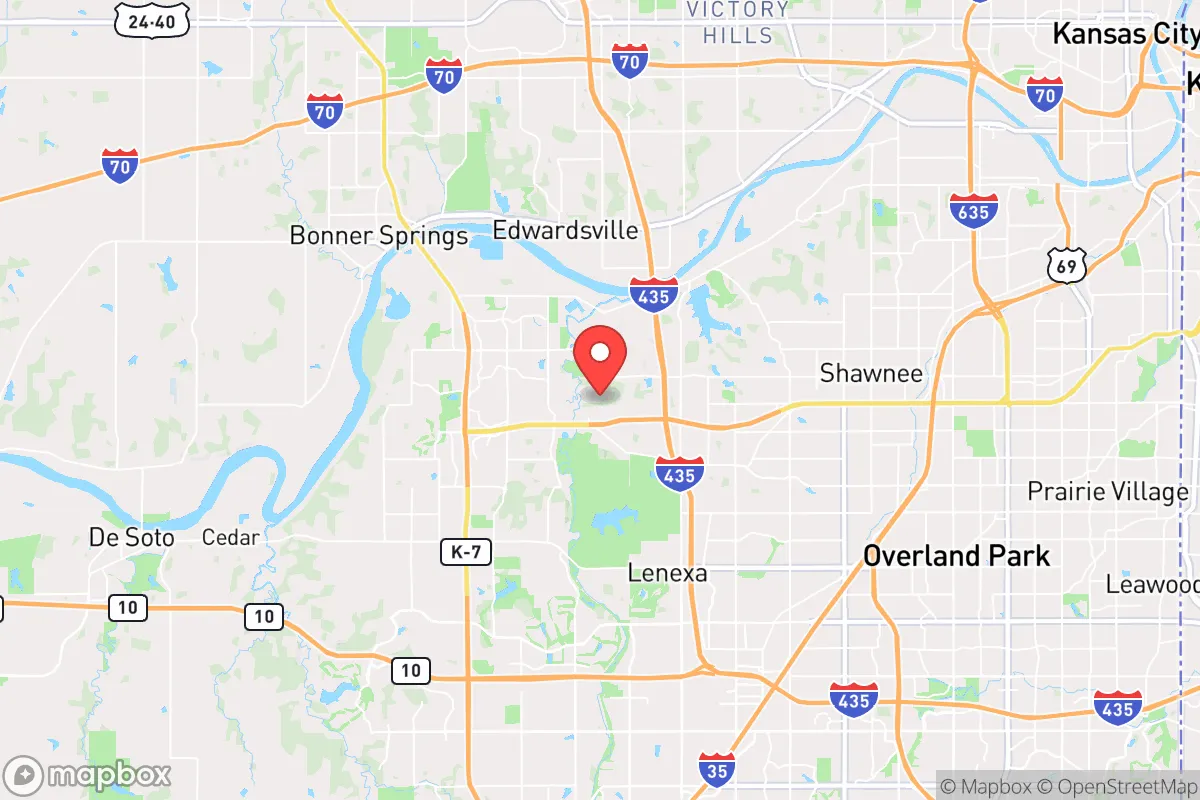
Photo: Wikipedia
Demographics of Shawnee, KS
Affluence Level in Shawnee, KS
An upper-middle-class area. Household wealth, education levels, and homeownership run ahead of national benchmarks.
People of Shawnee, KS
Shawnee, Kansas, is a predominantly white, college-educated suburb of 68,175 residents where 78.0% of the population identifies as white alone, 9.0% as Hispanic, 6.0% as Black, and 3.6% as foreign-born. The city’s character is shaped by its dual identity as a historic railroad town and a modern bedroom community for Kansas City metro professionals, with a notably high 52.4% of adults holding a bachelor’s degree or higher. Distinctive markers include a strong sense of local heritage preserved in older neighborhoods and a growing, though still modest, diversity in newer subdivisions.
How the city was settled and grew
Shawnee’s population history begins with the Shawnee Tribe, who were forcibly relocated to the area in the 1820s under federal Indian removal policy. The tribe established a farming community near the Kansas River, but by the 1850s, white settlers—primarily of German, Irish, and English descent—arrived via the Santa Fe Trail and the newly built railroad. The city’s original core, Old Shawnee (centered around Johnson Drive and Nieman Road), was platted in 1856 and became a trading post and stagecoach stop. The railroad’s arrival in the 1860s spurred growth, drawing farmers and merchants who built the Downtown Shawnee district, now a historic commercial hub. By 1900, the population was nearly all white, with a small number of Black families working as laborers on nearby farms and railroads, concentrated in the Shawnee Heights area south of the railroad tracks. The city remained a small agricultural town through the 1940s, with fewer than 5,000 residents.
Modern era (post-1965)
Shawnee’s transformation into a suburb began in earnest after the 1965 Immigration and Nationality Act, though the city’s foreign-born population remains low at 3.6% today. The dominant demographic shift was domestic: white middle-class families from Kansas City, Missouri, and rural Kansas moved into new subdivisions built on former farmland. The Westglen neighborhood (developed in the 1970s west of Quivira Road) and Lackman area (along 75th Street) absorbed much of this wave, offering larger lots and newer schools. Hispanic residents began arriving in the 1980s, primarily from Mexico and Central America, drawn by construction and service jobs; they settled in the Shawnee Mission corridor near 55th Street and Pflumm Road, where a small but stable Hispanic community persists. Black population growth has been modest, rising to 6.0% today, with families concentrated in the Shawnee Town area (around 61st Street and Maurer Road) and newer developments near Shawnee Mission Parkway. East and Southeast Asian residents (1.7%) and Indian-subcontinent residents (1.5%) are more recent arrivals, many employed in the tech and healthcare sectors; they tend to settle in the Monticello area (near 83rd Street and Monticello Road), a newer, higher-priced subdivision built in the 2000s. The city’s racial and ethnic groups remain somewhat geographically distinct, with older neighborhoods like Old Shawnee and Shawnee Heights staying predominantly white, while newer areas show more mixing.
The future
Shawnee’s population is projected to grow slowly, reaching roughly 72,000 by 2035, driven by infill development and the expansion of the Shawnee Mission Parkway corridor. The white share is declining gradually (down from 85% in 2010), while Hispanic and Black shares are rising modestly. The foreign-born population is likely to plateau near 4%, as the city lacks the industrial or agricultural jobs that attract larger immigrant flows in other Kansas suburbs. East/Southeast Asian and Indian communities are growing but from a small base, and they show signs of assimilating into the broader suburban fabric rather than forming distinct ethnic enclaves. The city is not tribalizing into segregated enclaves; instead, newer subdivisions like Monticello and Stonegate (near 87th Street) are attracting a mix of white, Hispanic, and Asian families. The biggest demographic trend is aging: the median age is 39.5, and the share of residents over 65 is rising, as younger families are priced out by rising home values (median home price: $380,000).
Shawnee is becoming a stable, moderately diverse, and highly educated suburb where the population is slowly diversifying but remains overwhelmingly white and native-born. For a conservative-leaning mover, this means a community with strong schools, low crime, and a traditional suburban lifestyle, but with less ethnic variety than nearby Overland Park or Kansas City. The city’s future is one of gradual, managed growth, not rapid demographic change.

* Values derived from national, state, county, city and local statistics and may differ in a specific area. Last updated: 2026-05-03T06:02:22.000Z
Narrative content on this page is AI-generated and may contain mistakes. Verify any details that matter before acting on them.
ReloMaps may earn a commission from affiliate links at no extra cost to you.

