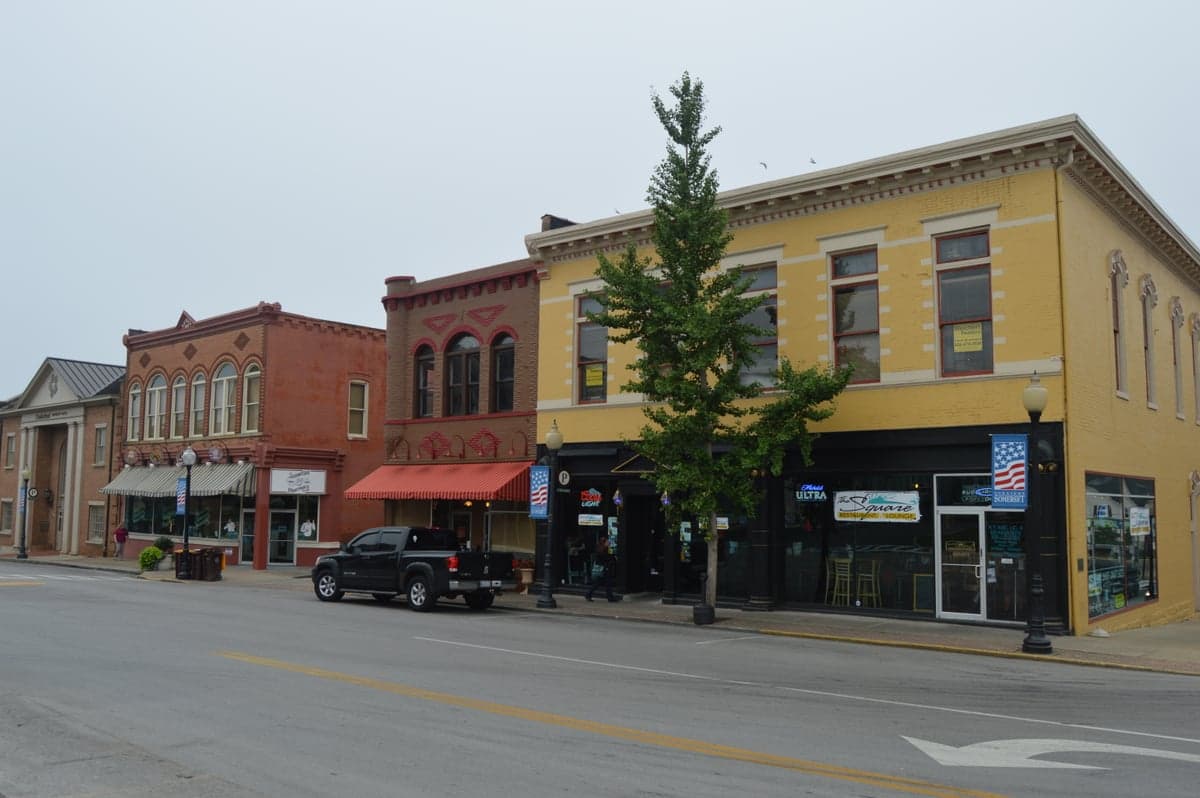
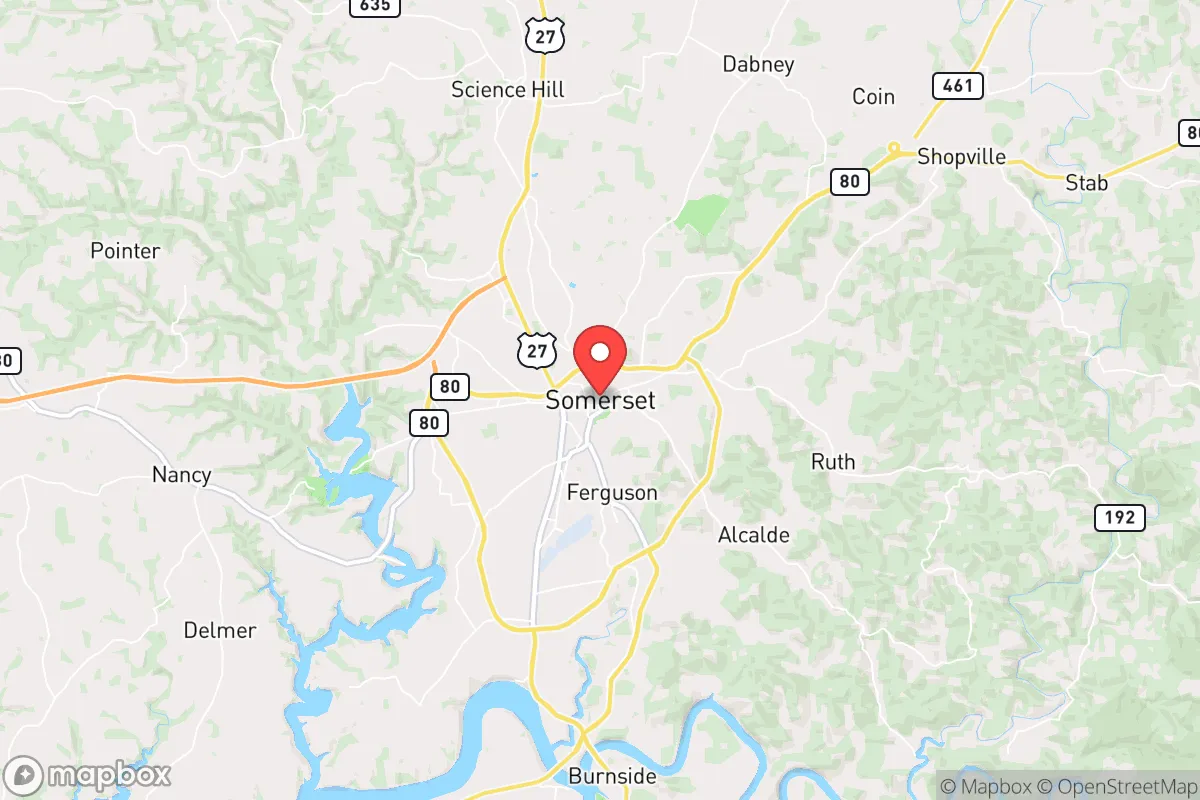
Photo: Wikipedia
Demographics of Somerset, KY
Affluence Level in Somerset, KY
A low-income area with significant economic hardship. Household wealth and educational attainment are well below national averages.
People of Somerset, KY
The people of Somerset, Kentucky today form a predominantly white, native-born community of 12,108 residents, with a notably low foreign-born share of 3.1% and a college attainment rate of 16.9%. The city’s character is shaped by its Appalachian foothill location, a strong manufacturing and healthcare employment base, and a population density that feels small-town but with regional retail and medical services drawing from surrounding Pulaski County. Distinctive identity markers include a deep-rooted Baptist and Methodist church presence, a reliance on Lake Cumberland tourism, and a demographic profile that has remained remarkably stable in racial composition over the past two decades, with white residents at 86.1%, Hispanic residents at 5.4%, Black residents at 3.6%, and Indian-subcontinent residents at 1.5%.
How the city was settled and grew
Somerset was founded in 1801 as the Pulaski County seat, drawing its earliest settlers primarily from Virginia, North Carolina, and Tennessee via the Cumberland Gap. These were largely Scots-Irish and English yeoman farmers who took up land grants in the surrounding fertile valleys. The original town grid, centered around the Pulaski County Courthouse, was built by these families, and their descendants still populate historic neighborhoods like Old Town Somerset (the original plat around Main and Mount Vernon Streets) and Oak Hill, a late-19th-century residential district developed by local merchants and tobacco farmers. The arrival of the Cincinnati Southern Railway in the 1880s triggered a second wave: a small but significant influx of German and Irish laborers who settled in the Railroad District near the depot on South Central Avenue. Tobacco and timber drove the economy through the early 1900s, keeping the population overwhelmingly white and native-born. No major immigrant enclave formed during this period; the city’s growth was organic, fueled by rural-to-urban migration from the surrounding Appalachian counties.
Modern era (post-1965)
The post-1965 period brought modest demographic shifts, largely through domestic in-migration rather than international immigration. The completion of Lake Cumberland in the 1950s and the expansion of U.S. Route 27 turned Somerset into a regional hub for healthcare (Lake Cumberland Regional Hospital) and manufacturing (Fruit of the Loom, later other light industrial employers). This drew a wave of workers from rural Pulaski and adjacent counties, many of whom settled in newer subdivisions like Westwood (developed in the 1970s-80s west of U.S. 27) and East Somerset (along Ky. 80 toward the lake). The Hispanic population, now 5.4%, began arriving in the 1990s and 2000s, primarily from Mexico and Central America, drawn by construction and agricultural work (tobacco and nursery operations). These families concentrated in the South U.S. 27 corridor and in mobile home parks near the industrial parks. The Black population, at 3.6%, has been historically small and stable, with most families living in the North Somerset area near the old segregated school sites. The Indian-subcontinent population (1.5%) is a recent, professional cohort—largely doctors and engineers recruited by Lake Cumberland Regional Hospital and local manufacturing firms—who have settled in Westwood and newer subdivisions like Pinewood Estates. East/Southeast Asian communities are effectively absent (0.0%), and the Arab population is negligible.
The future
The population of Somerset is projected to remain stable or grow slowly, with no major wave of international immigration expected. The city is homogenizing in the sense that the white share (86.1%) is only slightly declining, while the Hispanic and Indian-subcontinent shares are growing from a very small base. These groups are not tribalizing into distinct, isolated enclaves; rather, they are dispersing into existing neighborhoods, with the exception of the Hispanic corridor along South U.S. 27. The college attainment rate (16.9%) is well below the national average, which limits the city’s ability to attract high-tech or knowledge-economy employers, reinforcing a reliance on manufacturing, healthcare, and retail. Over the next 10-20 years, Somerset will likely see a gradual aging of its white population, a slow increase in Hispanic and Indian-subcontinent residents, and continued out-migration of young adults to larger metros. The city will remain a predominantly white, conservative, church-centered community with a modestly diversifying but still small minority presence.
For someone moving in now, Somerset offers a stable, low-crime, family-oriented environment with a predictable demographic trajectory. The city is not becoming a multicultural hub; it is slowly diversifying at the margins while retaining its core Appalachian and Southern identity. New residents will find a community where church networks, local schools, and civic organizations (like the Somerset-Pulaski County Chamber of Commerce) remain the primary social infrastructure, and where the cost of living is significantly below the national average.

* Values derived from national, state, county, city and local statistics and may differ in a specific area. Last updated: 2026-10-10T16:29:03.000Z
Narrative content on this page is AI-generated and may contain mistakes. Verify any details that matter before acting on them.
ReloMaps may earn a commission from affiliate links at no extra cost to you.

