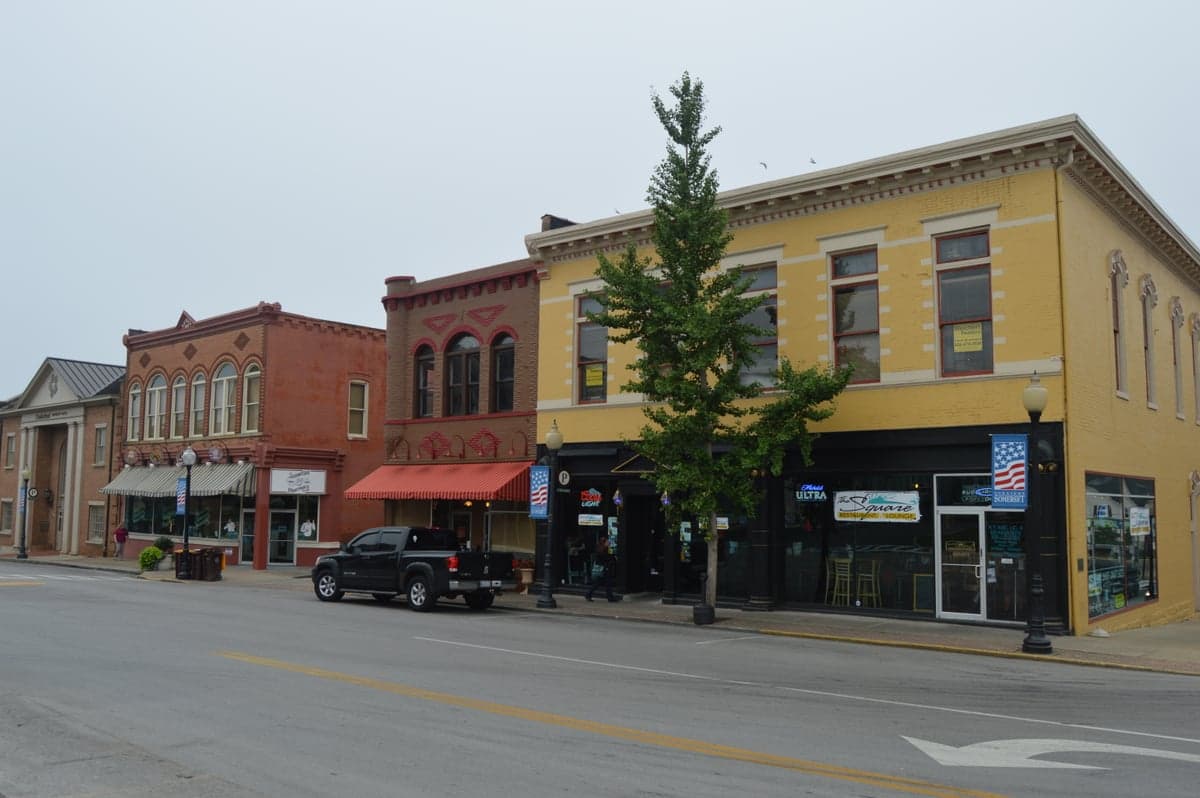

Photo: Wikipedia
Political ClimatePolitical Climate in Somerset, KY
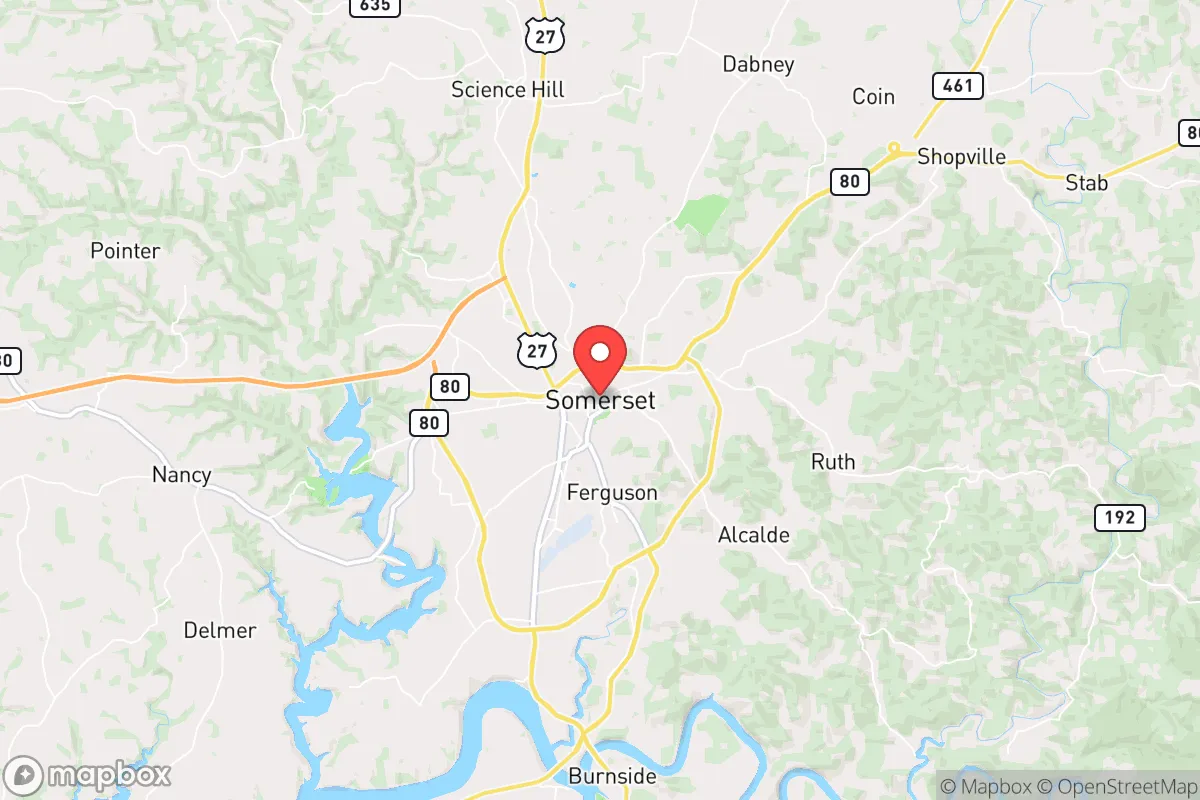
District shown is the primary district for this city’s centroid. Cities may span multiple districts.
Local Political AnalysisPolitical Analysis of Somerset, KY
Somerset, Kentucky, is about as solidly conservative as it gets, and that’s not changing anytime soon. The Cook Political Index gives it an R+32 rating, meaning the area votes Republican by a massive 32 points above the national average. In practical terms, that means local elections are decided in the GOP primary, and national Democrats don’t even bother campaigning here. The political lean is deeply rooted in a belief in limited government, personal responsibility, and a healthy skepticism of federal overreach—values that have defined this community for generations.
How it compares
Drive an hour north to Lexington, and you’ll find a different world—a college town with a growing progressive streak, where you’ll see more Harris-Walz yard signs than Trump flags. Somerset sits in stark contrast to that. Even nearby towns like London and Corbin, while also conservative, don’t have the same deep-seated, almost reflexive opposition to government expansion that you feel here. Somerset’s rural character and its distance from major urban centers mean the local culture hasn’t been diluted by transplants bringing big-city politics. The R+32 rating isn’t just a number; it reflects a community that has watched what’s happened in places like Louisville and Frankfort and decided they want no part of it.
What this means for residents
For the people who live here, this political climate means a lot of things you might take for granted if you’ve never lived anywhere else. Local government stays out of your business. There’s no talk of mask mandates, vaccine passports, or restrictive zoning that tells you what you can do with your own property. The county sheriff is a well-known figure who runs on a platform of upholding the Constitution, not enforcing new state-level gun laws. Taxes are low, and the school board focuses on teaching kids how to think, not what to think. You won’t find critical race theory or gender ideology in the curriculum here—parents still have a real say. The downside? If you’re hoping for a vibrant, diverse political debate at the local coffee shop, you’ll be disappointed. It’s a bubble, but for most residents, it’s a comfortable one where their values are the norm, not the exception.
The cultural and policy distinctions here are subtle but important. Somerset has a strong independent streak that predates modern party politics. There’s a palpable distrust of any government program that promises to “help” but comes with strings attached. You see it in the resistance to federal grants for local projects that would require adopting DEI mandates or other progressive policies. The local economy is built on small businesses and manufacturing—places like Aisin Automotive Casting and the Lake Cumberland Regional Hospital—not on government contracts or tech startups. That economic base reinforces the political culture: people work hard, they keep what they earn, and they don’t want a bureaucrat in Frankfort or Washington telling them how to live. Looking ahead, the biggest concern among long-time residents is the slow creep of national progressive trends into local life—through school board elections, library boards, or even the local health department. So far, Somerset has held the line, but it takes constant vigilance. The feeling here is that if you want to keep your freedoms, you have to fight for them, even in a place as red as R+32.

State Political ClimatePolitical Climate in Kentucky
State Political AnalysisPolitical Environment in the State
Kentucky has long been a reliably red state in federal elections, voting for the Republican presidential candidate by double digits in every election since 2000, but its political landscape is far more nuanced than a simple partisan label suggests. The state’s dominant coalition is a mix of rural, socially conservative voters and a growing suburban Republican base, though the urban centers of Louisville and Lexington remain solidly Democratic. Over the last 10-20 years, the state has shifted sharply to the right, driven by a realignment of working-class voters and a backlash against national Democratic policies, particularly on energy, gun rights, and cultural issues.
Urban vs. rural divide
The political map of Kentucky is a textbook case of the urban-rural split. The state’s two major metros—Louisville (Jefferson County) and Lexington (Fayette County)—are the only reliably blue areas, consistently voting Democratic by margins of 15-20 points in statewide races. These cities are home to the University of Kentucky, the state’s largest employers like Humana and UPS, and a more diverse, college-educated population. In contrast, the rest of the state is overwhelmingly Republican. The rural counties of eastern Kentucky, once a Democratic stronghold due to unionized coal miners, have flipped hard red since 2008, with places like Pike County and Harlan County now voting Republican by 40-50 points. The northern Kentucky suburbs of Cincinnati, such as Boone County and Kenton County, are also solidly Republican, though with a more moderate, business-friendly tilt. The western part of the state, including the Purchase area around Paducah, is deeply conservative, with counties like Graves and Marshall routinely giving Republicans 70%+ of the vote. The only real exception is the city of Bowling Green, home to a growing immigrant population and Western Kentucky University, which leans slightly more moderate but still votes Republican in statewide races.
Policy environment
Kentucky’s policy environment is among the most conservative in the nation, with a strong emphasis on limited government and individual liberty. The state has a flat income tax of 4.5% (down from 6% in 2018) and is on a path to eliminate it entirely by 2029, a move championed by the Republican supermajority. Property taxes are low, and there is no state-level estate or inheritance tax. The regulatory posture is business-friendly, with right-to-work laws and a tort reform system that caps non-economic damages in medical malpractice cases. On education, Kentucky has a robust school choice movement, with charter schools legalized in 2017 and a new Education Opportunity Account program (passed in 2022) that allows parents to use state funds for private school tuition, tutoring, and other educational expenses. The state also passed a constitutional amendment in 2022 (Amendment 2) to explicitly allow public funds to go to private schools, though it was narrowly defeated. Healthcare policy is a mixed bag: Kentucky expanded Medicaid under the Affordable Care Act in 2014, but the state has since imposed work requirements and premiums for able-bodied adults. The state also has some of the most restrictive abortion laws in the country, with a near-total ban after six weeks (with exceptions for life of the mother and rape/incest) passed in 2019 and upheld after the Dobbs decision. Election laws are strict: voter ID is required, early voting is limited to three days before the election, and absentee voting requires an excuse. The state also purged over 100,000 inactive voters from the rolls in 2023, a move critics called voter suppression but supporters hailed as cleaning up the rolls.
Trajectory & freedom
Kentucky is becoming more free in many respects, particularly on economic and gun rights issues. The state passed constitutional carry (permitless concealed carry) in 2019, allowing any adult who can legally own a firearm to carry it without a permit. In 2021, the legislature overrode Governor Andy Beshear’s veto to pass a law banning “no-knock” warrants, a direct response to the Breonna Taylor case. On parental rights, Kentucky passed a law in 2022 requiring schools to notify parents of any “human sexuality” instruction and allowing parents to opt their children out. The state also banned transgender girls from participating in girls’ sports in 2022 and passed a law in 2023 banning gender-affirming care for minors. On medical autonomy, Kentucky has a strong religious freedom law and was one of the first states to pass a law prohibiting COVID-19 vaccine mandates for state employees and contractors. However, there are concerning trends: the state’s medical marijuana program, legalized in 2023, is heavily regulated and won’t be operational until 2025, and sports betting was only legalized in 2023. The state also has a high incarceration rate and a strict “three strikes” law that some argue infringes on personal liberty. Overall, the trajectory is toward more individual freedom on cultural and economic issues, but with a heavy hand on criminal justice and drug policy.
Civil unrest & political movements
Kentucky has seen its share of political flashpoints, most notably the 2020 protests in Louisville following the death of Breonna Taylor, which led to two nights of rioting, looting, and the deployment of the National Guard. The protests were largely confined to Louisville, but they galvanized both the left and the right across the state. On the right, the “Back the Blue” movement is strong, with regular rallies supporting law enforcement. The state has also seen a rise in “constitutional sheriff” movements, particularly in rural counties like Casey and Pulaski, where sheriffs have declared they will not enforce certain state or federal gun laws. Immigration politics are relatively quiet, as Kentucky has a small foreign-born population (about 4%), but there have been flashpoints over the resettlement of refugees in Louisville and Bowling Green. The state has no sanctuary cities, and in 2020, the legislature passed a law requiring all law enforcement to cooperate with federal immigration authorities. Election integrity has been a hot topic since 2020, with the Republican-controlled legislature passing a series of laws tightening voting rules, including requiring a photo ID and limiting drop boxes. There have been no major secession or nullification movements, though some rural counties have passed symbolic resolutions asserting local control over federal lands. A new resident would notice a general sense of political stability, with most people respectful of differing views, but the urban-rural divide is real and can be felt in everyday conversations.
Projection
Over the next 5-10 years, Kentucky is likely to become even more conservative, driven by two key trends: the continued realignment of rural voters and the in-migration of conservatives from blue states. The state’s population is growing slowly (about 0.5% annually), but the growth is concentrated in the suburban counties around Louisville, Lexington, and northern Kentucky, which are already red and getting redder. The urban cores of Louisville and Lexington are likely to remain Democratic, but their influence will wane as the state legislature continues to draw district maps that favor rural and suburban areas. The biggest wild card is the state’s aging population—Kentucky has one of the oldest median ages in the country (39.5)—and the potential for younger, more diverse voters to shift the balance in the long term. However, the state’s low cost of living, low taxes, and conservative cultural climate are attracting families and retirees from states like California, Illinois, and New York, who are likely to reinforce the Republican majority. The elimination of the income tax by 2029 will be a major draw for high-earners and businesses, potentially accelerating growth in the Lexington and Louisville suburbs. A new resident moving in now should expect to find a state that is solidly red, with a government that is actively reducing its footprint on economic and cultural issues, but with a persistent urban-liberal minority that will continue to fight on issues like abortion, education, and voting rights.
Bottom line for a new resident: If you’re looking for a state where your taxes are low, your gun rights are protected, your kids won’t be exposed to controversial gender ideology in school, and your vote actually counts, Kentucky is a strong bet. The political climate is stable and conservative, with a government that is actively working to expand personal freedom on most fronts. Just be aware that the urban areas are a different world, and the state’s history of poverty and opioid addiction means some rural areas are struggling. But for a family or individual who values liberty and tradition, Kentucky offers a solid foundation with a clear trajectory toward more freedom.
* Values derived from national, state, county, city and local statistics and may differ in a specific area. Last updated: 2026-10-10T16:29:03.000Z
Narrative content on this page is AI-generated and may contain mistakes. Verify any details that matter before acting on them.
ReloMaps may earn a commission from affiliate links at no extra cost to you.

