Photo: Wikipedia
Demographics of Somersworth, NH
Affluence Level in Somersworth, NH
A middle-class area roughly in line with national averages across income, home values, education, and employment.
People of Somersworth, NH
The people of Somersworth, New Hampshire, today number 12,060, forming a dense, historically grounded community where 82.5% of residents identify as White, with notable East/Southeast Asian (2.9%) and Hispanic (5.8%) minorities. The city carries a distinctive identity as a former mill town that has transitioned into a bedroom community for the Portsmouth-Dover-Seacoast region, with a lower-than-average college attainment rate of 28.7% and a very small foreign-born population of 2.7%. Somersworth’s population is older and more rooted than many neighboring towns, with a character shaped by successive waves of industrial labor and a recent stabilization rather than rapid growth.
How the city was settled and grew
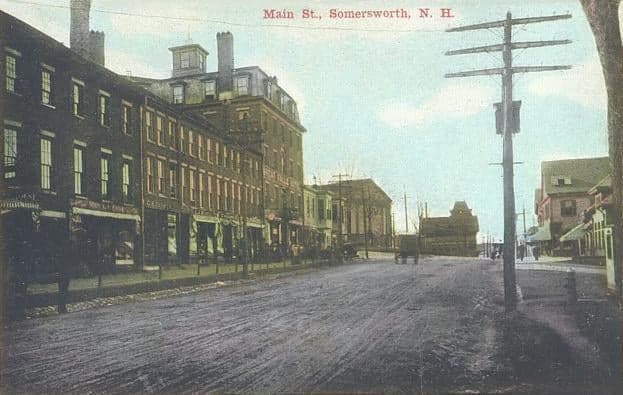
Somersworth’s human history begins with the Great Falls of the Salmon Falls River, which powered the city’s founding industry. Originally part of Dover, Somersworth was incorporated as a separate town in 1754, but its population remained sparse until the early 19th century. The construction of textile mills along the river—particularly the Great Falls Manufacturing Company (1823)—drew the first major wave of settlers: Yankee farmers and skilled millwrights from southern New England. These early residents built the Historic Hill District, a neighborhood of Federal and Greek Revival homes on the bluffs overlooking the mills, where managers and owners lived. By the 1840s, the mills required more labor than local Yankees could supply, prompting the second wave: Irish immigrants fleeing the Great Famine. They settled in the Lower Mill Yard area along the river, building tenements and St. Martin’s Church (1850) as their cultural anchor. A third wave arrived between 1880 and 1920, when French-Canadian families from Quebec crossed the border to work in the mills. They concentrated in the West Side (west of Main Street), establishing St. Ignatius Parish and creating a dense, French-speaking enclave that persisted for generations. Smaller numbers of Polish and Italian immigrants also arrived during this period, settling near the Blackwater Road corridor on the city’s eastern edge. By 1920, Somersworth’s population had reached roughly 6,000, overwhelmingly White, Catholic, and working-class.
Modern era (post-1965)
The post-1965 era brought gradual demographic change, though Somersworth remained more homogeneous than the national average. The 1965 Hart-Cellar Act had little immediate effect here—the city’s foreign-born share today is just 2.7%, far below the national rate. Instead, the major shift was domestic: the decline of the textile industry after the 1950s led to mill closures and out-migration of younger workers. The population fell from a peak of 9,900 in 1960 to 8,800 by 1980. The city began to reorient as a bedroom community for the Portsmouth Naval Shipyard and the University of New Hampshire, attracting white-collar commuters who settled in newer subdivisions like Pheasant Run and Country Club Estates on the city’s northern edge. The most notable modern ethnic arrival has been East/Southeast Asian communities, primarily of Vietnamese and Cambodian origin, who began arriving in the 1980s as secondary migrants from larger refugee resettlement cities like Lowell, MA, and Manchester, NH. They concentrated in the West Side and Lower Mill Yard neighborhoods, where older, affordable housing stock was available. Today, East/Southeast Asians make up 2.9% of the population, with a visible cluster of Vietnamese-owned businesses along High Street. The Hispanic population (5.8%) is more dispersed, with no single dominant neighborhood, though a small concentration exists near the Blackwater Road area. The Black population (2.6%) is similarly scattered, with no historic enclave. Notably, the Indian subcontinent population is 0.0%, meaning no measurable community exists.
The future
Demographic projections for Somersworth suggest a slow, modest diversification rather than rapid change. The White share (82.5%) is declining at roughly 0.5–1% per year, driven by an aging native-born population and out-migration of young adults to larger cities. The Hispanic and East/Southeast Asian shares are growing slowly, primarily through natural increase rather than new immigration, as the city’s limited rental stock and low foreign-born rate (2.7%) constrain new arrivals. The college-educated share (28.7%) is below the state average of 37%, and this is unlikely to rise sharply unless new employers—such as the nearby Great Bay Community College or the Portsmouth Naval Shipyard—attract more degree-holding workers. The city is not tribalizing into distinct ethnic enclaves; rather, the small minority populations are assimilating into the broader working-class fabric. The West Side remains the most diverse area, but even there, no single group dominates. The next 10–20 years will likely see Somersworth remain a predominantly White, older, blue-collar city, with gradual growth in Hispanic and East/Southeast Asian shares to perhaps 8–10% and 4–5% respectively. The population is projected to hold steady around 12,000–12,500, with no major boom or bust.
For someone moving in now, Somersworth offers a stable, affordable, and historically rooted community where the population is slowly diversifying but remains overwhelmingly White and working-class. The city is becoming a quieter, more commuter-oriented place, with the mill-era ethnic neighborhoods fading into memory and newer subdivisions filling with families seeking lower housing costs than Portsmouth or Dover. It is not a melting pot, but a place where small minority groups are gradually integrating into a still-dominant Yankee and French-Canadian cultural base.

* Values derived from national, state, county, city and local statistics and may differ in a specific area. Last updated: 2026-05-01T08:42:49.000Z
Narrative content on this page is AI-generated and may contain mistakes. Verify any details that matter before acting on them.
ReloMaps may earn a commission from affiliate links at no extra cost to you.

