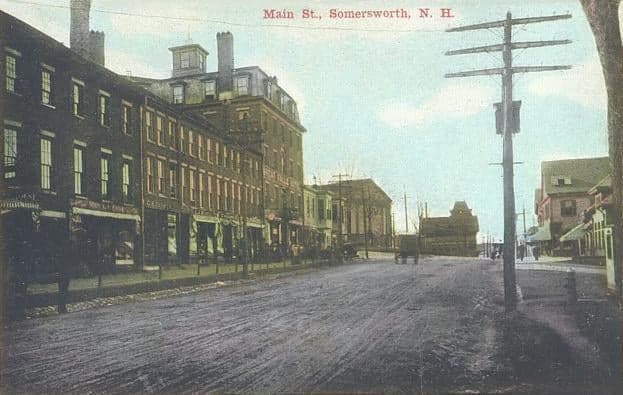
Photo: Wikipedia
Personal Sovereignty in Somersworth, NH
Viable for self-reliance. Generally workable, though some barriers may limit total independence.
What does Personal Sovereignty tell us?
Personal Sovereignty measures your capacity for self-reliance and independence with minimal government friction. Higher scores mean fewer barriers between you and the way you want to live... but it assumes you have the space you need and good neighbors.
What does this tell us?
Personal Sovereignty measures your capacity for self-reliance and independence with minimal government friction. Higher scores mean fewer barriers between you and the way you want to live... but it assumes you have the space you need and good neighbors.
State Policy
Energy independence: Importer (10% of energy produced in-state)
Personal Liberty
Homesteading

Personal Liberty Analysis
Somersworth, New Hampshire, offers a notably high degree of personal sovereignty compared to most of New England and the broader Northeast, largely due to the state’s "Live Free or Die" ethos and its absence of a broad-based income or sales tax. For individuals and parents operating from a survivalist or prepper mindset, this translates into a legal environment that generally respects personal autonomy, though it is not without its constraints. The city’s proximity to the Maine border and its location within Strafford County place it in a region where local governance tends to be more pragmatic than intrusive, but residents must remain vigilant against creeping municipal ordinances that can nibble at the edges of liberty. Overall, Somersworth provides a solid foundation for self-directed living, provided one understands the specific legal frameworks governing taxes, self-defense, property use, and family rights.
Tax burden and regulatory posture: How New Hampshire’s structure protects your wallet and choices
New Hampshire’s tax climate is a major draw for those seeking to minimize government extraction from their earnings. The state has no general income tax on wages or salaries and no statewide sales tax, which means every dollar you earn or spend stays in your pocket unless you choose to invest it. Somersworth, like all New Hampshire municipalities, funds its services primarily through property taxes and local fees. The city’s property tax rate is moderate for the region—around $24 per $1,000 of assessed value as of recent data—but this can be offset by the absence of other state-level levies. For a prepper household, this tax structure allows for greater capital accumulation for supplies, land improvements, or emergency reserves. Regulatory posture in New Hampshire is also comparatively light: there is no state-level business profits tax on sole proprietorships, and occupational licensing requirements are less burdensome than in neighboring Massachusetts or Maine. However, Somersworth does enforce standard building codes and zoning ordinances, so any off-grid construction or major property modifications require permits. The key takeaway is that the state’s fiscal restraint gives residents more control over their resources, but local compliance with basic safety and land-use rules is still mandatory.
Self-defense and gun law specifics: What the Second Amendment looks like in Somersworth
New Hampshire is one of the most firearm-friendly states in the nation, and Somersworth residents benefit directly from that. The state has constitutional carry—no permit is required to openly carry a handgun or to carry a concealed firearm for anyone legally allowed to possess one. There is no state-level firearm registry, no waiting periods for purchases, and no magazine capacity restrictions. The state also has a stand-your-ground law with no duty to retreat in any place where a person is lawfully present, which is critical for self-defense planning. New Hampshire preempts local gun ordinances, meaning Somersworth cannot pass its own stricter rules—a protection against city council overreach. For parents, this means you can train your children in firearm safety without fear of state interference, and you can keep firearms in your home or vehicle without special storage mandates beyond general safety. The only notable restriction is that carrying a loaded firearm in a motor vehicle is allowed without a permit, but the firearm must be stored in a manner that does not violate federal law. For those with a survivalist mindset, this legal framework provides a robust foundation for personal and family defense, though it is wise to stay informed about any federal-level changes that could affect interstate transport or purchases.
Self-reliance and homesteading viability: Lot sizes, zoning, and off-grid feasibility in Somersworth
Somersworth is a small city with a mix of residential neighborhoods and some rural pockets, but it is not a sprawling homesteading paradise. The typical residential lot size in the city is between 0.25 and 0.5 acres, with some larger parcels available in the outskirts near the Salmon Falls River. Zoning regulations generally permit backyard gardens, small livestock like chickens (subject to local ordinances), and rainwater collection for non-potable uses. However, full off-grid living is challenging within city limits due to building codes that require connection to municipal water and sewer in most developed areas. For those seeking true self-reliance, the surrounding towns of Rollinsford, Milton, or Farmington offer larger parcels (1–5+ acres) with fewer restrictions. Somersworth does allow accessory dwelling units (ADUs) by right, which can be used for multi-generational living or rental income to offset property taxes. Solar panels are permitted, and net metering is available through the local utility, Eversource. The city’s zoning does not explicitly prohibit composting toilets or alternative energy systems, but any permanent structure must meet state building codes. For a prepper family, the best strategy is to purchase a home with a garage or workshop space for food storage and equipment, and to consider a secondary property in a less regulated town for serious homesteading. The city’s infrastructure is reliable, but that very reliability means you are still tied to the grid.
Personal liberties: Parental rights, medical autonomy, speech, and property protections
New Hampshire has strong legal protections for parental rights, which is a major consideration for conservative families. The state’s parental bill of rights (RSA 186-C:7) affirms that parents have the primary responsibility for the education and upbringing of their children, including the right to opt out of certain school curricula or medical treatments. Medical autonomy is also respected: New Hampshire does not have a state-level vaccine mandate for adults, and while school vaccine requirements exist, exemptions are available for medical, religious, or philosophical reasons. The state’s Right to Try law allows terminally ill patients access to experimental treatments without FDA interference, and there is no state-level prescription drug monitoring program that mandates reporting for all controlled substances—though pharmacies do participate in a voluntary system. Free speech is robustly protected under the state constitution, and Somersworth has no local ordinances that restrict political expression or assembly beyond standard time-place-manner rules. Property rights are strong: New Hampshire has no statewide rent control, and the state’s eminent domain laws require just compensation and a public purpose, with recent court rulings limiting the use of eminent domain for private development. For those concerned about government overreach, these protections create a buffer against federal or state mandates, though local school boards and health departments can still impose policies that require active parental engagement to challenge.
In the broader context of the United States, Somersworth offers a level of personal sovereignty that is increasingly rare, especially in the Northeast. The combination of no income or sales tax, constitutional carry, strong parental rights, and relatively light regulation places it in the top tier of New England locales for those prioritizing autonomy. However, it is not a libertarian utopia: property taxes are real, zoning limits full off-grid living within city limits, and the state’s reliance on federal funding means some federal strings remain attached. For a survivalist or prepper household, Somersworth works best as a base of operations—a place to earn and save money, exercise self-defense rights, and raise children with minimal state interference—while maintaining a secondary property or plan for deeper self-reliance in a more rural setting. Compared to areas like Massachusetts or New York, where taxes are higher and gun laws are restrictive, Somersworth is a clear winner. Compared to states like Texas or Idaho, it falls short on land availability and climate resilience, but it offers a unique blend of liberty and community infrastructure that is hard to find elsewhere in the region. The bottom line: if you value your freedoms and are willing to navigate local ordinances, Somersworth is a solid choice for a strategic relocation.

* Values derived from national, state, county, city and local statistics and may differ in a specific area. Last updated: 2026-05-01T08:42:49.000Z
Narrative content on this page is AI-generated and may contain mistakes. Verify any details that matter before acting on them.
ReloMaps may earn a commission from affiliate links at no extra cost to you.

