Photo: Wikipedia
Demographics of South Bend, IN
Affluence Level in South Bend, IN
A below-average socioeconomic profile. Incomes, home values, and educational attainment trail the U.S., with higher poverty and unemployment.
People of South Bend, IN
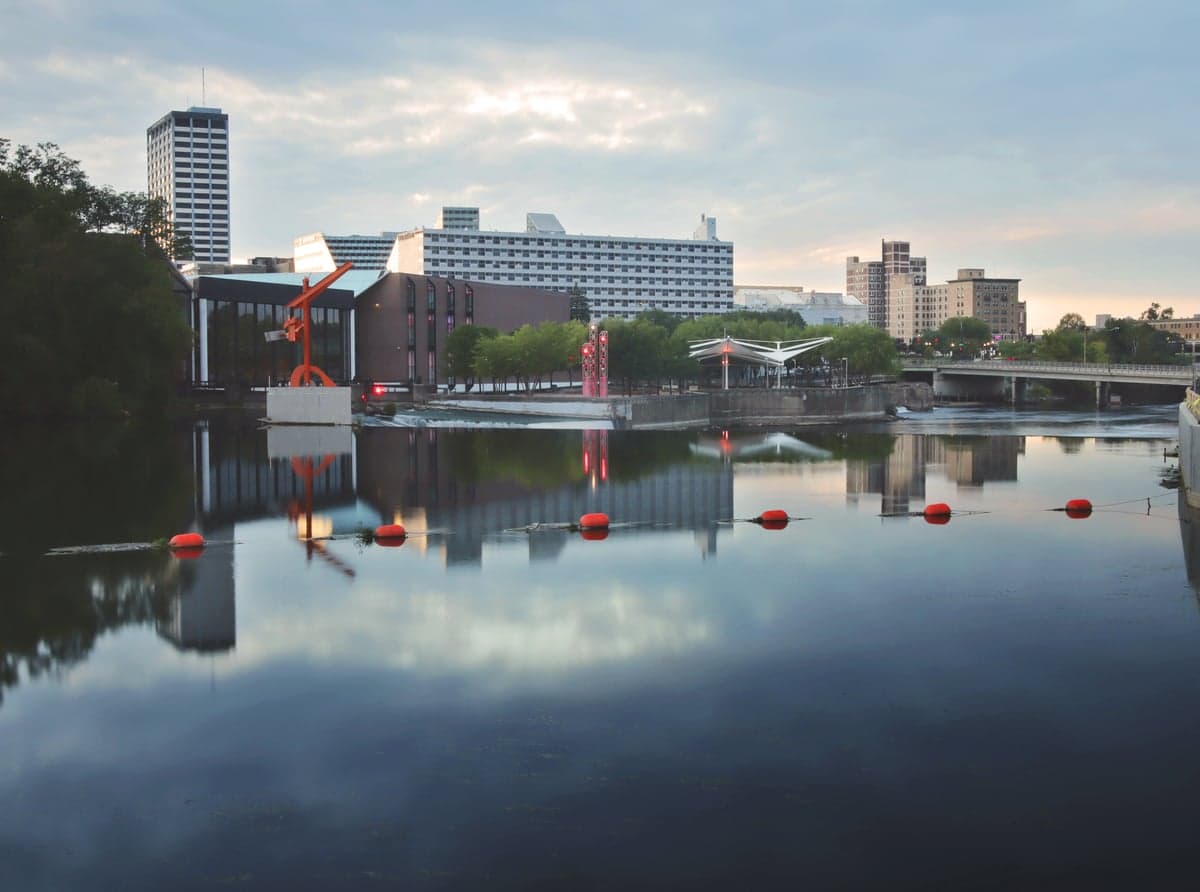
South Bend, Indiana, is a city of 102,866 residents defined by its industrial roots and a demographic landscape that is nearly evenly split between white (50.7%) and non-white populations, with a significant Black community (24.1%) and a fast-growing Hispanic population (17.3%). The city’s character is shaped by a legacy of manufacturing booms and subsequent declines, creating a population that is resilient, working-class in ethos, and increasingly diverse. With a college-educated rate of 29.4% and a foreign-born share of 6.1%, South Bend is a Midwestern city in transition, balancing its blue-collar heritage with a growing professional and immigrant presence.
How the city was settled and grew
South Bend’s population history begins with the Potawatomi people, who ceded the land in the 1830s, after which European-American settlers arrived via the St. Joseph River. The city’s founding in 1865 was driven by the manufacturing of wagons and later automobiles, with the Studebaker Corporation becoming the dominant employer. The first major wave of immigrants came from Germany and Ireland in the mid-1800s, settling in the Near Northwest Neighborhood, where German Catholic churches and Irish pubs still mark the area. A second wave of Polish and Hungarian immigrants arrived between 1880 and 1920, drawn by factory jobs; they established the West Side neighborhood, centered around St. Adalbert’s Church, which remains a Polish cultural hub. African Americans began migrating from the South during the Great Migration (1910–1970), settling primarily in the LaSalle Park and Rum Village areas, where they built a tight-knit community around the city’s industrial core. By 1950, South Bend’s population peaked at 115,911, with a heavily white, ethnic-European character.
Modern era (post-1965)
The post-1965 era brought profound demographic shifts. The 1965 Hart-Cellar Act opened immigration from Asia and Latin America, but South Bend’s foreign-born population remains modest at 6.1%. The most significant change has been the growth of the Hispanic community, which rose from negligible numbers in 1970 to 17.3% today. This wave, primarily Mexican and Central American, settled in the East Bank and Mishawaka Avenue corridor, where Spanish-language businesses and Catholic parishes now anchor the community. Meanwhile, white flight to the suburbs accelerated after the 1967 race riots and the closure of Studebaker in 1963, hollowing out the city’s core. The Black population, which grew to 24.1%, concentrated in the Howard Park and Rum Village neighborhoods, though economic decline led to population loss—the city dropped from 125,000 in 1960 to 102,866 today. East and Southeast Asian communities (1.4%) and Indian subcontinent residents (0.3%) are small but present, often clustered near the University of Notre Dame in the Northeast Neighborhood, where professional families have settled.
The future
South Bend’s population is stabilizing after decades of decline, but it is not homogenizing—it is tribalizing into distinct enclaves. The white population continues to shrink (50.7%), while the Hispanic share is growing rapidly, projected to reach 20–25% by 2040, concentrated in the East Bank and West Side. The Black population is plateauing, with younger families moving to suburban Mishawaka or Granger. The foreign-born share (6.1%) is likely to rise modestly as refugee resettlement programs bring Burmese and Congolese families to the Near Northwest Neighborhood, but it will remain below the national average. The city is becoming more polarized by income and education: college-educated professionals (29.4%) cluster near downtown and Notre Dame, while working-class families of all races remain in the outer neighborhoods. Over the next 10–20 years, South Bend will likely see a slow population increase to 110,000, driven by Hispanic growth and a modest return of young professionals, but it will remain a city of distinct, self-reinforcing ethnic and economic zones.
For someone moving in now, South Bend is a city where neighborhood choice matters more than ever. The city is becoming more diverse and slightly more educated, but it is also more segregated by class and ethnicity than it was a generation ago. New residents should expect a place where community identity is strong but often insular, and where the future hinges on whether these enclaves can integrate economically while retaining their cultural character.

* Values derived from national, state, county, city and local statistics and may differ in a specific area. Last updated: 2026-04-22T09:06:58.000Z
Narrative content on this page is AI-generated and may contain mistakes. Verify any details that matter before acting on them.
ReloMaps may earn a commission from affiliate links at no extra cost to you.

