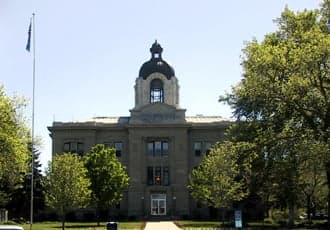
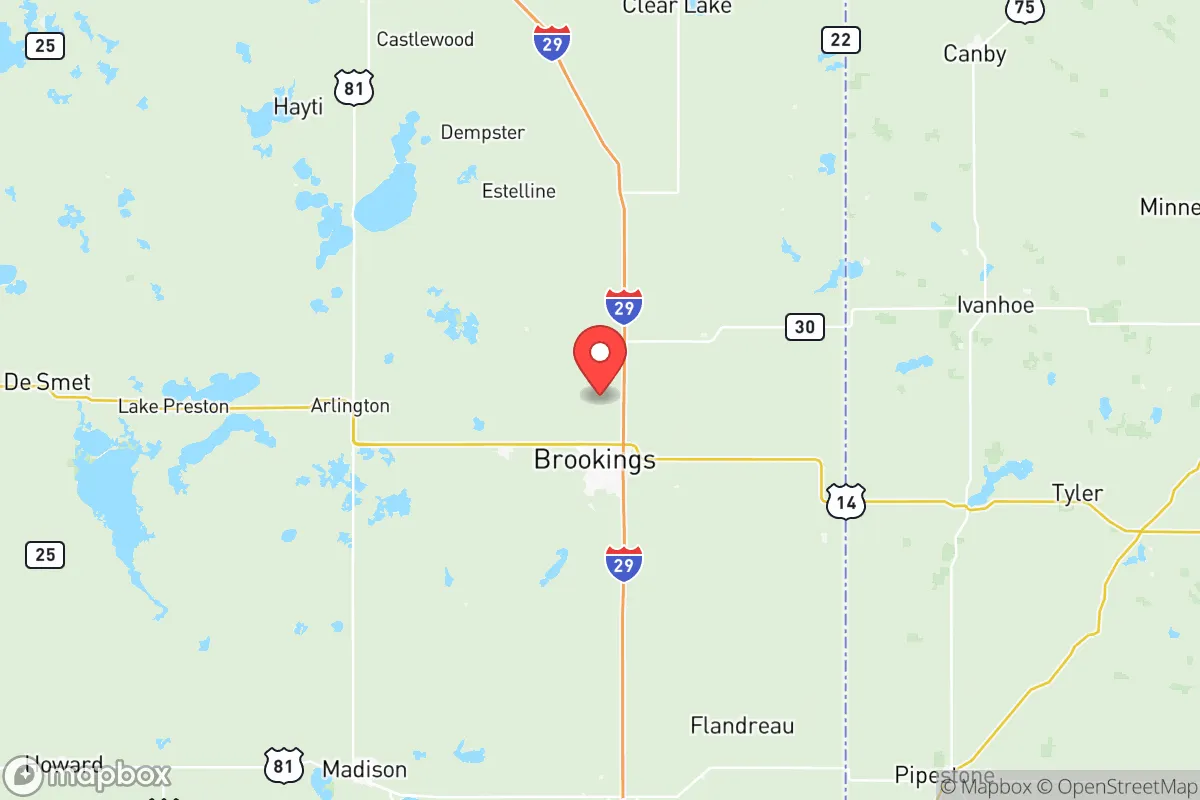
Photo: Wikipedia
Demographics of Brookings County
Affluence Level in Brookings County
A middle-class area roughly in line with national averages across income, home values, education, and employment.
People of Brookings County
Brookings County, South Dakota, is home to 34,968 residents, a population that is 87.9% white and notably well-educated, with 44.0% holding a college degree. The county’s character is defined by the presence of South Dakota State University (SDSU) in the city of Brookings, which injects a transient student population and a progressive-leaning academic enclave into an otherwise conservative, agricultural region. The foreign-born share is a modest 3.8%, with the largest non-white groups being Hispanic residents at 4.3% and Indian-subcontinent residents at 1.8%, the latter largely tied to the university and tech sectors.
Settlement & growth (pre-1960)
Before American settlement, the area that is now Brookings County was part of the traditional territory of the Dakota (Sioux) people, specifically the Yankton and Sisseton-Wahpeton bands. They followed the seasonal bison herds and established camps along the Big Sioux River, which runs through the county. The 1851 Treaty of Traverse des Sioux and subsequent land cessions opened the region to Euro-American settlement, though significant white migration did not begin until after the 1862 Homestead Act.
The first permanent American settlers arrived in the late 1860s and early 1870s, drawn by the promise of 160-acre homesteads under the Homestead Act. These pioneers were overwhelmingly of Northern European stock—primarily Norwegian, Swedish, and German immigrants, along with a smaller number of Yankees from the Upper Midwest. The town of Brookings was platted in 1879 as a railroad stop on the Chicago and North Western Railway, and it quickly became the county seat. The surrounding towns of Volga, Elkton, and White were founded in the 1880s as agricultural service centers, each settled by distinct ethnic clusters: Volga attracted a heavy Norwegian contingent, while White drew German Lutherans.
Agriculture—wheat, corn, and livestock—drove the economy through the early 20th century. The establishment of South Dakota State College (now SDSU) in Brookings in 1881 added a layer of educated professionals and government employees to the county’s otherwise rural, farming character. The Dust Bowl and Great Depression of the 1930s hit the region hard, causing a net out-migration of farm families, but the county’s population stabilized after World War II as agricultural mechanization reduced the need for farm labor. By 1960, Brookings County was 98% white, with a population of about 18,000, and its economy was split between farming and the college.
Modern era (post-1965)
The 1965 Hart-Cellar Act had a limited direct impact on Brookings County compared to coastal urban centers, but it did open the door for a small, steady stream of international students and professionals. The most visible change has been the growth of the Indian-subcontinent population, which now stands at 1.8% of the county. This community is almost entirely concentrated in the city of Brookings, drawn by graduate programs in engineering, computer science, and pharmacy at SDSU, as well as by tech-related jobs at companies like Daktronics, a global leader in electronic displays headquartered in Brookings. These Indian residents are predominantly young, highly educated, and often temporary—many leave after graduation for larger metro areas, though a growing number are settling permanently and forming a small but stable enclave near the university.
The Hispanic population, at 4.3%, is the county’s largest minority group and has grown steadily since the 1990s. This growth is driven by labor demand in agriculture and food processing—specifically at the turkey processing plant in the town of Huron (neighboring Beadle County) and at dairy operations in the region. Hispanic residents are more dispersed than the Indian community, with significant numbers in Brookings and smaller towns like Volga and Arlington, where they work in construction, meatpacking, and farm labor. The East/Southeast Asian population (1.6%) is a mix of international students and faculty at SDSU, along with a small number of Hmong and Vietnamese families who arrived as secondary migrants from larger Midwestern hubs like Minneapolis and St. Paul.
Domestic migration since 1965 has been modest. The county has not experienced the Sun Belt-style boom seen in South Dakota’s western Black Hills region. Instead, growth has been steady and organic, driven by natural increase and the university’s expansion. The Black population remains very small at 1.1%, mostly consisting of African American students and faculty at SDSU, with no distinct enclave. Suburbanization has been limited: the city of Brookings has grown outward with new subdivisions, but the county’s rural towns—Aurora, Bruce, Sinai—have largely stagnated or lost population as young people leave for college and urban jobs.
The future
Brookings County is likely to continue its slow, steady growth, reaching perhaps 40,000 by 2040. The population is not homogenizing into a single cultural bloc; rather, it is tribalizing into three distinct groups. The first is the native-born white majority, concentrated in the rural towns and older neighborhoods of Brookings, who remain culturally conservative and tied to agriculture and local small business. The second is the university community—students, faculty, and staff—who are younger, more liberal, and more transient, creating a cultural divide within the city of Brookings itself. The third is the immigrant and minority population, which is growing but still small: the Indian community is likely to expand as SDSU continues to recruit internationally, while the Hispanic population will grow slowly through labor migration and higher birth rates.
The Indian community shows signs of assimilating into the professional class, with many buying homes in Brookings’ newer subdivisions and sending their children to the local public schools. The Hispanic community is more economically stratified, with some families settling permanently and others cycling through seasonal work. The East/Southeast Asian population is likely to remain small and tied to the university. Overall, the county’s cultural identity will remain predominantly white and Midwestern, but with a noticeable academic and international flavor in Brookings itself. For a conservative-leaning newcomer, the rural towns offer a familiar, stable environment, while the city of Brookings provides amenities and diversity without the scale or crime of a major metro area.
Brookings County is becoming a bifurcated place: a conservative, agricultural heartland in its small towns, and a college town with a growing international professional class in its seat. For someone moving in now, the choice is between these two worlds, both of which offer low crime, good schools, and a strong sense of community, but with very different social and political atmospheres.

* Values derived from national, state, county, city and local statistics and may differ in a specific area. Last updated: 2026-05-27T16:49:12.000Z
Narrative content on this page is AI-generated and may contain mistakes. Verify any details that matter before acting on them.
ReloMaps may earn a commission from affiliate links at no extra cost to you.

