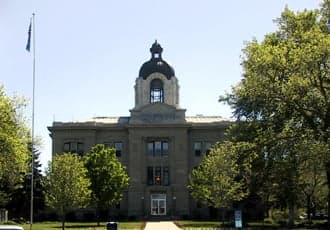
Photo: Wikipedia
Political ClimatePolitical Climate in Brookings County
Showing state-level results — no local-only data available.
Local Political AnalysisPolitical Analysis of Brookings County
Brookings County, South Dakota, has a Cook PVI of R+15, matching the state as a whole, but don't let that number fool you into thinking it's a monolith. The county is a classic case of a deep-red rural landscape surrounding a blue-leaning college town, and the political tension here is real. If you've been around as long as I have, you've watched the county shift from a reliably conservative stronghold to a place where the cultural battles are fought block by block, especially in Brookings itself. The trajectory is concerning for anyone who values limited government and personal freedoms, because the progressive influence from the university is steadily pushing policies that feel more like a coastal transplant than a South Dakota tradition.
How it compares
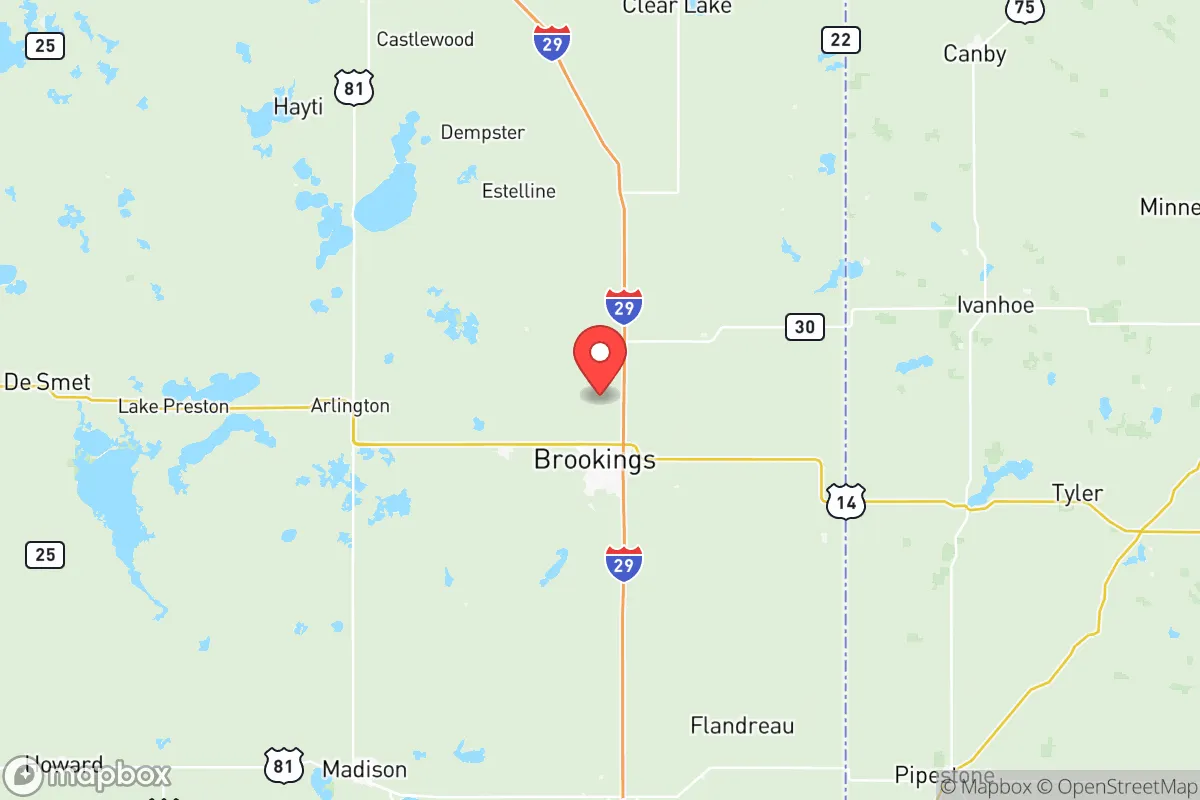
On paper, Brookings County and South Dakota share the same PVI, but the lived reality is starkly different. The rural towns like Aurora, Bushnell, and Sinai vote overwhelmingly red, often by margins of 70% or more, and they're the backbone of the county's conservative lean. But then you have Brookings city proper, home to South Dakota State University, where precincts near campus can swing blue by 10-15 points in a good year for Democrats. The swing precincts are those just outside the city limits—places like Volga and Bruce—where working-class families and farmers decide elections. Those folks are still solidly conservative, but they're getting squeezed by the influx of university staff and out-of-state students who vote for higher taxes and more government programs. Statewide, South Dakota's R+15 is held up by places like rural Brookings County, but the county itself is becoming a microcosm of the national divide: the countryside is holding the line, while the city is slowly drifting left.
What this means for residents
For a conservative resident, this split means you're constantly fighting to keep government out of your life. The county commission is still reliably conservative, but the city council in Brookings has seen progressive wins on issues like zoning restrictions and diversity initiatives that feel like government overreach. You can't drive through town without seeing a new ordinance or program that tells you how to live, from rental regulations to "inclusive" signage mandates. The rural towns are fighting back, but they're outnumbered in population by the city. If you value your Second Amendment rights, low taxes, and the freedom to run your business without a dozen permits, you'll feel the pressure building. The long-term trend is worrying: as the university grows, so does the appetite for progressive policies that erode the personal liberties we used to take for granted.
Culturally, Brookings County still has a strong agricultural and hunting tradition, but you can see the fault lines at the county fair and in local school board meetings. The policy distinctions are clear: rural towns keep their budgets lean and their laws simple, while Brookings city debates things like "sanctuary city" status for illegal immigrants and taxpayer-funded diversity programs. It's a tale of two counties under one name, and if you're a conservative, you're best off living in a small town like White or Elkton where the old ways still hold. But keep an eye on the next census—if the city keeps growing, the county's political balance could tip, and that's a future nobody who values freedom wants to see.

State Political ClimatePolitical Climate in South Dakota
State Political AnalysisPolitical Environment in the State
South Dakota is about as reliably Republican as a state gets, with a Cook PVI of R+15 that has only deepened over the past two decades. The dominant coalition is a blend of rural conservatives, libertarian-leaning ranchers, and a growing number of out-of-state transplants fleeing blue states, all united by a shared suspicion of federal overreach. Over the last 10-20 years, the state has shifted further right, driven by an influx of new residents to places like Rapid City and Sioux Falls who are explicitly seeking lower taxes and fewer regulations, while the Native American population in counties like Shannon (now Oglala Lakota) remains a consistent but outvoted Democratic bloc. The result is a state where Republicans hold supermajorities in the legislature and the governor’s office, and where the political conversation is less about whether to be conservative and more about how conservative to be.
Urban vs. rural divide
The political map of South Dakota is starkly divided between a handful of small urban centers and the vast rural expanse. Sioux Falls, the largest city, is the state’s only real blue dot, with Minnehaha County often voting within single digits of the national average—though even there, the surrounding suburbs like Harrisburg and Tea are deeply red. Rapid City in the west is a conservative stronghold, with Pennington County reliably Republican, driven by a strong military presence at Ellsworth Air Force Base and a ranching economy. The rural counties—think Harding, Perkins, and Jones—routinely deliver 80-90% of their votes to Republican candidates. The only consistent Democratic votes come from the nine Native American reservations, particularly Pine Ridge in Oglala Lakota County and Rosebud in Todd County, but these are geographically isolated and have little influence on statewide races. The urban-rural split isn’t a battle; it’s a rout, with rural votes overwhelming the small urban centers.
Policy environment
South Dakota’s policy environment is a dream for those who want government out of their lives. There is no state income tax, no corporate income tax, and no personal property tax on vehicles or business equipment—just a 4.5% sales tax and relatively low property taxes. The regulatory posture is aggressively pro-business, with no state-level minimum wage beyond the federal $7.25 and no mandatory paid leave. Education policy is a mixed bag: the state has a robust school choice movement, with a new Education Savings Account program passed in 2024 that lets parents use public funds for private or homeschool expenses, but teacher pay remains among the lowest in the nation. Healthcare is largely unregulated, with no state-run insurance exchange and a Medicaid expansion that only passed in 2023 after years of resistance. Election laws are among the most secure in the country: voter ID is required, same-day registration is not allowed, and absentee voting requires an excuse. The state also banned ranked-choice voting in 2024, a clear signal against progressive election reforms.
Trajectory & freedom
South Dakota is becoming more free by almost any measure, and the trajectory is accelerating. In 2023, Governor Kristi Noem signed a law banning transgender procedures for minors, a move that drew national attention but was wildly popular in-state. The same year, the legislature passed a “parental bill of rights” that requires schools to notify parents of any curriculum involving sexuality or gender identity. Gun rights are virtually unrestricted: permitless carry has been law since 2019, and there are no magazine capacity limits or red flag laws. Property rights were strengthened in 2024 with a law limiting the use of eminent domain for carbon pipeline projects, a direct response to the controversial Summit Carbon Solutions pipeline that had landowners up in arms. On the taxation front, the state has been cutting sales taxes on groceries and considering a full repeal of the sales tax on food, which would make it even more attractive for families. The only area where freedom has contracted is in the realm of medical autonomy: the state has a near-total abortion ban with no exceptions for rape or incest, which some libertarians view as overreach, but the conservative majority sees it as protecting life.
Civil unrest & political movements
South Dakota is remarkably stable compared to other states, but there have been flashpoints. The most visible was the 2023-2024 fight over the Summit Carbon Solutions pipeline, which sparked a grassroots landowners’ movement that crossed party lines—ranchers and farmers, both Republican and Democrat, protested the use of eminent domain for a private project. This led to the aforementioned 2024 law limiting eminent domain, a rare instance of the legislature bowing to populist pressure. On the left, the Native American community has organized around voting rights and police accountability, particularly after the 2020 killing of a Lakota man by a Rapid City officer, but these movements have not gained traction beyond the reservations. Immigration politics are muted, as the state has a tiny foreign-born population, but there is a strong undercurrent of opposition to any sanctuary policies—the state passed a law in 2024 requiring local law enforcement to cooperate with ICE. Election integrity controversies are minimal, as the state’s system is widely trusted, though there was a brief kerfuffle in 2022 when a Democratic candidate for governor claimed voter suppression on the reservations. A new resident would notice that political activism is low-key and mostly centered on property rights and local school board issues, not street protests.
Projection
Over the next 5-10 years, South Dakota will likely become even more conservative, driven by two forces: continued in-migration of freedom-seeking individuals from California, Illinois, and Minnesota, and a growing libertarian streak within the Republican Party itself. The population is expected to grow fastest in the Sioux Falls and Rapid City areas, but these new arrivals are not liberals—they are people who want lower taxes and fewer mandates, which reinforces the existing political culture. The only wild card is the Native American population, which is growing faster than the state average and could eventually shift a few legislative districts, but statewide races will remain safely Republican. The biggest policy fights will be over property taxes (which are rising with home values) and the balance between local control and state preemption on issues like land use and school curriculum. Someone moving in now should expect to find a state that is doubling down on its identity as a low-tax, low-regulation haven, with no signs of a blue shift on the horizon.
For a new resident, the bottom line is simple: if you want a state where your tax dollars stay in your pocket, your kids aren’t exposed to progressive ideology in schools, and your Second Amendment rights are absolute, South Dakota delivers. The trade-off is that you’ll be living in a place with harsh winters, limited cultural amenities, and a political monoculture that can feel insular. But for those who value personal freedom over convenience, it’s hard to beat.
* Values derived from national, state, county, city and local statistics and may differ in a specific area. Last updated: 2026-05-27T16:49:12.000Z
Narrative content on this page is AI-generated and may contain mistakes. Verify any details that matter before acting on them.
ReloMaps may earn a commission from affiliate links at no extra cost to you.

