Photo: Wikipedia
Demographics of Southaven, MS
Affluence Level in Southaven, MS
A middle-class area roughly in line with national averages across income, home values, education, and employment.
People of Southaven, MS
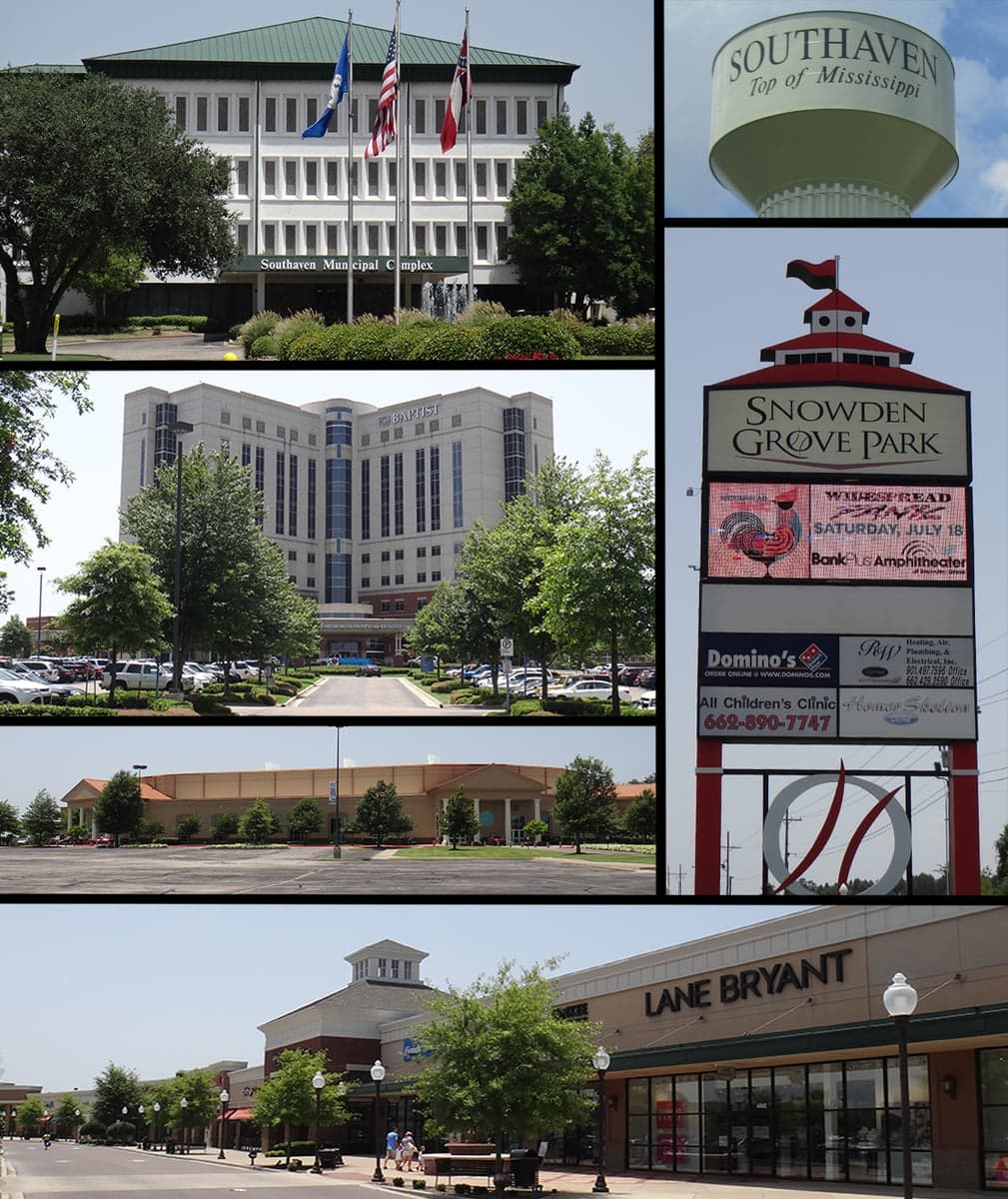
Southaven, Mississippi, is a rapidly maturing Memphis suburb of 55,531 residents that has transformed from a white, working-class bedroom community into a racially diverse, politically mixed city. Its population is now 52.3% white and 38.3% Black, with a small but growing Hispanic share of 5.8% and a notably low foreign-born rate of just 2.0%. The city’s identity is defined by its role as a family-oriented, middle-class alternative to Memphis, offering newer housing stock, lower crime rates, and a strong sense of local boosterism centered on the Snowden Grove sports complex and the Tanger Outlets corridor.
How the city was settled and grew
Southaven did not exist as a settlement until the 20th century. The land was originally part of DeSoto County’s agricultural economy, with cotton farms and small crossroads communities like Pleasant Hill (near present-day Goodman Road and Getwell Road) serving the area’s sparse population. The city was officially incorporated in 1980, but its growth began in earnest during the 1950s and 1960s as white families fled Memphis’s post-war urban changes. The first major subdivision, Southaven Estates (centered around Stateline Road and Airways Boulevard), was built in the late 1950s and attracted working-class white Memphians seeking affordable homes and lower taxes. A second wave in the 1970s filled in Greenbrook and Pleasant Hill neighborhoods with larger ranch-style homes, drawing a mix of white-collar and blue-collar families. By 1980, Southaven’s population was over 95% white, and the city had become a classic “white flight” suburb, with its own school district (DeSoto County Schools) and a growing retail base along Goodman Road.
Modern era (post-1965)
The 1990s and 2000s brought the first significant demographic shift. As Memphis’s Black middle class expanded, families began moving south across the state line into DeSoto County. Southaven’s Black population grew from under 5% in 1990 to roughly 20% by 2010, with most settling in newer subdivisions east of I-55, particularly in Hickory Ridge and Briarwood (near Church Road and Getwell). These neighborhoods offered larger lots and newer schools, appealing to upwardly mobile Black professionals. The Hispanic population also began to appear during this period, concentrated in apartment complexes along Goodman Road and in the Southaven Towne Center area, drawn by construction and service jobs tied to the city’s retail boom. The Asian population remains tiny (0.8% East/Southeast Asian, 0.3% Indian), with most families living in the Snowden Grove area near the sports complex, often in newer subdivisions built after 2005. The foreign-born share has stayed low (2.0%) because Southaven lacks the industrial base or ethnic enclaves that attract large immigrant populations; most newcomers are domestic migrants from Memphis or other parts of Mississippi.
The future
Southaven’s population is likely to continue diversifying slowly, but it will not become a majority-minority city in the next decade. The white share (52.3%) is declining gradually as older white residents age in place and younger white families choose more distant exurbs like Olive Branch or Hernando. The Black share (38.3%) is rising steadily, driven by continued out-migration from Memphis and by Black families seeking better schools and lower crime. The Hispanic share (5.8%) is growing but remains modest, as the city lacks the low-wage industrial jobs that anchor larger Hispanic communities in the Delta or along the Gulf Coast. The city is not tribalizing into distinct ethnic enclaves; rather, neighborhoods like Greenbrook and Hickory Ridge are becoming more integrated, while older subdivisions like Southaven Estates remain predominantly white. The biggest wildcard is housing supply: if Southaven builds more affordable starter homes, it could attract younger families of all backgrounds; if it stagnates, growth will shift to Olive Branch and Byhalia.
For a conservative-leaning family or single person moving in now, Southaven offers a stable, middle-class environment with a growing Black middle class, a small but visible Hispanic community, and a white population that remains the largest single group. The city is becoming more racially diverse but not more culturally fragmented, and its low foreign-born share means it lacks the ethnic tensions or enclave dynamics seen in larger metros. The bottom line: Southaven is a solid, family-oriented suburb where the population is slowly shifting toward a Black-white balance, with Hispanics and Asians as small but stable minorities. It is not a melting pot, but it is a place where diversity is increasing organically through domestic migration, not immigration.

* Values derived from national, state, county, city and local statistics and may differ in a specific area. Last updated: 2026-04-22T21:25:58.000Z
Narrative content on this page is AI-generated and may contain mistakes. Verify any details that matter before acting on them.
ReloMaps may earn a commission from affiliate links at no extra cost to you.

