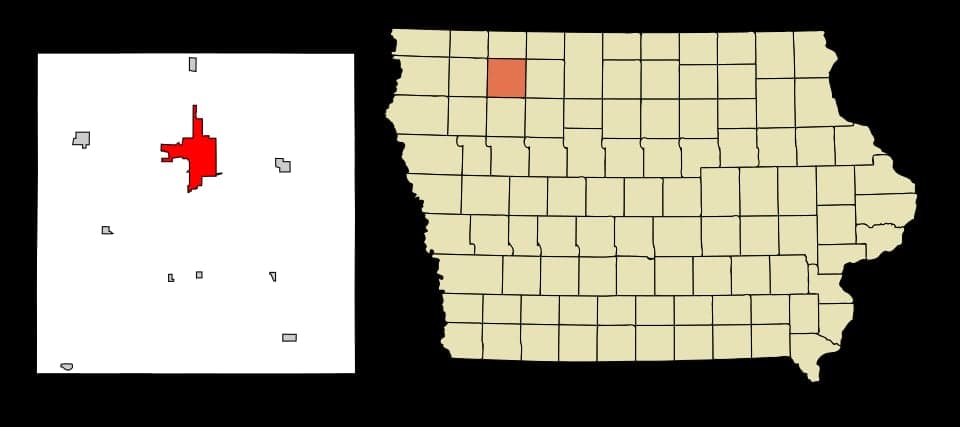
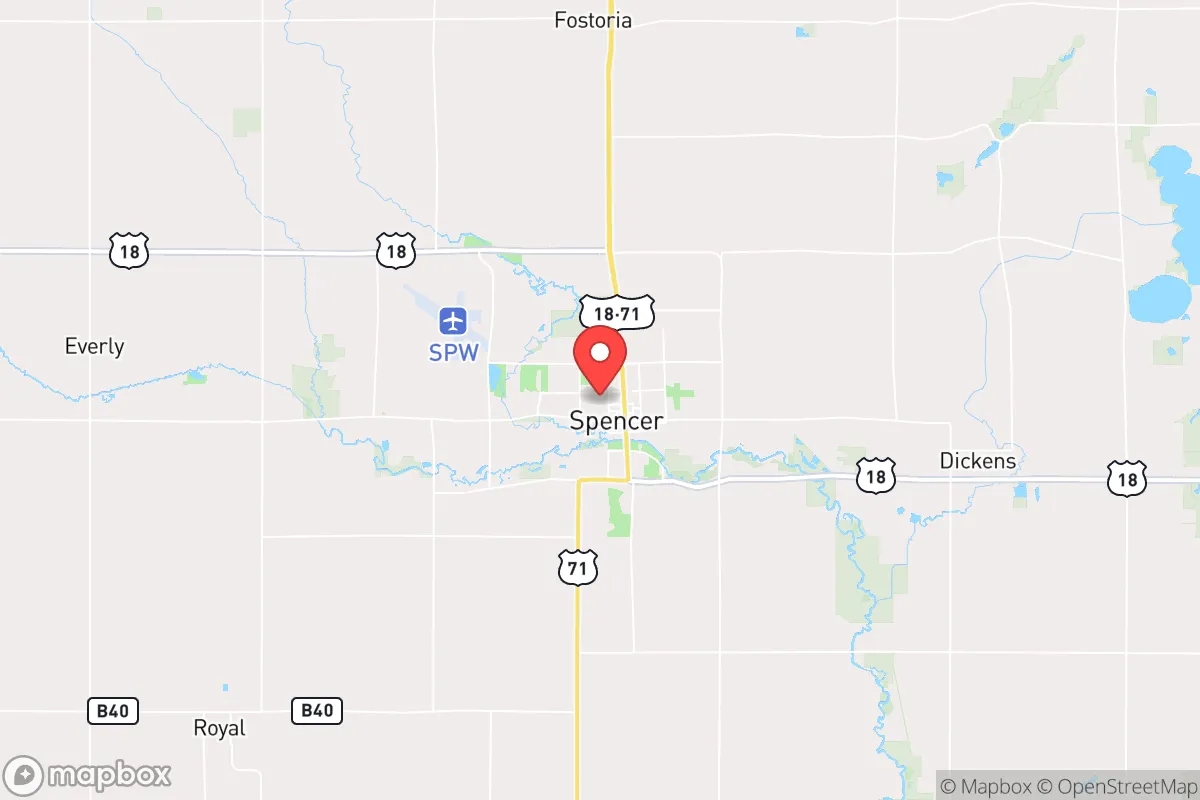
Photo: Wikipedia
Demographics of Spencer, IA
Affluence Level in Spencer, IA
A below-average socioeconomic profile. Incomes, home values, and educational attainment trail the U.S., with higher poverty and unemployment.
People of Spencer, IA
The people of Spencer, Iowa, today number 11,393 and form a predominantly white, native-born community with a strong small-town Midwestern character. The city’s identity is rooted in agricultural and manufacturing heritage, with a notably low foreign-born population of 0.9% and a Hispanic share of 5.5% that represents the largest minority group. Spencer’s population is slightly less college-educated than the national average at 28.2%, and its residents are concentrated in established neighborhoods like the historic downtown district, the residential areas around Peterson Park, and the newer subdivisions along 18th Street. The city projects a stable, family-oriented atmosphere, with a demographic profile that has shifted only modestly in recent decades.
How the city was settled and grew
Spencer was founded in 1859 as a railroad town on the Des Moines River, with the arrival of the Chicago, Milwaukee, St. Paul and Pacific Railroad driving its early growth. The original settlers were primarily Yankee and German immigrants drawn by land grants and the promise of fertile prairie soil for farming. By the 1880s, a wave of Danish and Swedish immigrants arrived, establishing themselves in the North Side neighborhood around Grand Avenue, where many built modest frame houses and worked in the grain elevators and lumber yards. The early 20th century brought a smaller influx of Irish and Czech families, who settled near the railroad depot in what is now the South Central district near 4th Avenue. The city’s population grew steadily through the 1950s, reaching about 8,500 by 1960, driven by the expansion of the Spencer Foods meatpacking plant and the local farm implement industry. The East Side, along Highway 71, developed as a working-class area with smaller homes and proximity to the industrial corridor.
Modern era (post-1965)
After the 1965 Hart-Cellar Act, Spencer saw minimal immigration compared to larger Iowa cities. The foreign-born share remained under 1% through the 1990s, and the city’s growth came almost entirely from domestic in-migration from rural Clay County and surrounding areas. The 1970s and 1980s saw suburban-style development in the West Side around 18th Street, where larger single-family homes and the Spencer Golf & Country Club attracted middle-class families. The Hispanic population, now 5.5%, began to grow in the 1990s, primarily through Mexican-origin families working in the meatpacking and food processing sectors. These households concentrated in the Southwest neighborhood near the industrial park, where rental housing and older homes offered affordable entry points. The East/Southeast Asian population remains very small at 0.4%, with no significant enclave, and the Indian-subcontinent population is effectively zero. The Black population, at 0.7%, is scattered across the city without a distinct neighborhood. Spencer’s racial and ethnic composition has remained overwhelmingly white (90.4%), with the Hispanic share rising from about 2% in 2000 to the current 5.5%, reflecting a gradual but steady diversification.
The future
Spencer’s population is projected to remain stable or decline slightly, as the city’s birth rate and domestic in-migration are offset by an aging population and outmigration of younger adults to larger metro areas. The Hispanic share is likely to continue growing slowly, potentially reaching 8–10% by 2040, as families expand and new workers arrive for agricultural and manufacturing jobs. However, the city is not experiencing rapid tribalization into distinct ethnic enclaves; instead, Hispanic residents are dispersing across existing neighborhoods, particularly the Southwest and East Side areas. The white population will likely remain the overwhelming majority, and the foreign-born share is expected to stay below 2%. The North Side and West Side neighborhoods are aging, with many long-term residents retiring, while the 18th Street corridor continues to attract younger families seeking newer housing. No significant growth in Asian, Indian, or Black populations is anticipated, given the lack of economic pull factors for those groups.
For someone moving to Spencer now, the city offers a stable, predominantly white, and culturally conservative community with a slow pace of demographic change. The population is homogenizing in the sense that most growth comes from within the region, but the Hispanic presence is gradually increasing without creating sharp residential divides. New residents will find a place where neighborhood identity is tied more to housing age and income than to ethnic clustering, and where the future looks much like the present—steady, small-town, and rooted in agricultural and manufacturing life.

* Values derived from national, state, county, city and local statistics and may differ in a specific area. Last updated: 2026-04-29T20:59:17.000Z
Narrative content on this page is AI-generated and may contain mistakes. Verify any details that matter before acting on them.
ReloMaps may earn a commission from affiliate links at no extra cost to you.

