
Photo by Intricate Explorer on Unsplash
Demographics of St Matthews, KY
Affluence Level in St Matthews, KY
A middle-class area roughly in line with national averages across income, home values, education, and employment.
People of St Matthews, KY
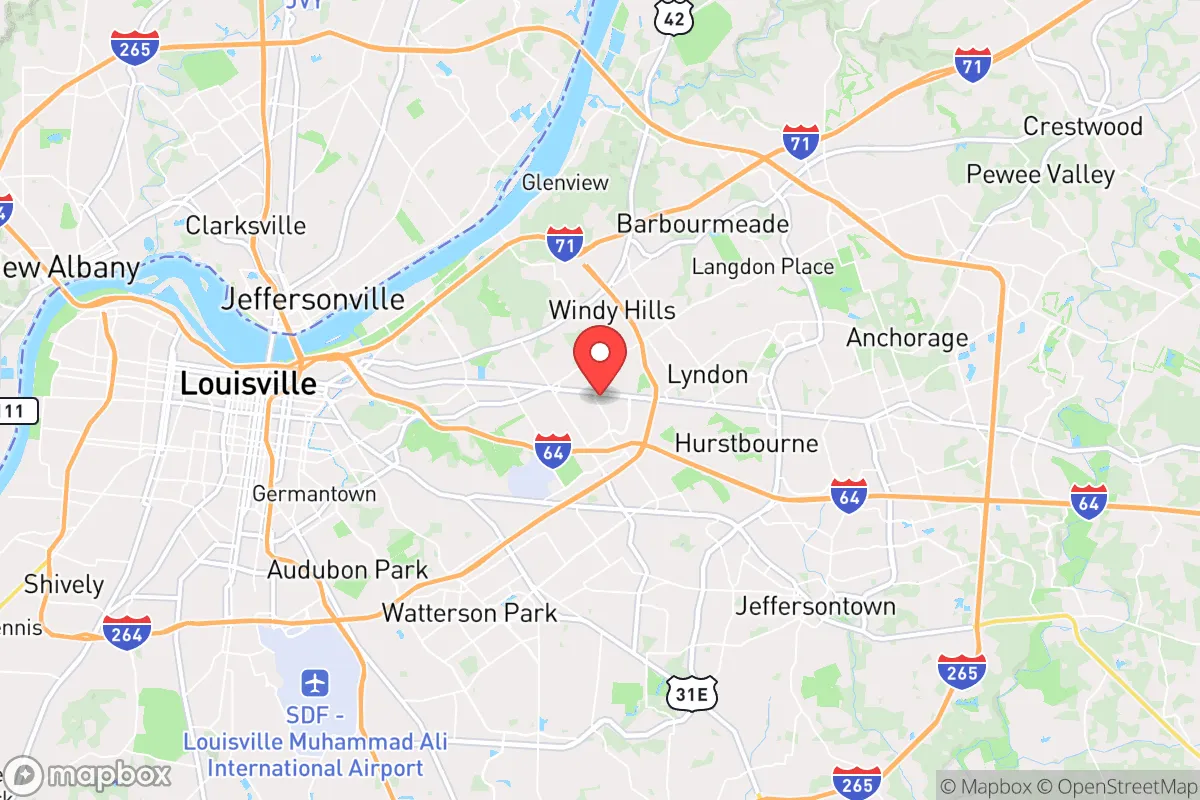
St. Matthews, Kentucky, is a densely developed inner-ring suburb of Louisville with a population of 17,491 that is notably older, whiter, and more highly educated than Jefferson County as a whole. The city's identity is shaped by its historic role as a streetcar suburb and commercial hub, today blending established single-family neighborhoods with high-end retail corridors. With 56.4% of residents holding a bachelor's degree or higher and a foreign-born population of just 2.8%, St. Matthews remains a predominantly native-born, professional-class enclave. Its character is that of a stable, established community where generational continuity is common, though recent demographic shifts are slowly introducing modest diversity.
How the city was settled and grew
St. Matthews was originally settled in the late 18th century by Anglo-American farmers and merchants drawn to the fertile land along Beargrass Creek, part of the Virginia Military District land grants awarded to Revolutionary War veterans. The community took its name from St. Matthew's Episcopal Church, founded in 1822, and remained a rural crossroads through the 19th century. The first major growth wave arrived after 1900 with the extension of the Louisville streetcar line, which turned St. Matthews into a commuter suburb. The historic Cherokee Triangle area (adjacent to the city's eastern edge) and the Gardiner Lane neighborhood were among the first to fill with middle-class families of German and Irish descent moving out from Louisville's urban core. A second wave followed World War II, when returning GIs used VA loans to build ranch homes in subdivisions like Bowman Field and Norbourne Estates, cementing the city's reputation as a safe, family-oriented suburb. These early waves were almost entirely white and native-born, a pattern that persisted for decades.
Modern era (post-1965)
The post-1965 era brought only modest demographic change to St. Matthews, largely because the city was already built out and lacked the affordable housing stock that attracted immigrant families to other parts of Jefferson County. The 1970s and 1980s saw white flight from Louisville's West End accelerate, but St. Matthews absorbed almost none of that movement; instead, it became a destination for upwardly mobile white families from other parts of the county. The Westport Village area and the Hurstbourne corridor (just east of St. Matthews proper) saw new apartment and condo construction that attracted some young professionals, but the city's housing stock remained dominated by single-family homes. By 2020, the population was 84.5% white, with Black residents at 5.6% and Hispanic residents at 3.6%. The East/Southeast Asian share (1.5%) and Indian-subcontinent share (1.3%) are small but concentrated in newer apartment complexes near the Shelbyville Road commercial strip. The foreign-born population of 2.8% is roughly half the Jefferson County average, reflecting St. Matthews's limited role as a destination for new immigrants.
The future
St. Matthews is likely to remain a predominantly white, highly educated suburb over the next decade, but modest diversification is underway. The city's aging housing stock—much of it built in the 1950s and 1960s—is being slowly replaced by townhome and apartment developments along major corridors like Shelbyville Road and Breckenridge Lane, which may attract younger, more diverse residents. The Indian-subcontinent and East/Southeast Asian populations, while small, are growing as professionals employed in Louisville's healthcare and logistics sectors seek proximity to the city's best schools and retail amenities. Hispanic and Black populations are expected to increase incrementally, but St. Matthews lacks the rental affordability and social networks that drive larger minority concentrations in suburbs like Okolona or Fern Creek. The city's high home values and property taxes act as a de facto filter, meaning future growth will likely come from high-income households of all backgrounds rather than broad-based immigration.
For a conservative-leaning individual or family considering relocation, St. Matthews offers a stable, low-crime environment with excellent schools and a strong sense of community continuity. The city is not becoming a melting pot in any dramatic sense; instead, it is slowly absorbing a thin layer of professional-class diversity while maintaining its core identity as a white, native-born, college-educated suburb. The bottom line: St. Matthews is a place where the population is aging in place, new arrivals are overwhelmingly high-income and highly educated, and the next 20 years will look much like the last 20, only slightly more diverse and slightly more expensive.

* Values derived from national, state, county, city and local statistics and may differ in a specific area. Last updated: 2026-05-01T05:25:07.000Z
Narrative content on this page is AI-generated and may contain mistakes. Verify any details that matter before acting on them.
ReloMaps may earn a commission from affiliate links at no extra cost to you.

