
Photo: Wikipedia
Political ClimatePolitical Climate in Starkville, MS
District shown is the primary district for this city’s centroid. Cities may span multiple districts.
Local Political AnalysisPolitical Analysis of Starkville, MS
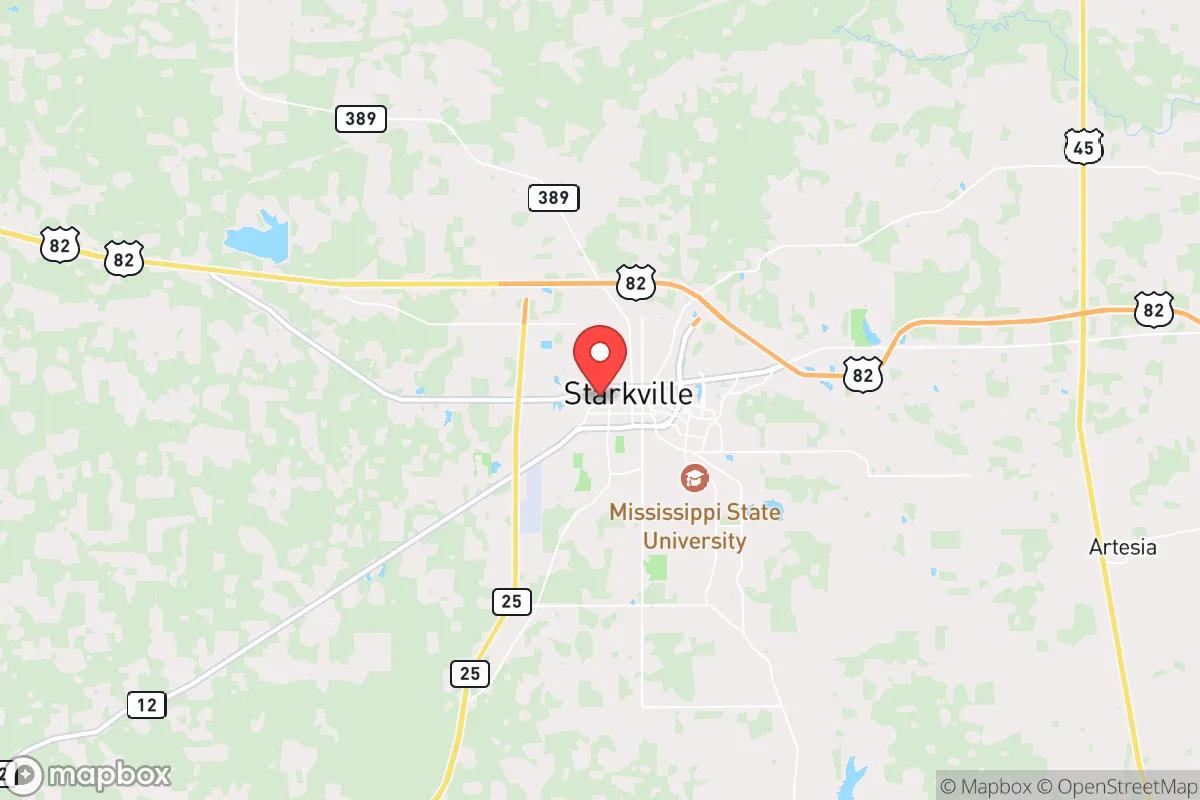
Starkville sits in the heart of Mississippi’s Golden Triangle, and politically, it’s a bit of an outlier compared to the surrounding countryside. The area carries a Cook PVI of R+14, meaning it leans solidly Republican in federal elections, but don’t let that number fool you into thinking it’s a straight red bastion. The presence of Mississippi State University injects a steady stream of progressive-leaning faculty and students, creating a noticeable blue undercurrent that’s been slowly rising over the past decade. In the 2024 presidential race, Oktibbeha County voted about 57% Republican, which is actually a few points softer than neighboring counties like Lowndes (Columbus) or Clay (West Point), where GOP margins routinely hit 65-70%. That gap tells you everything about the cultural tug-of-war here: the university acts as a liberalizing force, while the surrounding rural areas hold the line on traditional conservative values.
How it compares
If you drive 20 miles west to West Point or 25 miles east to Columbus, you’ll find a much more uniform conservative landscape—fewer transplants, less academic influence, and a stronger attachment to local church and family structures. Starkville, by contrast, has become a kind of blue island in a red sea. The city council has seen progressive pushes on issues like non-discrimination ordinances and zoning reforms that wouldn’t fly in the smaller towns around here. Meanwhile, the county supervisors, who represent the rural precincts, tend to be more reliably conservative, creating a constant friction between city and county governance. It’s not uncommon to see the city push for something like a diversity initiative while the county pushes back on spending or scope. That dynamic is the real story here: Starkville is politically split in a way that most of the rest of the district isn’t.
What this means for residents
For a conservative resident, the most immediate concern is the slow creep of progressive policy into local government. Over the last five years, the city has flirted with things like sanctuary city rhetoric and expanded public funding for social programs that many locals see as government overreach. The school board has also become a battleground, with some members pushing for curriculum changes that prioritize DEI over core academics. If you value limited government and personal freedom—meaning the freedom to run your business, raise your kids, and speak your mind without bureaucratic interference—you’ll want to keep a close eye on city council elections. The university’s influence means these shifts tend to come from the top down, not from grassroots demand. Long-term, if the trend continues, Starkville could start to look more like a college town in a blue state, with higher taxes and more regulations on housing and land use. That’s a real concern for folks who moved here for the low cost of living and the no-nonsense way of life.
Culturally, Starkville still holds onto its Southern roots in a lot of ways—church attendance is high, hunting and fishing are still big, and the NRA has a strong presence. But you can feel the change in the air. The university brings in events and speakers that wouldn’t have been tolerated twenty years ago, and the local paper has shifted noticeably leftward in its editorial stance. For now, the conservative majority in the county keeps the worst excesses in check, but the demographic tide is turning. If you’re thinking of relocating here, just know that the political climate is more contested than the R+14 rating suggests. It’s still a good place for a family that values tradition and personal liberty, but you’ll need to stay engaged if you want to keep it that way.

State Political ClimatePolitical Climate in Mississippi
State Political AnalysisPolitical Environment in the State
Mississippi is one of the most reliably conservative states in the nation, with a Republican trifecta that has grown only more entrenched over the past two decades. The state hasn’t voted for a Democratic presidential candidate since 1976, and in 2024, Donald Trump carried it by over 17 points. The dominant coalition is a blend of rural, evangelical, and working-class voters, with a growing suburban conservative base in the Jackson suburbs and along the Gulf Coast. Over the last 10-20 years, the shift has been stark: Democrats once held a majority in the state legislature as recently as 2010, but today Republicans hold supermajorities in both chambers, and every statewide office is held by the GOP. This trajectory reflects a broader realignment where cultural and economic conservatism have become the default, even as the state’s population remains one of the poorest and most racially diverse in the country.
Urban vs. rural divide
The political map of Mississippi is a textbook case of the urban-rural split, but with a twist: even the largest cities are not reliably blue. Jackson, the capital and largest city, is a Democratic stronghold—heavily African American, with a progressive city council and a mayor who has clashed with the state over water infrastructure and policing. But Jackson’s influence is shrinking; its population has declined by over 20% since 2000, and the surrounding suburbs—Madison and Ridgeland—are among the most conservative enclaves in the state, with Madison County routinely voting 70%+ Republican. The Gulf Coast metros, Biloxi and Gulfport, lean Republican but are more moderate on economic issues due to the tourism and casino industries. Hattiesburg, home to the University of Southern Mississippi, is a purple island in a red sea—the city itself tilts Democratic, but the surrounding Forrest and Lamar counties are solidly red. The Delta region, including Greenville and Clarksdale, remains the last bastion of Democratic voting outside Jackson, driven by a majority-black population and deep poverty. Meanwhile, the northeastern hill country around Tupelo and Oxford is reliably Republican, though Oxford’s university influence adds a libertarian-leaning streak that sometimes bucks the party line on social issues.
Policy environment
Mississippi’s policy environment is aggressively conservative, with a low-tax, low-regulation posture that appeals to many relocating families. The state has a flat income tax of 4.7% (phasing down to 4.0% by 2026), no estate tax, and a sales tax that averages around 7%. Property taxes are among the lowest in the nation, thanks to a homestead exemption that caps assessments. On education, the state has expanded school choice through the Mississippi Education Scholarship Account program, which allows parents to use public funds for private school tuition, tutoring, or homeschooling—a major draw for conservative parents. Healthcare is a mixed bag: Mississippi did not expand Medicaid under the Affordable Care Act, leaving a coverage gap for low-income adults, but the state has also passed some of the strictest pro-life laws in the country, including a near-total abortion ban that took effect in 2022. Election laws are tight: voter ID is required, and the state has closed its primary system, meaning only registered Republicans can vote in GOP primaries. There is no early voting, and absentee voting is restricted to specific excuses. For a conservative moving in, the policy environment is largely aligned with limited government principles, though the lack of Medicaid expansion can be a practical headache for self-employed or lower-income residents.
Trajectory & freedom
On the freedom front, Mississippi has been moving in a decidedly more liberty-oriented direction over the past five years, particularly on gun rights and parental rights. In 2023, the state passed a constitutional carry law, allowing permitless concealed carry for anyone 21 or older—a clear expansion of Second Amendment freedom. The same year, the legislature passed the "Parents’ Bill of Rights," which requires schools to notify parents of any medical or mental health services offered to their children and prohibits instruction on sexual orientation or gender identity in K-3 classrooms. On medical freedom, Mississippi was one of the first states to ban COVID-19 vaccine mandates for public employees and contractors, and it has resisted federal pressure on mask mandates. Property rights are strong, with no statewide zoning in most rural counties and a right-to-farm law that protects agricultural operations from nuisance lawsuits. Taxation is trending downward: the income tax phase-down was accelerated in 2024, and there is serious talk of eliminating it entirely within the decade. However, the state still has a high combined sales tax burden, and the lack of a state-level religious freedom restoration act (RFRA) has been a point of contention among some conservatives who want stronger protections for faith-based businesses.
Civil unrest & political movements
Mississippi has a quieter civil unrest landscape than many states, but there are flashpoints. The most visible is the ongoing battle over the state flag—the old Confederate-themed flag was replaced in 2020 after national pressure, a move that still rankles many traditionalists. The "New Magnolia" flag is now universally flown, but you’ll still see the old flag on private property in rural areas. Immigration politics are less heated here than in border states, but there is a vocal movement pushing for stronger enforcement; the state has a law requiring local law enforcement to cooperate with ICE, and sanctuary cities are banned. Election integrity has been a hot topic since 2020, with the state legislature passing a law in 2021 that tightened absentee ballot procedures and banned ballot drop boxes. There have been no major protests or riots in recent years, but the Jackson water crisis in 2022 did spark some localized activism around infrastructure and racial equity. On the right, the Mississippi Republican Party is dominated by the "American Conservative Union" wing, with groups like the Mississippi Tea Party pushing for even lower taxes and school choice expansion. On the left, the NAACP and Southern Poverty Law Center remain active, but their influence is limited to Jackson and the Delta.
Projection
Over the next 5-10 years, Mississippi is likely to become even more conservative, driven by two trends: suburban flight from Jackson and in-migration of retirees and remote workers from higher-tax states like California and Illinois. The Jackson suburbs—Madison, Ridgeland, and Flowood—are growing fast, and they vote 70-80% Republican. The Gulf Coast is also seeing an influx of out-of-state buyers drawn by low property taxes and coastal living, which will likely reinforce the region’s Republican lean. The Delta, meanwhile, continues to depopulate, reducing the Democratic base. The biggest wild card is the state’s stagnant population growth overall—Mississippi is one of the few states that hasn’t seen a net gain from domestic migration, and the brain drain of young professionals to Texas and Tennessee could limit the tax base. Expect the income tax to be fully eliminated by 2030, and school choice to expand further, possibly to universal vouchers. The biggest threat to the current trajectory is federal intervention: if the Biden or a future Democratic administration pushes for Medicaid expansion or voting rights mandates, Mississippi will likely resist, setting up legal battles. For a new resident, the state will feel more like Texas or Florida in terms of policy freedom, but with a slower pace and lower cost of living.
For a conservative individual or family considering relocation, Mississippi offers a policy environment that is broadly aligned with limited government, parental rights, and Second Amendment freedoms. The practical takeaways are straightforward: you’ll enjoy low taxes, strong gun rights, and a school choice system that lets you customize your child’s education. The trade-offs are a weaker healthcare safety net and a slower economy than the booming Sun Belt states. If you’re looking for a place where the government stays out of your life and your wallet, Mississippi is a solid bet—just be prepared for the humidity and the fact that you’ll need to drive an hour to find a Trader Joe’s.
* Values derived from national, state, county, city and local statistics and may differ in a specific area. Last updated: 2026-05-03T06:45:51.000Z
Narrative content on this page is AI-generated and may contain mistakes. Verify any details that matter before acting on them.
ReloMaps may earn a commission from affiliate links at no extra cost to you.

