Photo: Wikipedia
Demographics of Stephens City, VA
Affluence Level in Stephens City, VA
An upper-middle-class area. Household wealth, education levels, and homeownership run ahead of national benchmarks.
People of Stephens City, VA
Stephens City, Virginia, is a small, historically rooted town of 2,338 residents that retains a distinctly American character: predominantly White (63.4%) with a significant and growing Hispanic community (24.3%) and a smaller Black population (8.7%). The town’s identity is shaped by its deep Shenandoah Valley heritage, a strong sense of local community, and a population density that feels both settled and open. For those moving in, Stephens City offers a tight-knit, family-oriented atmosphere where traditional values and a slower pace of life remain central.
How the city was settled and grew
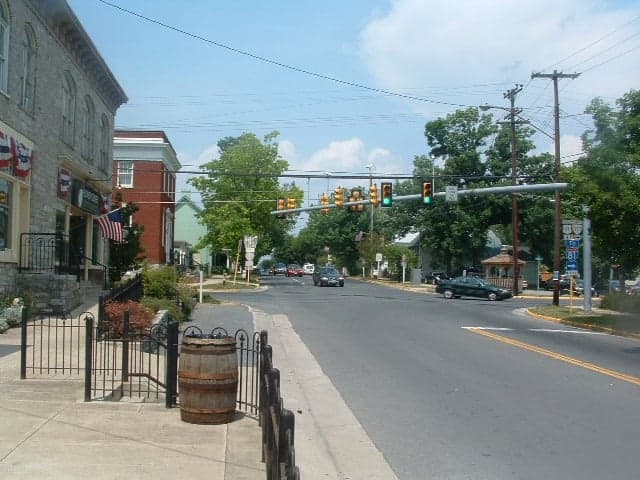
Stephens City was founded in the 1730s by German and Scots-Irish settlers drawn to the fertile limestone soil of the Shenandoah Valley. The town was originally a waypoint on the Great Wagon Road, a major migration route from Pennsylvania into the southern backcountry. The earliest families—the Stephens, the Hites, and the Burners—established farms and small trades, and the town was officially laid out in 1758. The historic Old Town district, centered along Main Street (U.S. 11), was the original settlement core, where these German and Scots-Irish families built their stone and brick homes, many of which still stand. The town remained a predominantly White, agricultural community through the 19th and early 20th centuries, with a small number of Black families living in the “Back Creek” area to the west, often working as farm laborers or domestic servants. The arrival of the railroad in the late 1800s brought a modest wave of Irish and German laborers, who settled in the “Depot Hill” neighborhood near the tracks, but the town’s population remained overwhelmingly of northern European descent until the mid-20th century.
Modern era (post-1965)
The post-1965 period brought gradual demographic change, driven less by international immigration and more by domestic in-migration from the Washington, D.C., and Northern Virginia suburbs. The town’s foreign-born population remains very low at just 2.1%, but the Hispanic share has grown substantially, from near zero in 1990 to 24.3% today. This growth is largely the result of Latino families moving from the Washington metro area and from other parts of Virginia, drawn by lower housing costs and work in construction, landscaping, and agriculture. These families have concentrated in the “Fairview Estates” and “Shenandoah Meadows” subdivisions, newer developments on the town’s eastern edge. The Black population, at 8.7%, includes both long-standing local families and newer arrivals from the D.C. region, many of whom have settled in the “Cedar Creek” area along Route 11. The White population, while still the majority, has declined from over 90% in 1980 to 63.4% today, as younger White families have moved to larger towns like Winchester or Front Royal for more amenities. The town’s college-educated share (28.3%) is below the national average, reflecting its working-class and agricultural roots, though it has risen slightly as some professionals have relocated for a quieter lifestyle.
The future
The population of Stephens City is becoming more diverse, but the pace of change is moderate. The Hispanic share is expected to continue growing, potentially reaching 30-35% by 2040, driven by both natural increase and continued in-migration from the D.C. region. These families are likely to continue settling in the newer subdivisions on the town’s periphery, such as “Stonewall Heights” and “Valley View Acres,” where affordable single-family homes are available. The White population will likely continue its slow decline, though it will remain the largest group. The Black population is expected to remain stable or grow slightly, as the area becomes more attractive to Black families seeking lower costs and a slower pace. The town’s cultural identity is evolving from a historically homogeneous, German-Scots-Irish community to a more multi-ethnic, working-class town, but the core values of family, faith, and self-reliance remain strong. The next 10-20 years will likely see continued suburban-style development on the town’s edges, but the historic core will retain its small-town character.
Stephens City is becoming a more diverse, family-oriented community that balances its deep Shenandoah Valley roots with a growing Hispanic and Black presence. For someone moving in now, the town offers a stable, affordable, and neighborly environment where traditional values still hold sway, but where the population is gradually broadening in its ethnic and cultural makeup. It is a place for those who want a quiet, rooted life in a community that is slowly, but steadily, changing.

* Values derived from national, state, county, city and local statistics and may differ in a specific area. Last updated: 2026-08-24T01:49:08.000Z
Narrative content on this page is AI-generated and may contain mistakes. Verify any details that matter before acting on them.
ReloMaps may earn a commission from affiliate links at no extra cost to you.

