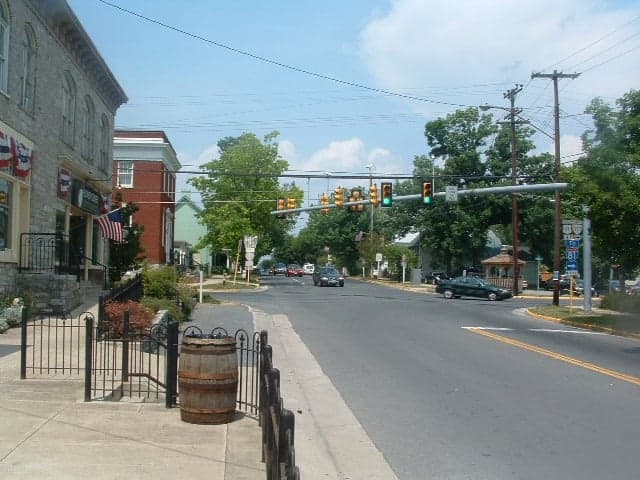
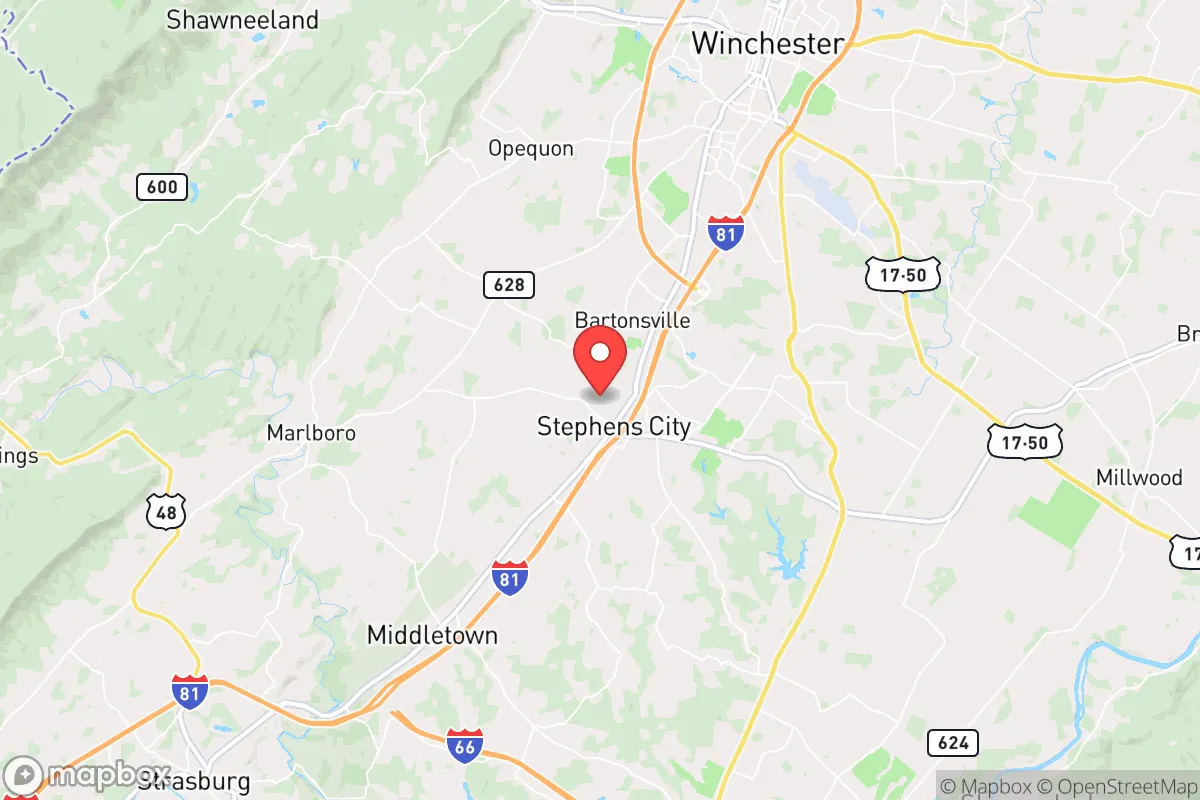
Photo: Wikipedia
Personal Sovereignty in Stephens City, VA
Viable for self-reliance. Generally workable, though some barriers may limit total independence.
What does Personal Sovereignty tell us?
Personal Sovereignty measures your capacity for self-reliance and independence with minimal government friction. Higher scores mean fewer barriers between you and the way you want to live... but it assumes you have the space you need and good neighbors.
What does this tell us?
Personal Sovereignty measures your capacity for self-reliance and independence with minimal government friction. Higher scores mean fewer barriers between you and the way you want to live... but it assumes you have the space you need and good neighbors.
State Policy
Energy independence: Importer (20% of energy produced in-state)
Personal Liberty
Homesteading

Personal Liberty Analysis
Stephens City, Virginia, offers a notably high degree of personal sovereignty, particularly for those who value limited government interference in daily life, property use, and self-defense. Located in Frederick County, this small town of roughly 2,000 residents sits within a state that maintains a broadly conservative legal framework on gun rights and parental authority, while the county itself leans toward a light-touch regulatory posture on land use and business operations. For a single individual or family prioritizing autonomy, Stephens City represents a middle ground—far less restrictive than Northern Virginia or the D.C. suburbs, yet not as unregulated as more remote parts of the Shenandoah Valley or West Virginia.
Tax burden and regulatory posture in Frederick County
Virginia is a moderately tax-friendly state, and Frederick County’s approach reinforces that reputation. The county levies a real property tax rate of $0.53 per $100 of assessed value as of 2025, which is below the state average and significantly lower than nearby Loudoun County ($1.18) or Fairfax County ($1.11). Personal property tax applies to vehicles and boats at a rate of $4.20 per $100 of assessed value, with a state-mandated car tax relief program reducing the bill on the first $20,000 of value for personal-use vehicles. There is no county-level income tax; Virginia’s state income tax is a flat rate of 5.75% on all taxable income, with no local add-ons. Sales tax in Frederick County is 5.3% (4.3% state + 1% local option), which is on the lower end for Virginia. The regulatory environment is business-friendly but not laissez-faire: Frederick County requires building permits for new construction and major renovations, but zoning is generally permissive for single-family homes on lots of one acre or more. There are no county-level rent control ordinances, no plastic bag bans, and no local energy mandates beyond state building codes. The town of Stephens City itself has a small-town planning commission that reviews subdivisions and commercial projects, but the overall impression is one of minimal bureaucratic friction for homeowners and small businesses.
Self-defense and gun law specifics in Virginia
Virginia is a shall-issue state for concealed handgun permits, meaning the sheriff must issue a permit if the applicant meets statutory requirements—no discretion to deny based on personal opinion. Frederick County Sheriff’s Office processes permits efficiently, typically within 45 days. Open carry of handguns is legal without a permit for anyone 18 or older who can legally possess a firearm, though local ordinances in Stephens City do not restrict it further. Virginia law preempts localities from enacting their own gun bans or magazine capacity limits, so Frederick County cannot impose restrictions stricter than state law. The state has a one-handgun-per-month purchase limit, but this does not apply to private sales or transfers. Stand-your-ground laws are not explicitly codified in Virginia statutes, but the state’s self-defense case law is favorable: there is no duty to retreat in one’s own home or place of business, and the Castle Doctrine applies. For a resident of Stephens City, the practical reality is that firearm ownership and carry are straightforward, with no local barriers beyond standard state background checks for retail purchases. The nearest gun ranges include the Izaak Walton League range in Winchester (about 10 minutes north) and the Frederick County Shooting Range near Gore, VA (about 20 minutes west).
Self-reliance and homesteading viability: lot sizes, zoning, and off-grid feasibility
Stephens City’s location in the northern Shenandoah Valley makes it viable for moderate homesteading, though not for full off-grid living without careful planning. Most residential lots in the town proper are 0.25 to 0.5 acres, typical of a small-town grid. However, the surrounding Frederick County zoning allows for agricultural and rural residential parcels of one acre or more, where chickens, goats, and small livestock are permitted without special permits. The county’s zoning ordinance explicitly allows backyard chickens on lots of 20,000 square feet or larger, and beekeeping is allowed on any parcel with a minimum setback of 10 feet from property lines. For those seeking larger acreage, parcels of 5 to 20 acres are available within a 15-minute drive of town, with prices ranging from $10,000 to $20,000 per acre as of 2025. Off-grid feasibility is limited by Virginia’s building code: the state requires connection to an approved water source and sewage system for any habitable dwelling. Wells and septic systems are permitted on parcels of one acre or more, but solar panels must comply with the Virginia Uniform Statewide Building Code, and battery storage systems require permits. Rainwater collection for non-potable use is legal without restriction, but potable rainwater systems must meet state health department standards. There are no county-level bans on clotheslines, composting toilets, or alternative building materials like straw bale or earthship construction, though they must pass structural inspections. For a family wanting to grow food, keep animals, and reduce utility dependence, Frederick County offers a permissive environment—but full autonomy from the grid requires navigating state-level health and safety codes.
Personal liberties: parental rights, medical autonomy, speech, and property
Virginia law provides strong protections for parental rights in education and healthcare. The state’s Parental Involvement in Education Act requires schools to notify parents of any changes in a student’s services or monitoring related to mental, emotional, or physical health, and parents have the right to opt their children out of any curriculum they find objectionable. Frederick County Public Schools, which serves Stephens City, has a conservative school board that has resisted state-level mandates on critical race theory and gender identity policies, maintaining a focus on parental notification and opt-out rights. Homeschooling is straightforward: parents must file a notice of intent with the school division and provide evidence of a curriculum, but there are no standardized testing requirements for the first year, and annual assessments can be a portfolio review rather than a standardized test. Medical autonomy is more limited: Virginia has not expanded Medicaid to cover elective procedures like vasectomies or tubal ligations without cost-sharing, but there are no state-level vaccine mandates for adults, and religious exemptions for childhood vaccines are available. The state does not have a right-to-try law for terminally ill patients beyond federal provisions, and medical marijuana is legal only for approved conditions with a doctor’s certification. Free speech protections are robust: Virginia has no state-level hate speech law that criminalizes expression, and Frederick County has no local ordinances restricting political signage or public assembly beyond standard time-place-manner rules. Property rights are strong: Virginia is a Dillon’s Rule state, meaning localities only have powers expressly granted by the state legislature, which limits the ability of Frederick County to impose rent control, inclusionary zoning, or short-term rental bans without explicit state authorization. Eminent domain is rarely used for private development, and property owners have a right to just compensation and a hearing.
Overall, Stephens City offers a personal sovereignty profile that is above average for Virginia and the Mid-Atlantic region, but not as unregulated as states like West Virginia or Texas. The tax burden is moderate, gun laws are permissive, and the regulatory environment for homesteading and property use is light-touch compared to urban Virginia. The main trade-offs are state-level constraints on medical autonomy and building codes that prevent full off-grid independence. For a conservative-leaning individual or family who wants a small-town atmosphere with room to garden, keep animals, own firearms, and raise children with minimal government interference, Stephens City is a strong contender—especially when compared to the high-tax, high-regulation environments of Northern Virginia or Maryland. The key is to buy a parcel of at least one acre outside the town limits to maximize flexibility, and to accept that Virginia’s state-level health and safety codes will require some compliance for any permanent dwelling.

* Values derived from national, state, county, city and local statistics and may differ in a specific area. Last updated: 2026-08-24T01:49:08.000Z
Narrative content on this page is AI-generated and may contain mistakes. Verify any details that matter before acting on them.
ReloMaps may earn a commission from affiliate links at no extra cost to you.

