Photo: Wikipedia
Demographics of Stephenville, TX
Affluence Level in Stephenville, TX
A middle-class area roughly in line with national averages across income, home values, education, and employment.
People of Stephenville, TX
The people of Stephenville, Texas, today number 21,345, forming a community that is predominantly White (72.9%) with a significant and growing Hispanic population (20.2%). The city is characterized by a strong Western and agricultural identity, a youthful demographic profile driven by Tarleton State University, and a notably low foreign-born share of just 2.3%. This is a place where the historical Anglo ranching and farming culture remains deeply influential, even as the population diversifies and suburbanizes.
How the city was settled and grew
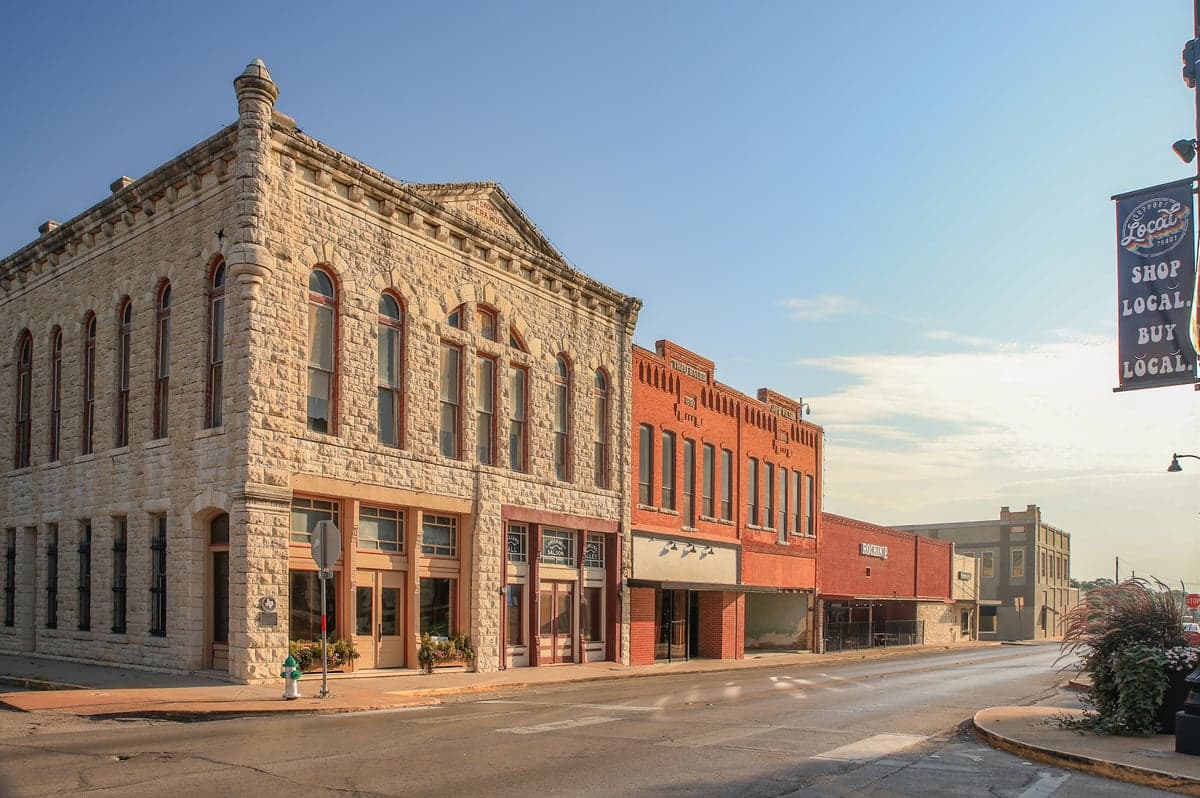
Stephenville’s human history begins with its founding in 1854 by John M. Stephen, a rancher who donated land for the county seat of Erath County. The original settlers were primarily Anglo-American cattle ranchers and farmers from the Upper South and Midwest, drawn by the open prairies and the promise of the Texas cattle industry. The arrival of the Texas Central Railroad in 1889 transformed the town from a remote outpost into a regional shipping hub for cotton, cattle, and wool. The historic Downtown Stephenville district, centered on the Erath County Courthouse, was built by these early merchants and ranchers. A distinct working-class neighborhood, West End, grew up near the rail yards and cotton gins, housing many of the railroad laborers and farmhands. The first half of the 20th century saw a stable, almost entirely White, native-born population, with the founding of Tarleton State University in 1899 adding a small but steady stream of faculty and students. The city remained a quiet agricultural service center through the 1950s, with no major immigrant waves during this period.
Modern era (post-1965)
The post-1965 period brought the most significant demographic shift to Stephenville: the growth of its Hispanic population. This was not driven by the Hart-Cellar Act’s immigration reforms, but rather by domestic migration from South Texas and Mexico, as agricultural labor demands expanded. Hispanic families began settling in the Southside neighborhood, south of Washington Street, and in the Hunter’s Crossing area, where affordable housing and proximity to ranch work drew many. By 2020, the Hispanic share had reached 20.2%, making it the largest minority group. The Black population, at 2.6%, has remained small and is concentrated in the East Stephenville area, near the historic Black school and church sites. East/Southeast Asian communities (1.2%) and Indian subcontinent residents (0.4%) are very recent arrivals, primarily associated with Tarleton State University’s international programs and the local healthcare sector; they tend to live in newer subdivisions like Pecan Creek near the university. The White population, while still the majority at 72.9%, has seen relative decline as the city’s overall growth has been driven by Hispanic and university-related in-migration. The college-educated share of 33.5% reflects Tarleton’s influence, with many professionals and faculty living in the University Hills area north of campus.
The future
The population of Stephenville is heading toward greater Hispanic plurality, though not necessarily rapid diversification. The Hispanic share is projected to continue rising through natural increase and continued domestic migration from the Rio Grande Valley, likely reaching 25-30% by 2040. The White population will remain the majority but will shrink as a proportion of the total. The foreign-born share (2.3%) is likely to remain low, as Stephenville is not a major immigrant gateway; most Hispanic growth is from U.S.-born families. The East/Southeast Asian and Indian communities will grow modestly, tied to Tarleton’s enrollment and the expanding regional medical center, but will remain small enclaves. The city is not tribalizing into distinct ethnic enclaves; rather, neighborhoods like Southside are becoming more mixed as younger White families also move into previously Hispanic areas. The biggest wildcard is Tarleton State University’s growth—if it continues to expand its student body and attract out-of-state and international students, Stephenville could see a more cosmopolitan shift, particularly in the College Hills area near the new student housing developments.
For someone moving in now, Stephenville is becoming a more diverse but still culturally conservative small city. The Anglo ranching heritage remains the dominant social and political force, but the Hispanic community is increasingly integrated into local business, schools, and civic life. The city is not a melting pot in the traditional sense, but a place where distinct groups—ranchers, university faculty, Hispanic families, and a small professional class—coexist with minimal friction. The future points to steady, moderate diversification without dramatic change, making it a stable choice for those seeking a growing but still traditional Texas community.

* Values derived from national, state, county, city and local statistics and may differ in a specific area. Last updated: 2026-04-18T19:22:45.000Z
Narrative content on this page is AI-generated and may contain mistakes. Verify any details that matter before acting on them.
ReloMaps may earn a commission from affiliate links at no extra cost to you.

