
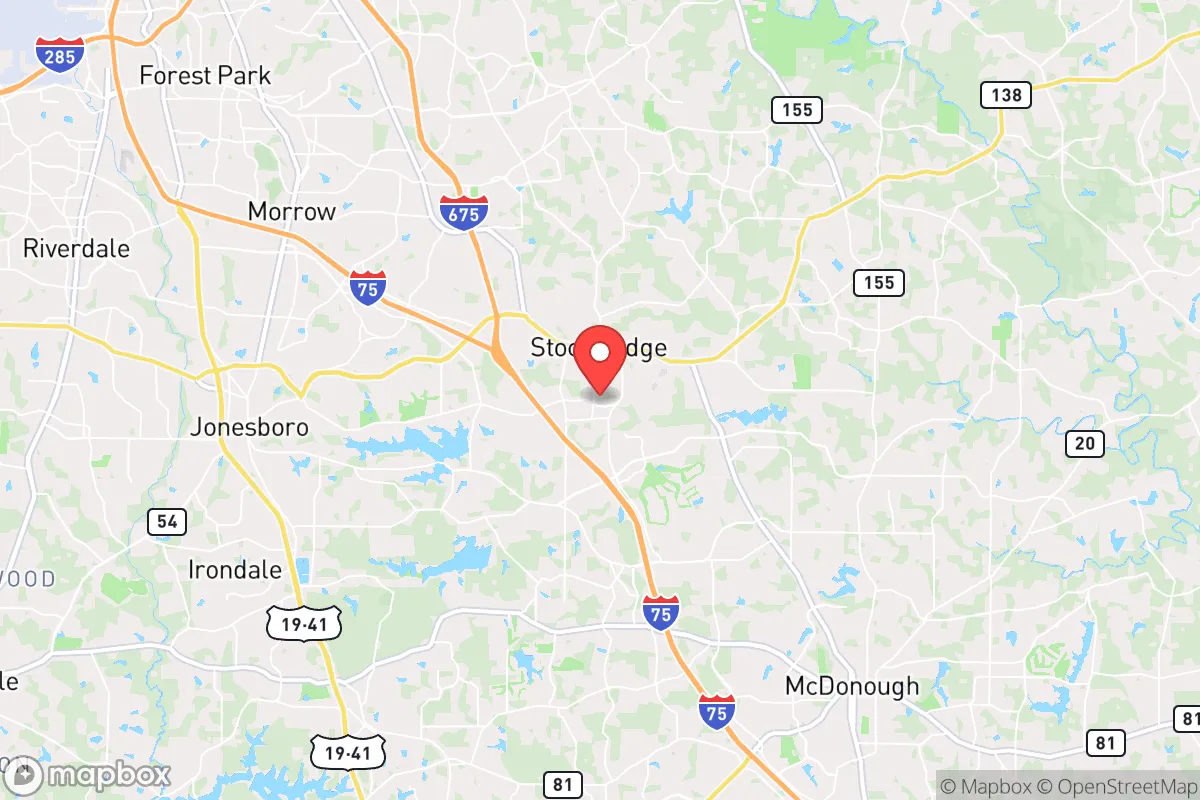
Photo: Wikipedia
Demographics of Stockbridge, GA
Affluence Level in Stockbridge, GA
A below-average socioeconomic profile. Incomes, home values, and educational attainment trail the U.S., with higher poverty and unemployment.
People of Stockbridge, GA
The people of Stockbridge, Georgia today form a predominantly Black, family-oriented suburban community of roughly 35,475 residents, with a character shaped by decades of southward migration from metro Atlanta and a growing professional class. The city is notably diverse for a Southern suburb of its size, with a population that is 66.6% Black, 15.1% White, 7.4% Hispanic, 4.8% East/Southeast Asian, and 2.8% Indian (subcontinent). Despite its diversity, Stockbridge remains a place where distinct neighborhoods reflect different eras of settlement, and where the foreign-born share (4.2%) is modest compared to nearby DeKalb or Gwinnett counties.
How the city was settled and grew
Stockbridge was founded in the 1820s as a railroad stop on the Macon & Western line, drawing its first permanent residents—mostly White farmers and merchants from the Georgia Piedmont—who established the original Old Stockbridge district around the depot. The town incorporated in 1920 with fewer than 500 people, and for its first century remained a sleepy agricultural hamlet serving cotton and timber operations. The Stockbridge Depot District (now a historic overlay) contains the original commercial buildings built by these early families, including the 1904 train depot. Through the 1950s, the population hovered around 1,000, almost entirely White, with a small Black workforce living in the Riverside area near the railroad tracks—a pattern common across Henry County’s rural towns.
Modern era (post-1965)
The city’s modern demographic transformation began in the 1970s, driven by two forces: the expansion of Interstate 75 and the southward push of Atlanta’s Black middle class. As White flight from DeKalb and Clayton counties accelerated in the 1980s and 1990s, Stockbridge became a primary destination for Black families seeking newer, larger homes on larger lots. The Eagles Landing subdivision, developed from the late 1980s through the 2000s, became the signature Black middle-class enclave—a golf-course community that attracted professionals from Atlanta’s corporate and government sectors. By 2000, Stockbridge’s Black population had risen to roughly 55%, and by 2020 it reached 66.6%. The Jodeco Estates and Lake Dow Estates neighborhoods absorbed much of the subsequent wave of Black families moving from Clayton County and south DeKalb during the 2000s housing boom. Meanwhile, the Stockbridge Village area (near the intersection of GA-138 and I-75) became a landing point for Hispanic families, many working in construction and logistics, growing the Hispanic share from under 2% in 1990 to 7.4% today. East/Southeast Asian families (4.8%) and Indian families (2.8%) have concentrated in newer subdivisions near the Mountain View area along Rock Quarry Road, drawn by the school system and proximity to employers in Henry County’s growing healthcare and distribution sectors.
The future
Stockbridge’s population is likely to continue its trajectory toward a solidly Black-majority, multiethnic suburb, but with important nuances. The city is not homogenizing into a single Black enclave; rather, it is tribalizing into distinct income and ethnic zones. Eagles Landing remains the high-end Black professional anchor, while Jodeco Estates and Lake Dow Estates are becoming more mixed-income as older homes turn over. The Hispanic population is growing steadily but not explosively—Henry County’s overall Hispanic share is 12%, suggesting Stockbridge may see further Hispanic in-migration from Clayton County as housing prices rise there. The East/Southeast Asian and Indian communities are small but stable, with little new immigration driving growth; most growth comes from domestic moves within metro Atlanta. The White population (15.1%) is aging in place in the historic Stockbridge Depot and Riverside neighborhoods, with few young White families moving in. Over the next 10–20 years, Stockbridge will likely become a predominantly Black city with a significant Hispanic minority, a small Asian/Indian presence, and a shrinking White cohort—a pattern common across Atlanta’s inner-ring southern suburbs.
For someone moving in now, Stockbridge is a place where the Black middle class is firmly established and politically influential, where Hispanic families are growing but not yet a dominant cultural force, and where the foreign-born share remains low enough that English-dominant life is the norm. The city offers a stable, family-oriented suburban environment with good schools in parts of Eagles Landing and Mountain View, but with infrastructure and retail that lag behind the northern suburbs. It is becoming a more diverse, more working-to-middle-class version of itself—not a boomtown, but a steady, settled community with clear neighborhood identities.

* Values derived from national, state, county, city and local statistics and may differ in a specific area. Last updated: 2026-04-29T23:24:04.000Z
Narrative content on this page is AI-generated and may contain mistakes. Verify any details that matter before acting on them.
ReloMaps may earn a commission from affiliate links at no extra cost to you.

