Photo: Wikipedia
Demographics of Summerset, SD
Affluence Level in Summerset, SD
An upper-middle-class area. Household wealth, education levels, and homeownership run ahead of national benchmarks.
People of Summerset, SD
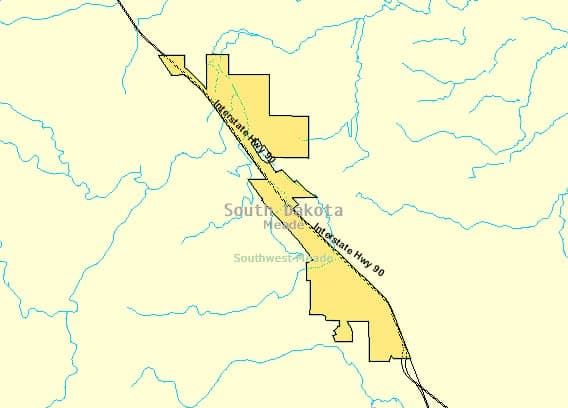
Summerset, South Dakota, is a small, rapidly growing city of 2,978 residents that is overwhelmingly white (93.4%) and native-born, with a foreign-born population of just 0.4%. The city’s character is defined by its recent, planned suburban expansion as a bedroom community for nearby Rapid City, attracting families and individuals seeking newer housing, lower taxes, and a quieter lifestyle while remaining within commuting distance of a regional economic hub. With a college-educated rate of 41.1%, Summerset’s population is notably more educated than the state average, reflecting a demographic of professionals, remote workers, and military-affiliated families drawn to the Black Hills region.
How the city was settled and grew
Summerset did not exist as a named settlement until the late 20th century. Unlike older Black Hills towns founded during the 1870s gold rush, this area was originally open ranchland and unincorporated prairie in Meade County. The first permanent residents were homesteaders of Northern European descent—primarily German, Norwegian, and English stock—who took advantage of the 1862 Homestead Act to claim 160-acre parcels. These early families established scattered farms and ranches, with no concentrated village forming. The area that is now Summerset’s original core, near the intersection of Elk Creek Road and Highway 79, remained a sparsely populated crossroads of working ranches well into the 1970s. The only significant early infrastructure was the railroad spur serving the nearby Black Hills Ordnance Depot (now Ellsworth Air Force Base), which brought a small number of military personnel and civilian workers to the broader region but did not create a distinct community here.
Modern era (post-1965)
Summerset’s true population history begins after the 1965 Immigration and Nationality Act, though its impact on this city was minimal—the area saw virtually no foreign-born influx. Instead, the modern era is a story of domestic in-migration driven by two forces: the expansion of Ellsworth Air Force Base and the suburban spillover from Rapid City. The city was formally incorporated in 2000, a direct result of developers platting large subdivisions on former ranchland to accommodate Rapid City’s growing workforce. The first major subdivision, Black Hawk Estates, was built in the late 1990s and attracted middle-class families, many with ties to the base or to Rapid City’s healthcare and retail sectors. This was followed by Elk Creek Village, a master-planned community of single-family homes that became the preferred destination for white-collar commuters and early retirees. A third neighborhood, Prairie Hills, developed in the 2010s, drew a slightly younger demographic of first-time homebuyers and remote tech workers. The city’s Hispanic population (1.2%) and East/Southeast Asian population (1.4%) are concentrated almost entirely in these newer subdivisions, reflecting their arrival as part of the general workforce migration rather than as distinct ethnic enclaves. There are no historically ethnic neighborhoods in Summerset; the city’s residential areas are uniformly white-majority and economically mixed within a narrow band of middle-to-upper-middle income.
The future
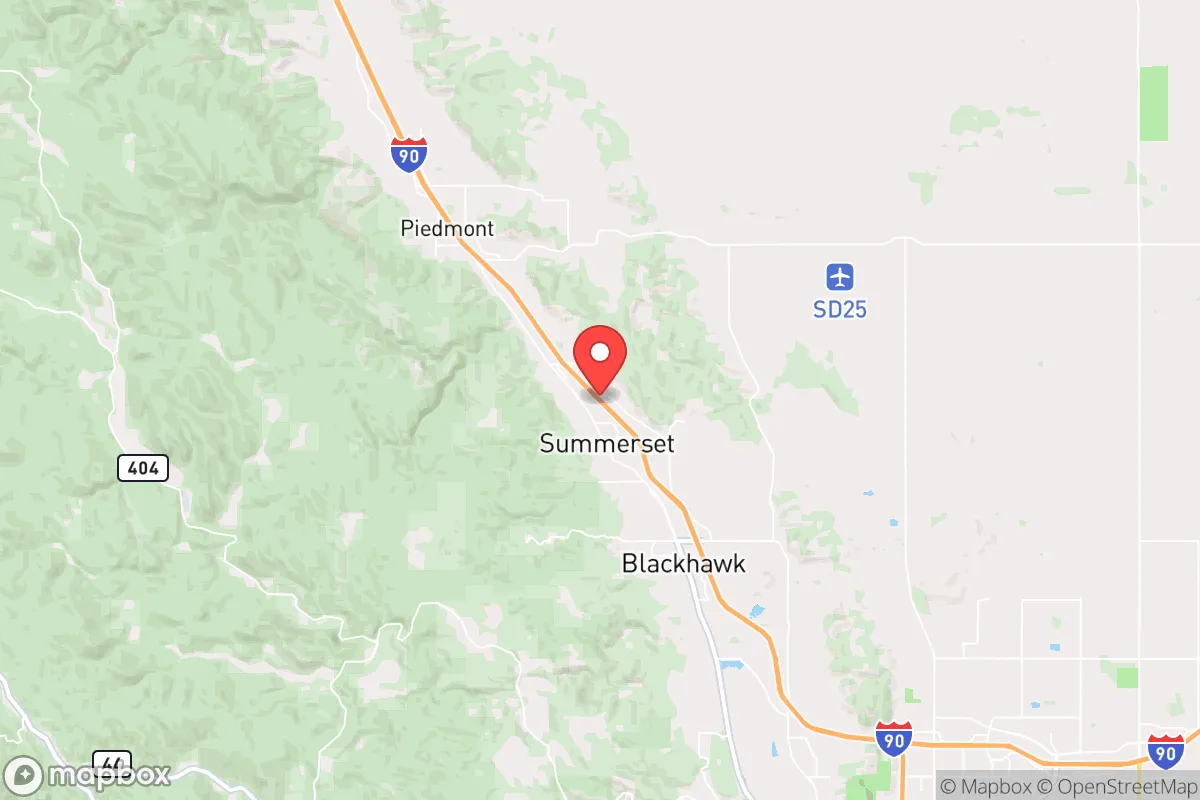
Summerset’s population trajectory points toward continued growth and homogenization. The city’s location along the Highway 79 corridor, combined with available land for annexation and development, positions it to absorb more Rapid City overflow. The 0.4% foreign-born rate is unlikely to rise significantly, as the city lacks the rental housing stock, public transit, and entry-level service jobs that typically attract immigrant populations. The East/Southeast Asian and Hispanic shares may increase slightly as Ellsworth Air Force Base diversifies its officer corps and as remote workers relocate from more diverse states, but these groups will remain small and dispersed. The most likely demographic shift is an aging of the population: the 41.1% college-educated rate suggests a cohort of professionals who will age in place, while the lack of large apartment complexes limits the influx of younger renters. The city is not tribalizing into distinct enclaves—its subdivisions are too small and too similar in housing type to support ethnic clustering. Instead, Summerset is becoming a more uniform, family-oriented, and politically conservative suburb, with a population that is whiter, more educated, and more native-born than the Rapid City metro area as a whole.
For a conservative-leaning individual or parent considering relocation, Summerset offers a stable, low-diversity environment with strong schools and low crime, but little cultural or ethnic variety. The city is solidifying its identity as a homogeneous, growth-oriented bedroom community where the population is likely to become more similar over time, not less. New arrivals will find a place that is still being built, with a social fabric defined by recent arrivals rather than deep historical roots.

* Values derived from national, state, county, city and local statistics and may differ in a specific area. Last updated: 2026-04-23T09:18:04.000Z
Narrative content on this page is AI-generated and may contain mistakes. Verify any details that matter before acting on them.
ReloMaps may earn a commission from affiliate links at no extra cost to you.

