Demographics of Swanton, VT
Affluence Level in Swanton, VT
A below-average socioeconomic profile. Incomes, home values, and educational attainment trail the U.S., with higher poverty and unemployment.
People of Swanton, VT
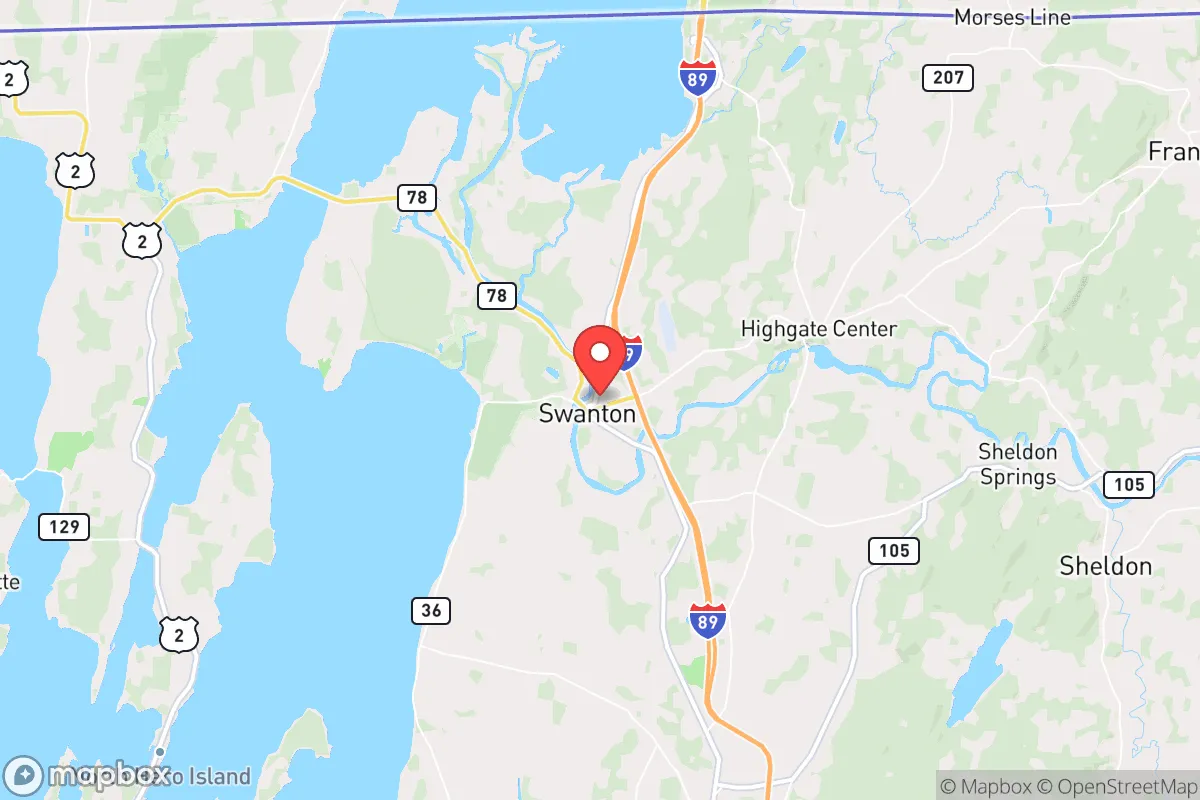
Swanton, Vermont, is a small, tight-knit village of 2,732 residents where 91.3% of the population is White, giving it a notably homogeneous character compared to the national average. The community is defined by its Franco-American and French-Canadian heritage, a legacy of 19th-century immigration, and a modest but growing East/Southeast Asian presence at 3.9%. With only 4.2% foreign-born and a low college attainment rate of 12.8%, Swanton remains a working-class, family-oriented enclave along the Missisquoi River, where local identity is deeply tied to the lake, the railroad, and the border with Canada.
How the city was settled and grew
Swanton’s human history begins with the Western Abenaki, who inhabited the Missisquoi River delta for centuries before European contact. The village was chartered in 1763 as part of the New Hampshire Grants, but permanent settlement by Euro-Americans did not accelerate until after the War of 1812. The Champlain Canal (1823) and the arrival of the Central Vermont Railroad in the 1850s transformed Swanton into a transportation and milling hub. The first major wave of non-Abenaki settlers were Yankees from southern New England, who established farms and small businesses along Mercy Point and the Swanton Village Historic District. By the 1880s, the railroad and the lumber industry drew a second, larger wave: French-Canadian families migrating south from Quebec. These immigrants settled in what became known as French Hill, a neighborhood east of the railroad tracks where they built St. Francis of Assisi Church (1892) and maintained French-language schools. A smaller contingent of Irish laborers arrived during the same period, clustering near the rail yards in the Depot District. By 1900, Swanton’s population was overwhelmingly Franco-American, a demographic imprint that persists today.
Modern era (post-1965)
The 1965 Hart-Cellar Act had minimal direct impact on Swanton’s demographics. Unlike Burlington or Winooski, Swanton did not see a wave of refugee resettlement. Instead, the post-1965 period was defined by domestic out-migration of younger residents seeking jobs in Chittenden County, and a slow suburbanization of the village core. The construction of Interstate 89 in the 1970s made Swanton a bedroom community for Burlington, 30 minutes south, but the population remained overwhelmingly White and Franco-American. The most notable demographic shift came in the 2000s and 2010s, when a small number of East/Southeast Asian families—primarily of Vietnamese and Chinese ancestry—moved into the Swanton Village core and the newer subdivisions along Canada Street. Today, the Asian population stands at 3.9%, the largest non-White group, while the Indian subcontinent population is a separate 0.8%. The Hispanic (1.1%) and Black (0.6%) populations remain negligible. The Lake Street area, near the Missisquoi Bay, has seen some second-home development by out-of-state buyers, but this has not altered the village’s ethnic composition.
The future
Swanton’s population is aging and slowly shrinking, with a median age of 43.5 years. The village is not homogenizing further—it is already near-maximum homogeneity—but it is not tribalizing into distinct ethnic enclaves either. The East/Southeast Asian community, while small, is stable and concentrated in the village core, with no signs of rapid growth or assimilation into the Franco-American mainstream. The Indian subcontinent population (0.8%) is too small to form a distinct neighborhood. The foreign-born share (4.2%) is unlikely to rise significantly, as Swanton lacks the job base or housing stock to attract new immigrants. Over the next 10–20 years, the most likely demographic trend is continued slow decline, with the Franco-American majority aging in place and younger families moving to larger towns or out of state. The village’s low college attainment rate (12.8%) suggests limited economic mobility, which may further suppress in-migration.
For someone moving in now, Swanton offers a stable, culturally cohesive community with deep roots and a predictable future. It is not a place of rapid demographic change or ethnic diversification. The village remains what it has been for over a century: a Franco-American working-class town on the Canadian border, where family, church, and the lake define daily life. New residents—especially those seeking a quiet, safe, and traditional environment—will find a community that values continuity over change.

* Values derived from national, state, county, city and local statistics and may differ in a specific area. Last updated: 2026-10-10T16:29:07.000Z
Narrative content on this page is AI-generated and may contain mistakes. Verify any details that matter before acting on them.
ReloMaps may earn a commission from affiliate links at no extra cost to you.

