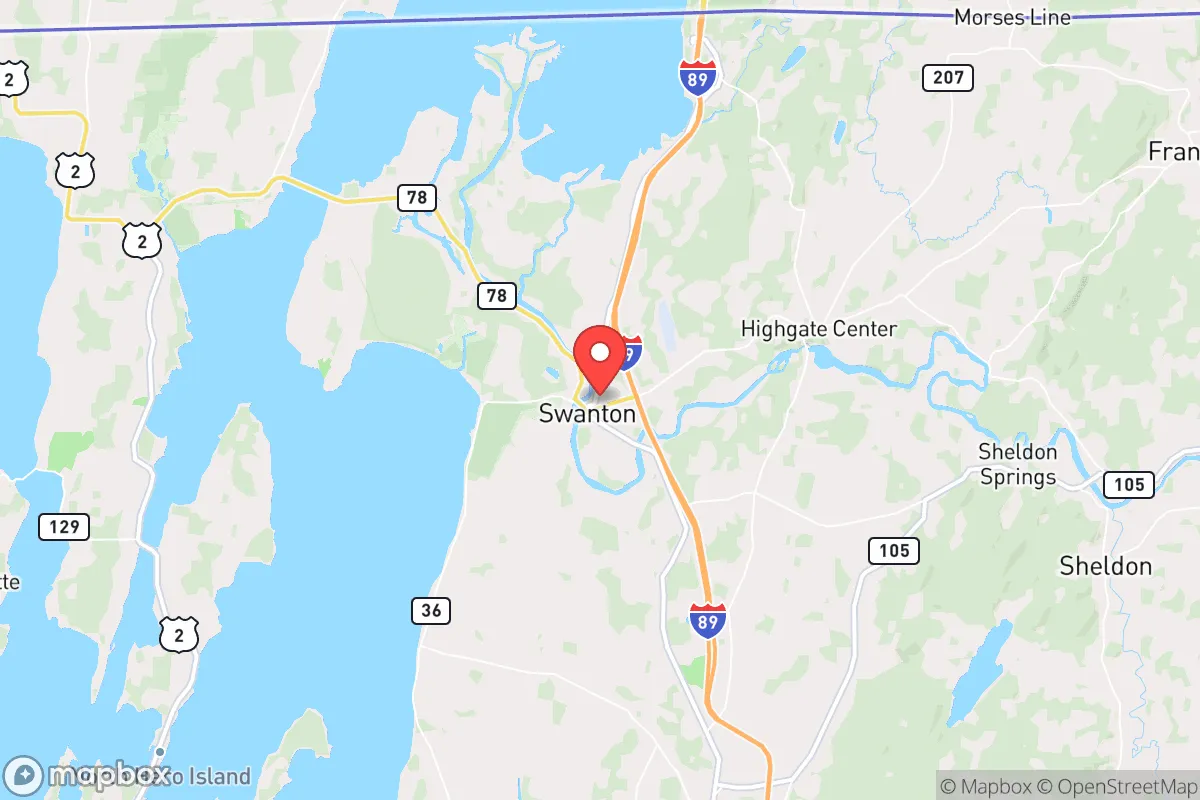
Political ClimatePolitical Climate in Swanton, VT
District shown is the primary district for this city’s centroid. Cities may span multiple districts.
Inherited from parent state — no local data available.
Local Political AnalysisPolitical Analysis of Swanton, VT
Swanton, Vermont, sits in a D+17 Cook PVI district, meaning it votes about 17 points more Democratic than the national average, but don’t let that number fool you into thinking it’s a lockstep progressive stronghold. The reality on the ground is more complicated—this is a working-class town along the Canadian border where a lot of folks, myself included, remember when the local economy was built on farming and manufacturing, not government programs or tech startups. Over the last decade, you’ve seen a slow but steady shift toward progressive policies coming out of Montpelier, and that’s got a lot of us watching our freedoms a little closer.
How it compares
Drive 15 minutes south to St. Albans, and you’ll find a similar blue-collar vibe but with a slightly more moderate streak—it’s still deep blue on paper, but local elections there often hinge on taxes and property rights. Head east to Enosburg Falls, and you’re in a town that’s more reliably conservative, where the Second Amendment isn’t up for debate and people are skeptical of state mandates. The real contrast is with Burlington, about 45 minutes south, where the political energy is full-on progressive—think rent control, sanctuary city policies, and a city council that’s not shy about regulating everything from plastic bags to short-term rentals. Swanton, by comparison, feels like a place where people still wave at each other on the street, but the pressure from Montpelier to adopt those same policies is real and growing.
What this means for residents
For the average Swanton resident, the biggest concern isn’t national politics—it’s how state-level decisions are chipping away at local control. The push for stricter gun laws, like the 2018 magazine capacity ban and universal background checks, didn’t sit well with a lot of hunters and sport shooters here. Then there’s the Act 250 reform talk, which could make it harder to build a new garage or expand a small business without jumping through state hoops. Property taxes are already among the highest in the nation, and every new social program out of Montpelier seems to come with a price tag that lands on our local tax bills. If you value the freedom to make your own choices about your land, your home, and your family’s safety, you’re probably feeling a little squeezed right now.
Looking ahead, the long-term trajectory is what worries me most. The state’s push for universal healthcare, carbon taxes, and renewable energy mandates sounds good in a press release, but the cost and bureaucracy trickle down to towns like Swanton. We’re already seeing younger families move out because they can’t afford the taxes or find work that pays enough to stay. If the trend continues, Swanton could become a bedroom community for Burlington commuters, losing the independent, self-reliant character that made it a good place to raise kids. For now, the best advice I can give is to get involved in local town meetings—that’s where you can still push back against the overreach before it becomes law. It’s not about being anti-government; it’s about keeping the government from running your life.

State Political ClimatePolitical Climate in Vermont
State Political AnalysisPolitical Environment in the State
Vermont has long been a deep blue state, but the reality on the ground is more complicated than the statewide voting totals suggest. For decades, the state has been dominated by a progressive coalition in Burlington and the Chittenden County suburbs, but the rest of the state—the Northeast Kingdom, the southern counties, and the rural central spine—has been trending redder or at least holding firm as a conservative-leaning, independent-minded region. Over the last 10-20 years, the overall partisan lean has shifted from a moderate-blue to a solidly progressive-blue, driven by an influx of out-of-state transplants and a shrinking rural population. In 2024, Vermont gave Kamala Harris a 35-point margin, but that number masks a deep urban-rural chasm that is widening every cycle.
Urban vs. rural divide
The political map of Vermont is essentially a story of two states. Chittenden County, anchored by Burlington, is the progressive engine—home to the University of Vermont, a dense tech and healthcare sector, and a highly educated, transplant-heavy population. This county alone delivers 20-25% of the state’s vote and leans about 40 points blue. The other major population centers—Montpelier, Brattleboro, and Middlebury—follow suit, each hosting liberal arts colleges or state government hubs that amplify progressive turnout. But drive 20 minutes outside any of these towns, and the landscape changes fast. The Northeast Kingdom—Newport, St. Johnsbury, Lyndonville—is a working-class, rural region that has flipped from reliably Democratic to competitive or even red-leaning in local races. In 2020, Donald Trump won Essex County (the Kingdom’s core) by 10 points, and in 2024, he carried it by 14. The same pattern holds in the southern tier: Bennington and Rutland counties are now swing areas, with Rutland City itself trending more conservative as its manufacturing base shrinks and property taxes push out younger families. The divide isn’t just about party registration—it’s about culture, economics, and a growing resentment of Burlington’s one-party rule.
Policy environment
Vermont’s policy environment is a textbook case of progressive governance with a heavy hand. The state has the highest combined state and local tax burden in the nation—about 12% of income for middle-class families—driven by a progressive income tax (top rate 8.75% on income over $213,000) and some of the highest property taxes in the country (averaging 1.8% of home value). The regulatory posture is aggressive: Act 250, the state’s land-use law, has been expanded repeatedly and now effectively blocks most new housing development outside designated village centers, driving up home prices and rents. Education policy is dominated by the Vermont Agency of Education, which has pushed universal pre-K, a statewide school funding system that redistributes from rural districts to urban ones, and a controversial “ethnic studies” framework that critics say prioritizes activism over academics. Healthcare is heavily regulated, with a single-payer-like system via the Green Mountain Care Board that caps hospital budgets and limits private insurance options. Election laws are among the most permissive in the country: universal mail-in voting, same-day registration, and no voter ID requirement. For a conservative-leaning family, the policy environment feels like a slow squeeze—higher taxes, less local control, and a state government that views personal choice as a problem to be managed.
Trajectory & freedom
Vermont is becoming less free by almost any measure of personal liberty, especially for those who value gun rights, parental authority, and economic autonomy. The most glaring example is gun policy: in 2023, the legislature passed S.30, which bans the sale of most semi-automatic rifles (including the AR-15), limits magazine capacity to 10 rounds, and raises the purchase age to 21. This came after a 2018 law that already required universal background checks and a 10-day waiting period. On parental rights, Act 1 (2023) removed the requirement for schools to notify parents if a child changes their gender identity or pronouns, effectively cutting parents out of decisions about their own kids. Medical autonomy has also taken a hit: Vermont’s vaccine mandate for healthcare workers remains in place, and the state has a strict “medical aid in dying” law that some see as a slippery slope. Property rights are under constant pressure from Act 250 expansions and a new “land use” bill that gives the state veto power over local zoning decisions. On the economic front, the state’s paid family leave program (Act 47) imposes a 0.55% payroll tax on all workers, and the “Clean Heat Standard” (Act 18) will force homeowners to pay for renewable energy upgrades. The trend is clear: every session brings new mandates, new taxes, and new limits on what you can do with your own life and property.
Civil unrest & political movements
Vermont’s political activism is a study in contrasts. On the left, Burlington has seen periodic protests around racial justice and climate issues, but the most organized movement is the Vermont Progressive Party, which holds seats in the legislature and pushes for rent control, a state bank, and a “Green New Deal” for the state. On the right, the Vermont Republican Party is small but active, with a strong grassroots presence in the Northeast Kingdom and southern counties. The most visible flashpoint in recent years has been the gun control debate: after the 2018 law, thousands of gun owners staged a “Second Amendment Sanctuary” movement, with over 100 towns passing resolutions declaring they would not enforce state gun laws. The state’s sanctuary policy for undocumented immigrants (Act 58, 2021) has also been a hot-button issue, with some towns like Swanton and Derby pushing back against state mandates. Election integrity is a quieter concern: Vermont’s universal mail-in voting system has been praised by progressives, but conservatives point to a lack of voter ID and a 2020 incident where thousands of ballots were sent to outdated addresses. The overall atmosphere is one of simmering tension—most Vermonters are polite, but the cultural divide between Burlington and the rest of the state is as wide as it’s ever been.
Projection
Over the next 5-10 years, Vermont is likely to become more progressive, more expensive, and less demographically diverse. The in-migration pattern is clear: wealthy retirees and remote workers from New York and Massachusetts are buying up second homes in Stowe, Manchester, and Woodstock, driving up property values and pushing out younger families. Meanwhile, the native-born population is aging and shrinking—Vermont has the second-oldest median age in the nation (43.2 years) and a birth rate below replacement. The legislature is dominated by the Progressive-Democratic coalition, and with no term limits, the same faces keep passing the same bills. Expect more gun restrictions, more environmental mandates (like a statewide carbon tax), and more centralization of education and land-use decisions. The rural towns that once voted Democratic are flipping Republican, but their populations are too small to shift the statewide balance. For a conservative-leaning family moving in now, the realistic outlook is that Vermont will continue to be a high-tax, low-freedom state for the foreseeable future, with the political center of gravity firmly in Burlington.
Bottom line for a new resident: If you value low taxes, gun rights, parental control over your kids’ education, and the ability to build or develop your own property, Vermont is a tough sell. The state’s natural beauty and small-town charm are real, but they come with a heavy price tag—both in dollars and in personal freedom. The best bet for a conservative-leaning family is to look at the Northeast Kingdom or southern Vermont towns like Rutland or Bennington, where the culture is more independent and the politics are less suffocating. But even there, the state government in Montpelier will reach you eventually. If you’re moving here, come for the mountains and the quiet, but don’t expect the state to leave you alone.
* Values derived from national, state, county, city and local statistics and may differ in a specific area. Last updated: 2026-10-10T16:29:07.000Z
Narrative content on this page is AI-generated and may contain mistakes. Verify any details that matter before acting on them.
ReloMaps may earn a commission from affiliate links at no extra cost to you.

