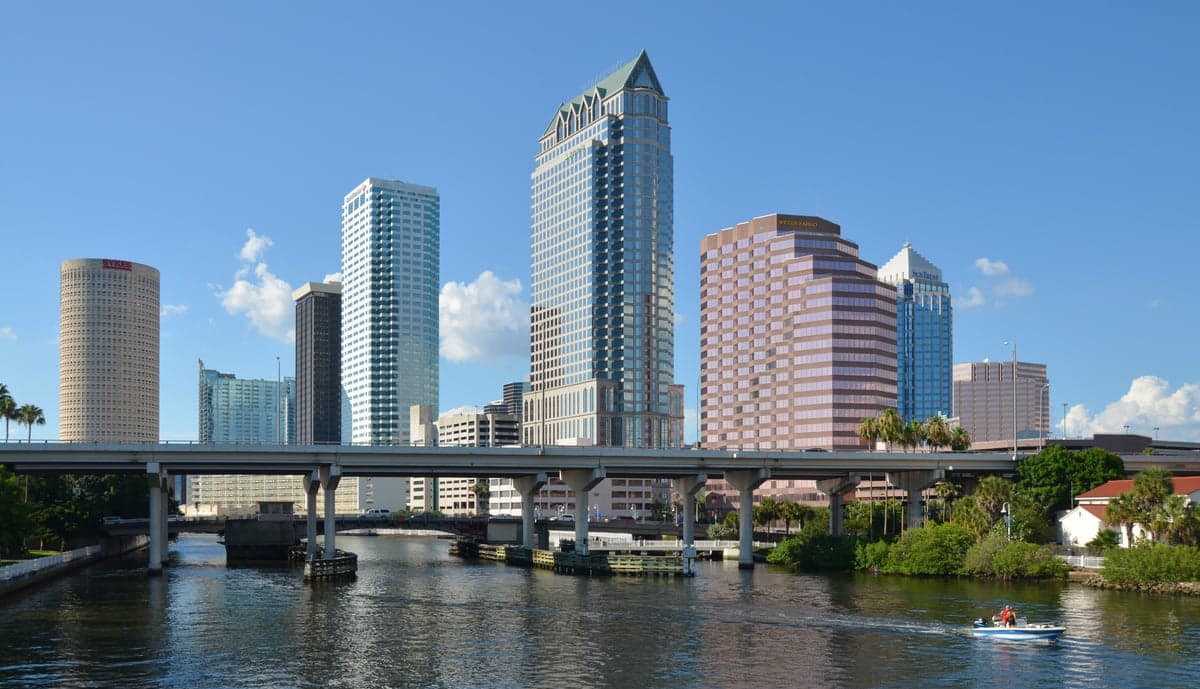
Photo: Wikipedia
Personal Sovereignty in Tampa, FL
Viable for self-reliance. Generally workable, though some barriers may limit total independence.
What does Personal Sovereignty tell us?
Personal Sovereignty measures your capacity for self-reliance and independence with minimal government friction. Higher scores mean fewer barriers between you and the way you want to live... but it assumes you have the space you need and good neighbors.
What does this tell us?
Personal Sovereignty measures your capacity for self-reliance and independence with minimal government friction. Higher scores mean fewer barriers between you and the way you want to live... but it assumes you have the space you need and good neighbors.
State Policy
Energy independence: Importer (10% of energy produced in-state)
Personal Liberty
Homesteading

Personal Liberty Analysis
Tampa offers a notably strong environment for personal sovereignty compared to many major U.S. metros, but it’s not a libertarian free-for-all. The real advantage lies in Florida’s state-level preemption laws and constitutional protections, which create a buffer against the kind of municipal overreach common in cities like Austin or Portland. For a prepper or survivalist-minded individual, Tampa’s balance of urban infrastructure and access to rural escape routes makes it a strategic base—provided you understand where the lines are drawn and where they aren’t.
Tax burden and regulatory posture: how much the state leaves in your pocket
Florida’s lack of a state income tax is the headline, and it’s genuine. For a single earner or family, that means every dollar earned stays yours—no state-level withholding for income, Social Security, or pensions. Property taxes in Hillsborough County average around 0.97% of assessed value, which is moderate nationally but higher than some rural Florida counties. The real win is the regulatory climate: Florida has a right-to-work law, weak union influence, and a state government that actively preempts local ordinances on everything from short-term rentals to vaccine mandates. For a prepper, this means fewer layers of bureaucracy when you want to build a shed, keep chickens, or run a home-based business. The downside? Homeowners’ association (HOA) density in Tampa proper and its suburbs is high—many subdivisions have restrictive covenants that limit vehicle storage, generator placement, and even garden height. If you want true autonomy, you’ll need to look outside city limits, where county zoning is looser. The state’s building codes are strict due to hurricane risk, which adds cost but also ensures structural resilience—a trade-off worth accepting.
Self-defense and gun law specifics: what you can carry and where
Florida is a shall-issue state for concealed carry, meaning permits are issued if you meet basic criteria—no subjective “good cause” requirement. As of 2023, permitless (constitutional) carry is legal for residents 21 and older who can legally possess a firearm, so you can carry concealed without a permit. Open carry is generally prohibited except for hunting, fishing, or camping. Stand-your-ground laws are fully in effect: no duty to retreat in any place you have a legal right to be. Castle doctrine applies to your home and vehicle. Magazine capacity is unrestricted, and there is no state-level assault weapon ban. The practical reality in Tampa: gun ranges are plentiful, and the local sheriff’s office is generally pro-2A. However, private property rights still apply—businesses can post “no guns” signs, and those signs carry force of law if properly displayed. For a prepper, the key limitation is that you cannot carry in government buildings, schools (with narrow exceptions), or airports beyond the security checkpoint. The legal landscape is solid, but you must stay current on local signage and federal restrictions like the NFA items—suppressors are legal but require a tax stamp.
Self-reliance and homesteading viability: lot sizes, zoning, and off-grid feasibility
Within Tampa city limits, true homesteading is nearly impossible. Minimum lot sizes in urban zones are typically 5,000 to 7,500 square feet, and HOAs often ban livestock, large gardens, and external storage. The real opportunity lies in the surrounding unincorporated areas of Hillsborough County or neighboring Pasco and Polk counties. There, you can find parcels of 1 to 10 acres with agricultural zoning that allows chickens, goats, and even small-scale farming. Off-grid feasibility is limited by Florida’s building codes: you must connect to municipal water and sewer if available, but in rural areas, wells and septic systems are standard. Solar panels are legal and common, but net metering rules have become less favorable in recent years—utilities like TECO now charge fixed fees that reduce the financial benefit. Rainwater collection is legal for non-potable uses, but potable collection requires treatment and permitting. The biggest constraint is hurricane preparedness: any off-grid setup must account for extended power outages (days to weeks) and flooding risk. A generator, fuel storage, and elevated structures are non-negotiable. For a serious prepper, the best strategy is to buy land in eastern Hillsborough or northern Polk County, where zoning is lax and land prices are still reasonable—under $20,000 per acre for raw parcels.
Personal liberties: parental rights, medical autonomy, speech, and property
Florida has become a battleground for parental rights, and the current state government has passed laws that strengthen them. The Parental Rights in Education Act (often called “Don’t Say Gay”) restricts classroom instruction on sexual orientation and gender identity through third grade, and a 2023 law expanded that to all grades. Medical autonomy is a mixed bag: Florida banned gender-affirming care for minors and imposed restrictions on adult access through telehealth, but it also protects conscientious objection for medical providers. Vaccine mandates were banned for private employers and government entities in 2023, giving individuals more control over their own medical decisions. Speech protections are strong under the state constitution, and Florida has preempted local “hate speech” ordinances that could chill expression. Property rights are reinforced by the Bert J. Harris Jr. Private Property Rights Protection Act, which allows landowners to sue if a government regulation reduces property value by more than 50%. For a survivalist, this means you have legal recourse if zoning changes or environmental rules cripple your homestead plans. The catch: Florida’s emergency powers during hurricanes can override normal property rights—mandatory evacuations, curfews, and even temporary seizure of supplies have occurred. Knowing the emergency management structure and having a plan to leave or shelter in place is critical.
Overall, Tampa ranks well above average for personal sovereignty among U.S. metros of its size. The state’s preemption laws, lack of income tax, and strong 2A protections create a foundation that many cities lack. But the urban core itself is not a prepper’s paradise—HOAs, building codes, and hurricane regulations impose real constraints. The strategic move is to live within commuting distance of Tampa for work and medical access, but own land in a less-regulated county for actual self-reliance. Compared to places like California or New York, Tampa is a haven. Compared to rural Montana or Texas, it’s a compromise. For someone who wants urban opportunity without surrendering the ability to defend their family, store supplies, and make independent medical choices, Tampa is one of the better bets in the Southeast.

* Values derived from national, state, county, city and local statistics and may differ in a specific area. Last updated: 2026-04-15T23:46:30.000Z
Narrative content on this page is AI-generated and may contain mistakes. Verify any details that matter before acting on them.
ReloMaps may earn a commission from affiliate links at no extra cost to you.

