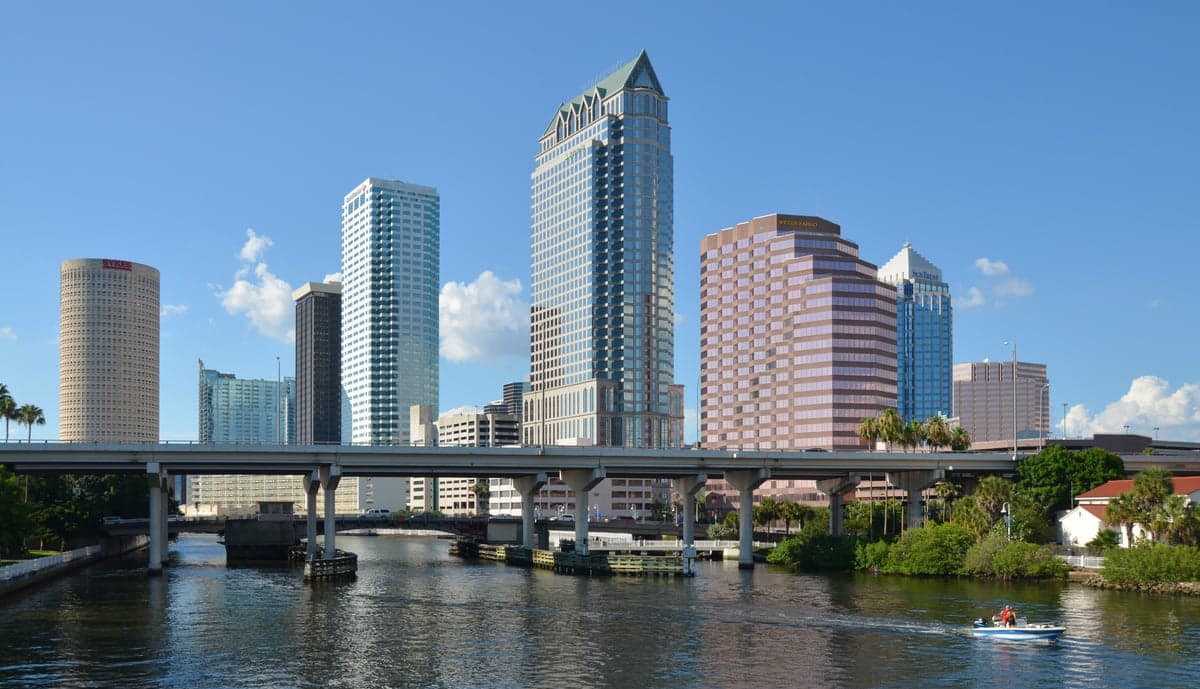
Photo: Wikipedia
Political ClimatePolitical Climate in Tampa, FL
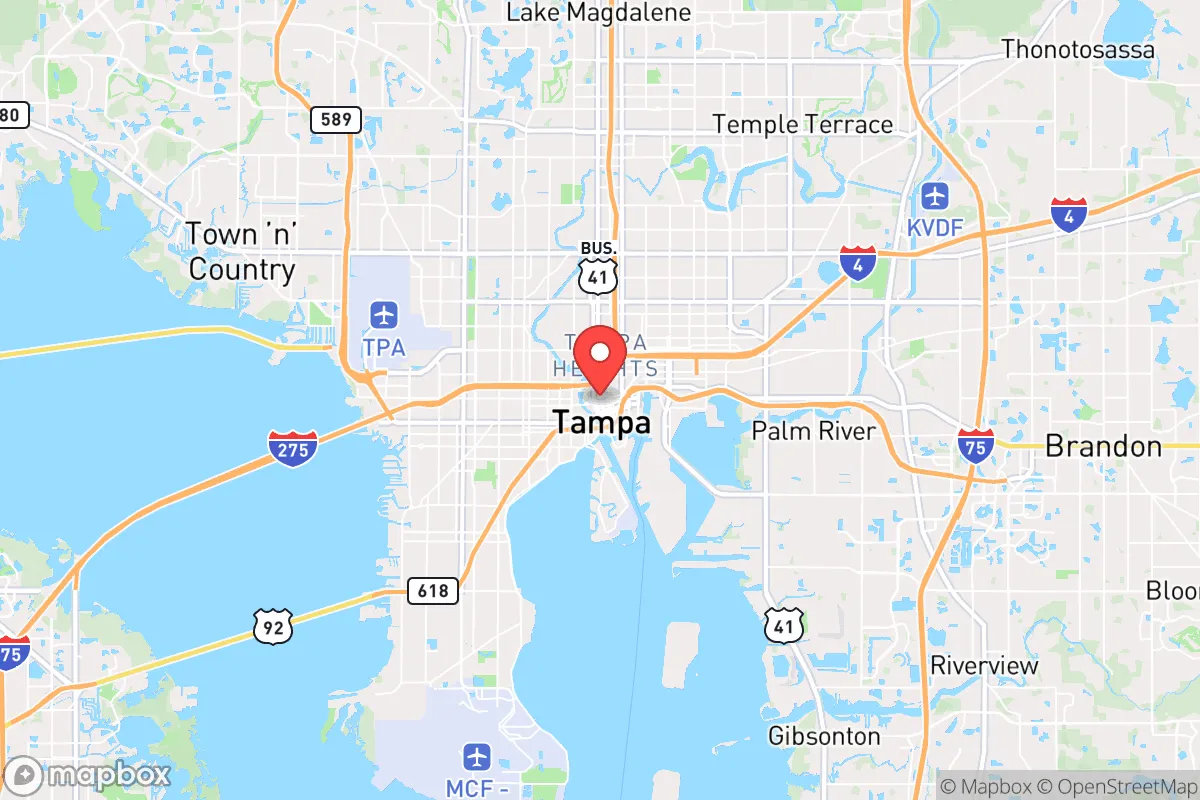
District shown is the primary district for this city’s centroid. Cities may span multiple districts.
Local Political AnalysisPolitical Analysis of Tampa, FL
Tampa's political climate has shifted noticeably over the past decade, and not in a direction that sits well with folks who value limited government and personal freedoms. The city itself now carries a Cook PVI of D+5, meaning it leans about five points more Democratic than the national average—a far cry from the purple swing area it used to be. While surrounding Hillsborough County still has conservative pockets, especially out towards Brandon and Riverview, the urban core has been trending left, driven largely by transplants from blue states and a growing young professional class. If you've lived here as long as I have, you've watched the local government get more comfortable with telling people how to live, and that's a real concern.
How it compares
Drive just 20 minutes north to Lutz or Land O' Lakes in Pasco County, and you'll find a completely different political landscape—those areas still lean reliably red, with lower taxes and a more hands-off approach from local officials. Head south to Manatee County, places like Parrish and Lakewood Ranch, and you're back in conservative territory. But Tampa itself? It's become an island of progressive policy in a sea of more traditional Florida values. The contrast is stark: while Pasco and Manatee counties are fighting to keep property taxes low and zoning restrictions minimal, Tampa's city council has been pushing higher impact fees, stricter rental regulations, and more red tape for small businesses. It's like two different states sometimes.
What this means for residents
For the average person, this shift translates directly into your wallet and your daily life. Tampa's local government has shown a willingness to impose new mandates—think mask requirements that lingered longer than necessary, vaccine passport talk that thankfully fizzled, and ongoing debates about rent control that would only make housing scarcer. Property taxes have crept up as the city spends more on pet projects and feel-good initiatives rather than core services like roads and public safety. If you own a business, you've probably noticed more licensing hurdles and compliance costs. The real kicker is that while politicians promise "equity" and "inclusion," the practical result is often less freedom to run your life or your business without a bureaucrat looking over your shoulder.
One cultural distinction that stands out is Tampa's growing embrace of identity politics in local governance. The city has created official commissions and offices focused on specific demographic groups, which sounds nice on paper but often leads to government picking winners and losers rather than treating everyone equally under the law. Meanwhile, the surrounding suburbs and exurbs are doubling down on the opposite approach—keeping government small, taxes low, and letting people sort out their own lives. The long-term trajectory is concerning: if Tampa keeps moving left, you'll see more families and businesses voting with their feet, heading to Pasco, Polk, or Manatee counties where the political climate still respects individual liberty. For now, it's still a great place to live if you know where to plant your flag, but keep an eye on those city council meetings—they're deciding how much of your freedom you get to keep.

State Political ClimatePolitical Climate in Florida
State Political AnalysisPolitical Environment in the State
Florida has transformed from a classic purple swing state into a solidly Republican-leaning powerhouse over the past two decades, with the GOP now holding a supermajority in both legislative chambers and every statewide elected office. The state’s political trajectory has been decisively rightward since 2010, driven by a massive influx of conservative-leaning domestic migrants from blue states, particularly New York, California, and Illinois, who are drawn by low taxes, no state income tax, and a perceived culture of personal freedom. While Democrats still hold sway in a few dense urban cores, the overall partisan lean has shifted from a 50-50 battleground to a state where Republicans routinely win by 5-10 points in presidential elections, and the 2024 results saw Donald Trump carry Florida by over 13 points, cementing its status as a red anchor in the Southeast.
Urban vs. rural divide
The political map of Florida is a stark study in contrasts, with the state’s vast rural and suburban expanse overwhelmingly Republican, while a handful of dense urban counties remain Democratic strongholds. The Miami-Dade County area, once a reliable Democratic bastion, has seen a dramatic shift: in 2020, Joe Biden won it by only 7 points, down from Hillary Clinton’s 19-point margin in 2016, and by 2024, Trump actually flipped Miami-Dade, winning it by 11 points, driven by a massive swing among Cuban-American and Venezuelan-American voters who are deeply skeptical of socialism. Meanwhile, the I-4 corridor counties like Hillsborough (Tampa) and Orange (Orlando) are still competitive but trending red, with Osceola County flipping to Trump in 2024. The Panhandle, from Pensacola to Tallahassee, is deeply red, with counties like Santa Rosa and Okaloosa routinely voting 70%+ Republican. The real story is the suburbs: places like St. Johns County (south of Jacksonville), Collier County (Naples), and Sarasota County have become GOP strongholds, while once-purple Pinellas County (St. Petersburg) has shifted right. The only true blue holdouts are Alachua County (Gainesville), home to the University of Florida, and Leon County (Tallahassee), the state capital, but these are small population centers that don’t move the needle.
Policy environment
Florida’s policy environment is a model of limited government conservatism that has made it a magnet for those fleeing high-tax, high-regulation states. The state has no personal income tax, a 6% corporate income tax with generous exemptions, and a 7% sales tax that is among the lowest in the nation for a state with no income tax. Property taxes are local but capped at 3% annual increases for homesteaded properties under the Save Our Homes amendment, providing predictability. The regulatory posture is aggressively pro-business: Florida is a right-to-work state, has no state-level minimum wage above the federal floor (though a $15 minimum was passed by ballot initiative in 2020, it’s being phased in slowly), and has streamlined permitting for development. On education, Governor Ron DeSantis pushed through the Parental Rights in Education Act (HB 1557, the “Don’t Say Gay” law) and the Stop WOKE Act (HB 7), which restrict classroom instruction on sexual orientation and critical race theory, and expanded school choice via the Family Empowerment Scholarship program, now the largest private school voucher program in the nation. Healthcare policy is mixed: Florida did not expand Medicaid under the ACA, keeping the uninsured rate higher than average, but it has strong certificate-of-need laws that limit hospital competition. Election laws were tightened with SB 90 in 2021, adding voter ID requirements, limiting drop boxes, and restricting mail-in ballot requests, which critics call suppression but supporters call integrity measures. The state also passed a constitutional carry law (permitless carry) in 2023, eliminating the need for a license to carry a concealed firearm.
Trajectory & freedom
Florida is unequivocally becoming more free in the sense of personal liberty and limited government, especially when compared to the national trend. The 2023 legislative session was a landmark for freedom: the permitless carry law (HB 543) expanded Second Amendment rights, the Live Local Act (SB 102) preempted local zoning to allow more housing development, and the Parental Rights in Education Act was expanded to cover all grades. On medical autonomy, Florida banned COVID-19 vaccine mandates for private employers and government workers (SB 252, 2023) and prohibited mask mandates in schools (SB 183, 2021). Property rights were strengthened with the Private Property Rights Protection Act (HB 403, 2023), which limits local governments’ ability to downzone or impose burdensome regulations without compensation. Taxation has been trending downward: the corporate income tax rate was cut from 5.5% to 4.5% in 2024, and the state eliminated the business rent tax on commercial leases. However, there are concerns: the state’s heavy reliance on sales tax is regressive, and the Florida Insurance Guaranty Association is strained by property insurance crises, leading to higher premiums that some see as a hidden tax. Overall, the trajectory is toward more personal freedom, but the insurance and housing affordability issues are real headwinds.
Civil unrest & political movements
Florida has seen relatively little civil unrest compared to blue states, but there have been notable flashpoints. The 2020 Black Lives Matter protests in Miami, Orlando, and Jacksonville were large but mostly peaceful, with some looting in Miami’s Brickell area. The state’s response was firm: DeSantis activated the National Guard and pushed the Combating Public Disorder Act (HB 1, 2021), which enhanced penalties for rioting, blocking roads, and damaging property, and created a new crime of “mob intimidation.” Immigration politics are a major issue: Florida passed the SB 1718 in 2023, the toughest anti-illegal immigration law in the nation, requiring E-Verify for all employers, banning local “sanctuary” policies, and making it a felony to transport illegal immigrants into the state. This has led to some protests from immigrant rights groups, but overall public support is high. Election integrity remains a hot topic: the 2020 and 2022 elections saw no major fraud scandals, but the state created the Office of Election Crimes and Security in 2022, which has prosecuted a handful of cases of double voting and non-citizen voting. There is a visible presence of conservative activist groups like Moms for Liberty, which has chapters in Brevard County and Palm Beach County, and they have been effective in school board races. On the left, the Dream Defenders and Florida Rising organize around criminal justice reform and voting rights, but their influence is limited. A new resident would notice the absence of the kind of street-level political chaos seen in Portland or Seattle; Florida is generally orderly, with a strong law-and-order culture.
Projection
Over the next 5-10 years, Florida is likely to become even more conservative as in-migration continues from blue states. The state is adding roughly 300,000 new residents per year, and the vast majority are coming from New York, California, and Illinois, and they are not bringing their old politics with them—polls show that a majority of new arrivals identify as Republican or lean conservative. The demographic shift is also favorable: the Hispanic population, particularly Cuban-Americans and Venezuelan-Americans in Miami-Dade and Collier County, is trending heavily Republican, while the white retiree population in The Villages and Sarasota remains rock-ribbed GOP. The only potential counter-trend is the growth of younger, more diverse populations in Orange County and Hillsborough County, but these areas are also seeing conservative in-migration. The state’s political leadership is likely to remain in GOP hands for the foreseeable future, with DeSantis’s influence shaping the party for years. Expect further tax cuts, expansion of school choice, and continued resistance to federal overreach on environmental and immigration policy. The biggest risk is the property insurance crisis: if premiums continue to rise, it could dampen in-migration and create economic pressure that might shift the political conversation. But for now, the trajectory is clear: Florida is solidifying as a red state where personal freedom and limited government are the norm.
For a new resident, the bottom line is that Florida offers a political environment where your rights are broadly protected, taxes are low, and the government generally stays out of your personal life. You’ll find a state that values parental control over education, Second Amendment rights, and a business-friendly climate. The trade-offs are a higher cost of property insurance, a sales-tax-heavy revenue system, and a political culture that can feel intensely partisan if you’re in a blue enclave like Gainesville or Tallahassee. But if you’re looking for a place where the government sees itself as your servant, not your master, Florida is about as close as it gets in 2026.
* Values derived from national, state, county, city and local statistics and may differ in a specific area. Last updated: 2026-04-15T23:46:30.000Z
Narrative content on this page is AI-generated and may contain mistakes. Verify any details that matter before acting on them.
ReloMaps may earn a commission from affiliate links at no extra cost to you.

