Demographics of Tega Cay, SC
Affluence Level in Tega Cay, SC
An upper-middle-class area. Household wealth, education levels, and homeownership run ahead of national benchmarks.
People of Tega Cay, SC
Tega Cay, South Carolina, is a planned lakefront community of 13,267 residents that has rapidly transformed from a quiet 1970s retirement and second-home enclave into a dense, family-oriented suburb dominated by college-educated professionals. The city’s population is notably diverse for the Charlotte region, with a White majority (69.3%) alongside significant Hispanic (12.1%) and Indian-subcontinent (9.5%) communities, creating a distinctive blend of traditional Southern suburban life and newer immigrant-driven growth. The city’s identity is shaped by its gated and non-gated neighborhoods, its strong school system, and a population that is 65.7% college-educated—a figure that signals a highly selective, knowledge-worker demographic.
How the city was settled and grew
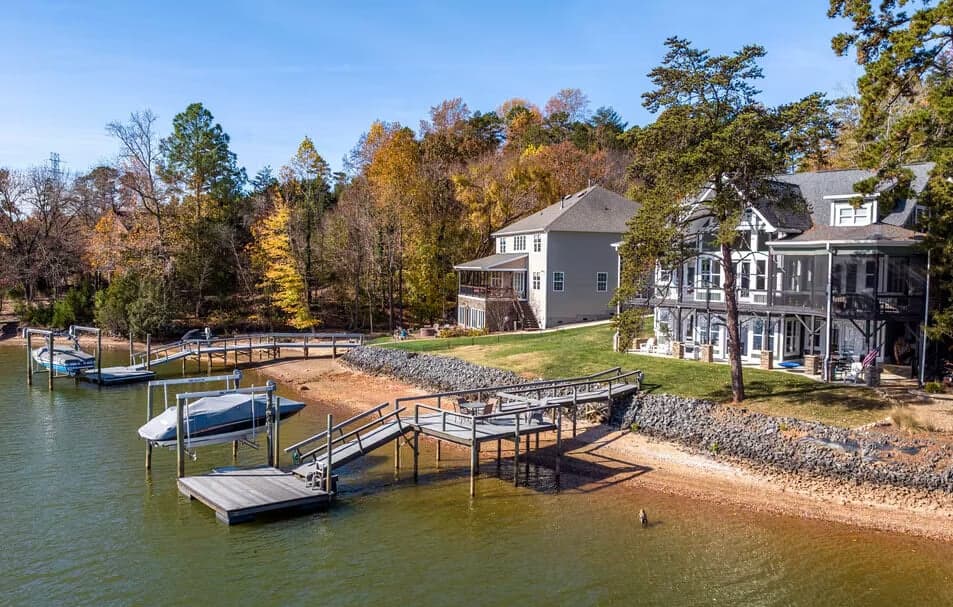
Tega Cay is a post-1900 planned community with no colonial or antebellum history. The land was originally part of the Catawba River floodplain, sparsely populated by small farms and summer fishing camps. The modern city was conceived in 1970 by the Ervin Company, which purchased 1,200 acres of lakefront property on Lake Wylie to build a private, gated resort community. The first wave of residents were primarily White retirees and second-home buyers from Charlotte and the Northeast, drawn by the promise of a secure, recreational lifestyle. These early settlers built the original Windjammer and Harbour Towne neighborhoods, which remain the city’s historic core—characterized by smaller lakefront cottages and a tight-knit, older demographic. The city incorporated in 1974, and for its first two decades, growth was slow and homogeneous, with the population hovering under 2,000 and almost entirely White.
Modern era (post-1965)
The post-1965 Hart-Cellar Act had little immediate effect on Tega Cay, as the city was not yet a significant destination for immigrants. The real demographic shift began in the late 1990s and accelerated after 2010, driven by two forces: the expansion of Charlotte’s financial and tech sectors, and the construction of new, larger homes that appealed to a more diverse, affluent buyer pool. The Glen at Tega Cay and Rivertree neighborhoods, built between 2000 and 2015, became the primary landing zones for domestic in-migrants—White and Black professionals from the Northeast and Midwest seeking lower taxes and better schools. Simultaneously, a distinct wave of Indian-subcontinent professionals (engineers, doctors, IT managers) began moving into Bayshore and the newer sections of Windjammer, drawn by the York County School District’s reputation and the city’s proximity to Charlotte’s corporate campuses. The Hispanic population (12.1%) is more dispersed, with many families living in the older, more affordable Harbour Towne apartments and townhomes, often working in construction, landscaping, and hospitality across the Lake Wylie area. The East/Southeast Asian community (0.6%) remains very small, concentrated in a handful of households in Rivertree.
The future
The population of Tega Cay is heading toward greater ethnic diversity but also increasing economic stratification. The Indian-subcontinent community (9.5%) is the fastest-growing ethnic group, driven by continued professional migration and chain migration from established families in Bayshore and Windjammer. This group is highly assimilated into the city’s school and civic life, with little evidence of tribalization into separate enclaves. The Hispanic population is plateauing, as rising home prices in Tega Cay push new arrivals toward cheaper areas in nearby Rock Hill and Fort Mill. The White majority is aging in place, particularly in the original Harbour Towne and Windjammer neighborhoods, while younger White families continue to buy in Glen at Tega Cay and Rivertree. Over the next 10–20 years, Tega Cay will likely become more homogenized in terms of income and education—the city’s high college-attainment rate and lack of affordable housing will filter out lower-income households of all backgrounds. The city is not tribalizing into ethnic enclaves; rather, it is becoming a single, high-amenity suburb where diversity is present but largely middle- to upper-middle-class.
For a conservative-leaning individual or family moving to Tega Cay now, the city offers a stable, safe, and increasingly diverse environment where traditional suburban values—good schools, low crime, lake access—are preserved, but the faces in the neighborhood are changing. The Indian-subcontinent and Hispanic communities are integrated into the fabric of the city, not isolated, and the overall trajectory is toward a more educated, more professional, and slightly more diverse population that still votes reliably Republican and prioritizes property rights and school quality above all else.

* Values derived from national, state, county, city and local statistics and may differ in a specific area. Last updated: 2026-10-10T16:29:09.000Z
Narrative content on this page is AI-generated and may contain mistakes. Verify any details that matter before acting on them.
ReloMaps may earn a commission from affiliate links at no extra cost to you.

