Photo: Wikipedia
Demographics of Temple, TX
Affluence Level in Temple, TX
A middle-class area roughly in line with national averages across income, home values, education, and employment.
People of Temple, TX
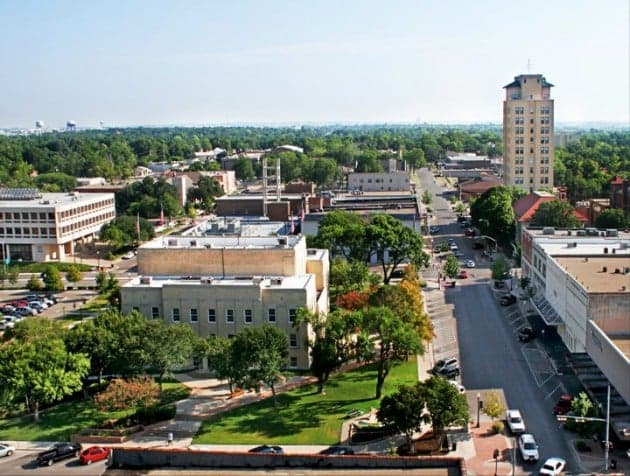
The people of Temple, Texas today form a community of 86,358 that is majority-minority and distinctly working-to-middle class, with a population that is 50.6% White, 29.1% Hispanic, 12.7% Black, 1.1% East/Southeast Asian, and 1.0% Indian (subcontinent). The city’s identity is shaped by its deep roots in railroad and medical employment, a relatively low foreign-born share of 4.6%, and a college attainment rate of 29.5% that trails the national average. Temple feels like a classic Central Texas crossroads town—proud of its Baylor Scott & White Medical Center anchor, culturally conservative, and increasingly diverse in its newer subdivisions.
How the city was settled and grew
Temple was founded in 1881 as a railroad town, platted by the Gulf, Colorado and Santa Fe Railway as a division point and repair shop. The original population was overwhelmingly Anglo-American, drawn from the rural South and Midwest by railroad jobs and the promise of cheap land. The city’s first major wave of non-White settlement came during the Great Migration (roughly 1910–1940), when Black families moved from East Texas cotton country to work on the railroad and in domestic service. They established the Lincoln Heights and East Temple neighborhoods east of the tracks, where the historic Dunbar School and several Black churches still anchor the community. A smaller wave of Mexican-origin laborers arrived in the 1910s and 1920s, working on railroad maintenance and in the growing cotton gins, settling in the North Temple area near the rail yards. By 1950, Temple was still about 80% White, with a Black population of roughly 15% and a Hispanic population under 5%.
Modern era (post-1965)
The post-1965 period brought two major shifts. First, the expansion of Baylor Scott & White Medical Center (now the city’s largest employer) drew a wave of professional in-migration from across Texas and the Midwest, mostly White and middle-class, who settled in the West Temple subdivisions like Lakewood Estates and Wildflower Ranch. Second, the Hart-Cellar Act and subsequent immigration waves increased Temple’s Hispanic population from about 5% in 1970 to 29.1% today. This growth came primarily from Mexican-American families moving from the Rio Grande Valley and from direct immigration from Mexico and Central America, who concentrated in the North Temple and South Temple neighborhoods near the industrial corridors. The Black population has remained relatively stable at 12.7%, with many families still in Lincoln Heights and East Temple, though some have moved to newer subdivisions in the Southwest Temple area. The East/Southeast Asian population (1.1%) and Indian population (1.0%) are small but growing, largely professionals recruited by the medical center and the nearby Fort Hood (now Fort Cavazos) military base, and they tend to settle in West Temple near the hospital. The foreign-born share of 4.6% is low by Texas standards, reflecting Temple’s character as a domestic-migration destination rather than a traditional immigrant gateway.
The future
Temple’s population is projected to continue growing at a moderate pace of 1–2% annually, driven by domestic migration from the Austin and Dallas-Fort Worth metros as housing costs push families outward. The Hispanic share is expected to rise to roughly 35–40% by 2040, while the White share will likely decline to the mid-40% range. The Black and Asian/Indian shares are expected to grow slowly, primarily through medical-sector recruitment. New development is concentrated in the West Temple and Southwest Temple master-planned communities, which are attracting a mix of White, Hispanic, and Asian families, while the older neighborhoods of North Temple and Lincoln Heights are seeing reinvestment but also some population loss. The city’s cultural identity is evolving from a historically Anglo railroad town into a more diverse, suburban-oriented community, though it remains politically conservative and family-focused. The low foreign-born share means that assimilation pressures are relatively mild, and English-dominant second-generation Hispanic families are common.
For someone moving in now, Temple offers a stable, affordable, and increasingly diverse community where the old railroad-town character is slowly giving way to a more suburban, medical-anchored economy. The population is becoming more Hispanic and more professional, but the city’s core identity—conservative, family-oriented, and rooted in healthcare and manufacturing—remains intact. New arrivals will find a place where neighborhoods are still fairly distinct by race and class, but where the newer subdivisions are more integrated than the historic core.

* Values derived from national, state, county, city and local statistics and may differ in a specific area. Last updated: 2026-07-20T01:55:26.000Z
Narrative content on this page is AI-generated and may contain mistakes. Verify any details that matter before acting on them.
ReloMaps may earn a commission from affiliate links at no extra cost to you.

