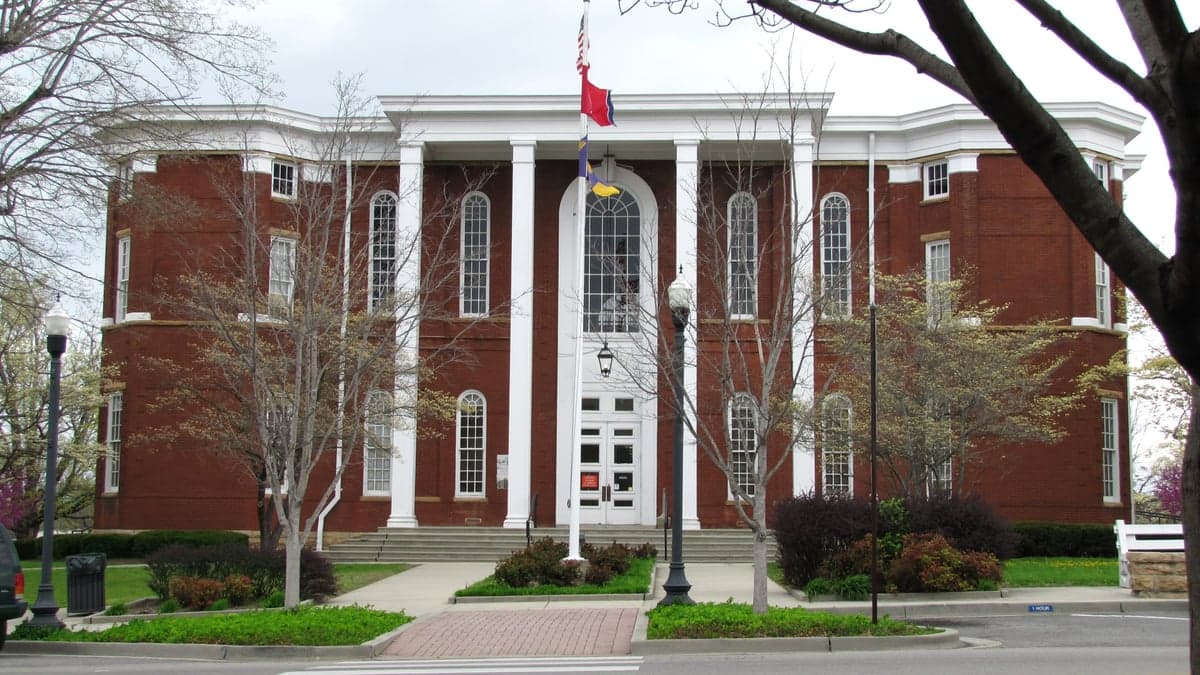
Photo: Wikipedia
Demographics of Putnam County
Affluence Level in Putnam County
A middle-class area roughly in line with national averages across income, home values, education, and employment.
People of Putnam County
Putnam County, Tennessee, is home to 81,366 residents who form a predominantly white (85.4%) and native-born (97.0%) population, with a growing Hispanic community (8.0%) that is reshaping parts of the county. The county’s identity is rooted in its Appalachian and Scots-Irish heritage, its role as a regional education and healthcare hub anchored by Tennessee Tech University in Cookeville, and a conservative social character that has been reinforced by steady domestic in-migration from other parts of Tennessee and the Midwest. Unlike many fast-growing Tennessee counties, Putnam’s population is not being transformed by international immigration but by a slow, organic expansion of its existing cultural base, with Cookeville serving as the demographic and economic center.
Settlement & growth (pre-1960)
Before European settlement, the area that is now Putnam County was part of the hunting grounds of the Cherokee and Creek nations, who used the upper Cumberland Plateau for seasonal travel and resource gathering. The region was not permanently inhabited by large Native villages due to its rugged terrain and thin soils, but the Cherokee maintained trails and temporary camps along the Calfkiller River and Falling Water River. European encroachment began in earnest after the Cherokee Removal of 1838, which opened the plateau to white settlement.
The first permanent settlers were overwhelmingly Scots-Irish and English migrants from Virginia, North Carolina, and East Tennessee, who arrived in the 1830s and 1840s. They were drawn by cheap land grants and the promise of subsistence farming in the isolated coves and valleys of the Cumberland Plateau. These early families—names like Bilbrey, Bohannon, and Maddux—settled along the Calfkiller River valley and in what would become Cookeville, Algood, and Baxter. The county was formally created in 1854 from parts of White, Overton, Jackson, and DeKalb counties, with Cookeville designated the county seat due to its central location.
After the Civil War, the population grew slowly through natural increase and continued migration from the Upper South. The arrival of the Tennessee Central Railroad in 1890 transformed Cookeville from a sleepy crossroads into a commercial center, attracting merchants, lawyers, and tradesmen. The railroad also brought a small number of German and Irish laborers who settled in Cookeville’s emerging working-class neighborhoods near the depot. By 1900, the county’s population had reached roughly 16,000, almost entirely native-born white Protestants with a small Black population (around 5%) descended from enslaved families who remained after emancipation.
The Great Depression and New Deal era brought federal projects that stabilized the rural economy, including the construction of Center Hill Dam (completed 1948) on the Caney Fork River, which created jobs and later spurred tourism. The most transformative event for Putnam County was the 1915 founding of Tennessee Polytechnic Institute (now Tennessee Tech University) in Cookeville. The university drew faculty and students from across the region, gradually shifting the county’s economic base from agriculture to education and services. By 1960, the population had reached 29,684, with Cookeville emerging as the dominant population center and the surrounding communities of Monterey, Algood, and Baxter remaining small farming and railroad towns.
Modern era (post-1965)
The 1965 Hart-Cellar Act had a minimal direct impact on Putnam County. Unlike Nashville or Memphis, the county did not attract significant post-1965 immigration from Asia, Africa, or Latin America. The foreign-born population today stands at just 3.0%, far below the national average. The most notable demographic shift since the 1970s has been domestic in-migration from other parts of Tennessee and the Rust Belt, particularly from Michigan, Ohio, and Illinois. Retirees and remote workers seeking lower costs and a slower pace have moved into subdivisions around Cookeville and along the Interstate 40 corridor, which bisects the county.
The Hispanic population, now 8.0% of the county, began growing in the 1990s as Mexican and Central American laborers were recruited for construction, poultry processing, and agricultural work. This community is concentrated in Cookeville, particularly in neighborhoods near the industrial parks and along West Broad Street, and in Algood, where several manufacturing plants operate. The Hispanic population is predominantly young and family-oriented, and its growth has been steady but not explosive, increasing from roughly 2% in 2000 to its current share. The Black population remains small at 2.4%, largely descended from historic families in Cookeville and Baxter, with no significant new migration from other regions. East/Southeast Asian residents (0.9%) and Indian-subcontinent residents (0.3%) are almost entirely associated with Tennessee Tech University—faculty, graduate students, and medical professionals at Cookeville Regional Medical Center—and live in university-adjacent neighborhoods in Cookeville.
Suburbanization has been modest compared to Middle Tennessee’s boom counties. Cookeville has expanded outward along Highway 111 and Interstate 40, absorbing former farmland into subdivisions and strip malls, but the county’s rural character remains intact outside the city limits. The college-educated share of the population is 29.2%, a figure driven by Tennessee Tech and the medical sector, but still below the national average. The county has not experienced the rapid racial diversification seen in Williamson or Rutherford counties; instead, it has remained culturally and politically conservative, with a population that is overwhelmingly native-born and English-speaking.
The future
Putnam County’s population is projected to continue growing slowly, reaching roughly 90,000 by 2035, driven by domestic migration from higher-cost states and natural increase among the existing population. The Hispanic community is likely to grow to 12-14% of the population over the next two decades, as younger families have higher birth rates and continued labor demand draws new arrivals. This growth will be concentrated in Cookeville and Algood, where existing enclaves provide social networks and employment. However, the county is not on a trajectory toward the kind of ethnic diversification seen in Nashville’s suburbs; the white, native-born majority will remain dominant, and the cultural identity of the county will continue to be shaped by its Appalachian and Southern roots.
The most significant demographic trend is the aging of the population, as retirees from the Midwest and Florida relocate to the Cookeville area for its lower cost of living and access to healthcare. This in-migration is reinforcing the county’s conservative political character and its demand for services like golf courses, medical clinics, and lakefront property on Center Hill Lake. The university will continue to attract a small, transient population of younger, more diverse residents, but they are unlikely to alter the county’s fundamental character. The county is not tribalizing into distinct ethnic enclaves; rather, it is slowly homogenizing around a white, native-born, conservative norm, with the Hispanic community gradually assimilating into that mainstream.
For someone moving to Putnam County today, the area offers a stable, culturally cohesive community where the population is growing modestly, the economy is anchored by education and healthcare, and the social fabric remains largely unchanged from its 19th-century Scots-Irish roots. The county is not becoming a melting pot or a multicultural hub—it is becoming a slightly more diverse version of what it has always been: a quiet, conservative, family-oriented part of the Upper Cumberland where newcomers are expected to adapt to the existing culture rather than transform it.

* Values derived from national, state, county, city and local statistics and may differ in a specific area. Last updated: 2026-05-12T12:18:18.000Z
Narrative content on this page is AI-generated and may contain mistakes. Verify any details that matter before acting on them.
ReloMaps may earn a commission from affiliate links at no extra cost to you.

