
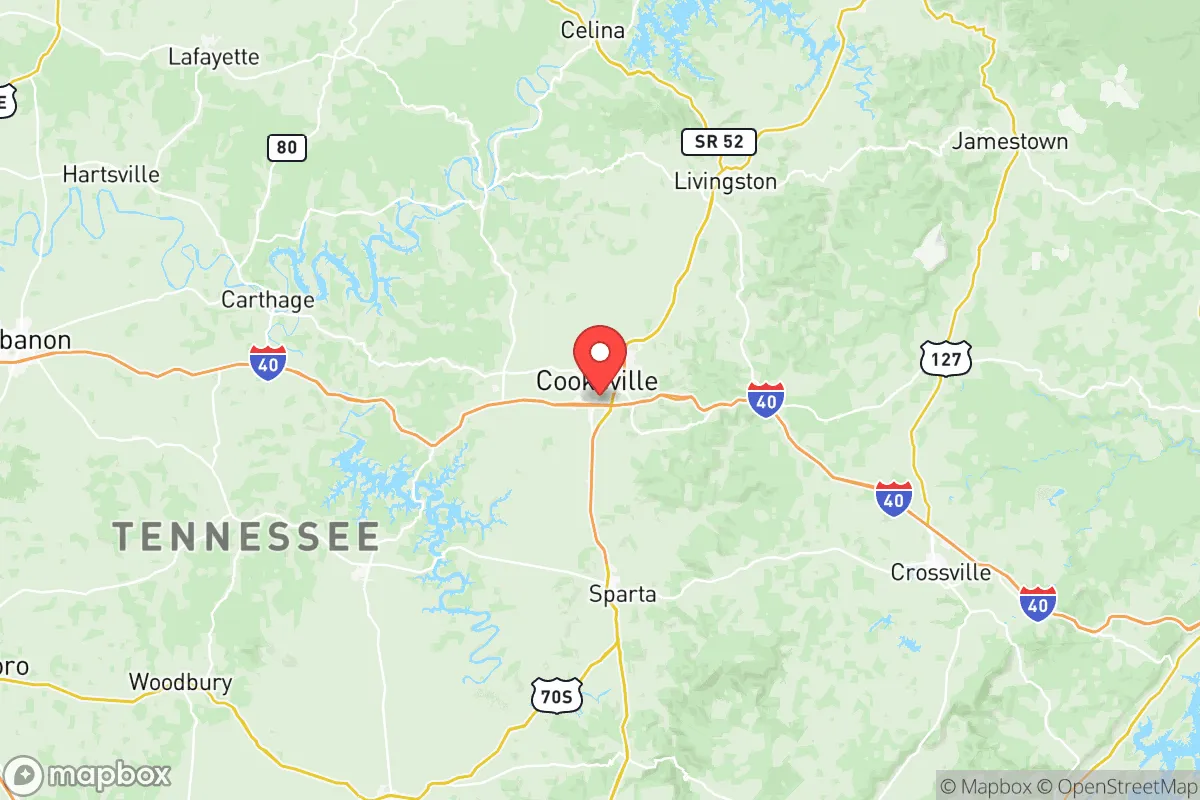
Photo: Wikipedia
Personal Sovereignty in Putnam County
Viable for self-reliance. Generally workable, though some barriers may limit total independence.
What does Personal Sovereignty tell us?
Personal Sovereignty measures your capacity for self-reliance and independence with minimal government friction. Higher scores mean fewer barriers between you and the way you want to live... but it assumes you have the space you need and good neighbors.
What does this tell us?
Personal Sovereignty measures your capacity for self-reliance and independence with minimal government friction. Higher scores mean fewer barriers between you and the way you want to live... but it assumes you have the space you need and good neighbors.
State Policy
Energy independence: Importer (25% of energy produced in-state)
Personal Liberty
Homesteading

Personal Liberty Analysis
Putnam County, Tennessee offers a sovereignty environment that stands in stark contrast to the creeping overreach seen in blue states and even some Tennessee cities. With no state income tax, constitutional carry, and rural townships where county commissioners still answer to neighbors rather than lobbyists, this is ground where personal autonomy isn't just tolerated—it's expected. For those watching the erosion of freedoms elsewhere, the Upper Cumberland region provides a working model of self-governance that remains largely intact, though vigilance is required to keep it that way.
How tax burden and regulatory climate compare to surrounding areas
Tennessee's lack of a state income tax is the foundation of personal financial sovereignty here, and Putnam County builds on that with a property tax rate that remains among the more reasonable in the region. The county's combined rate—county, school, and municipal—lands around $2.20 per $100 of assessed value in unincorporated areas, though that number ticks up inside Cookeville city limits where municipal services add roughly $0.40 more. Compare that to Nashville's metro rate pushing $3.50 or Knox County's $2.60, and the savings compound annually. The regulatory posture in Putnam County leans light: no county-wide zoning overlay in unincorporated areas means fewer hoops for building a shop, parking a trailer, or running a home-based business. Baxter and Monterey maintain minimal municipal codes focused on basic safety and sanitation, not aesthetic mandates or land-use experiments. The state's right-to-work law and absence of a state-level minimum wage above the federal floor further reduce the regulatory friction that chokes small operations in more controlled jurisdictions. For a prepper or homesteader, the takeaway is straightforward: fewer layers of government between you and your decisions mean more of your resources stay in your control.
Self-defense rights and gun law specifics in Putnam County
Tennessee's constitutional carry law, effective since 2021, means any law-abiding adult 21 or older can carry a handgun openly or concealed without a permit in Putnam County. The sheriff's office in Cookeville processes permits for those who want reciprocity with other states, but there is no mandate. The county has no local red-flag ordinance—Tennessee's state preemption statute prohibits municipalities from enacting their own gun control, so what you get in Algood is the same legal framework as Buffalo Valley. Stand-your-ground law is codified in state statute, with no duty to retreat in any place you are lawfully present. Private property rights extend to firearms: a landowner can prohibit carry on their land, but there is no requirement to post signage for that to be enforceable once you are notified. The practical reality in Putnam County is that gun ownership is the norm, not the exception. Ranges like the one at Center Hill Lake Wildlife Management Area and private clubs around Silver Point see regular use. For the survivalist mindset, the legal environment here removes the administrative burden that permit schemes impose elsewhere and affirms that self-defense is a right, not a privilege granted by the state.
Homesteading viability, lot sizes, and off-grid feasibility across the county
Putnam County's land-use landscape varies significantly depending on where you plant your flag, and that variation matters for anyone serious about self-reliance. Unincorporated areas—think Bloomington Springs, Buffalo Valley, and the rural stretches around Baxter—have no minimum lot size for agricultural use, meaning you can find parcels from 1 to 100 acres without subdivision approval eating your timeline. The county's zoning resolution exempts agricultural structures from building permits, so a barn, chicken coop, or greenhouse goes up on your timeline, not the government's. Off-grid feasibility is high in these areas: rainwater catchment is legal and common, composting toilets are permitted under state guidelines for rural properties without sewer access, and solar panel installation faces no county-level permitting hurdles beyond basic electrical safety. Monterey, sitting at a higher elevation on the Cumberland Plateau, offers well water that runs deep and cool, with many existing homesteads already running on solar-battery setups. Inside Cookeville city limits, the calculus shifts: minimum lot sizes of 6,000 square feet in residential zones, building permits required for any structure over 120 square feet, and city water/sewer hookup mandates that complicate true off-grid living. The strategic move for the prepper is to buy outside municipal boundaries—within a 15-minute drive of Cookeville's grocery stores and hardware suppliers—where county oversight is minimal and self-sufficiency is a practical daily reality.
Personal liberties landscape: parental rights, medical autonomy, speech, and property
Tennessee has moved aggressively in recent years to codify parental rights, and Putnam County's school board and local government reflect that shift. The state's Parental Bill of Rights gives parents explicit authority over their children's education, healthcare, and religious upbringing, with no local ordinances in Putnam County attempting to undermine it. Medical autonomy is a live issue: Tennessee has no state-level vaccine mandate for adults, and the county health department in Cookeville does not enforce mandates beyond federal requirements for certain travel-related immunizations. The state's shield laws protect healthcare providers who decline to participate in procedures they object to on conscience grounds, and there is no county-level interference with that protection. Free speech is robust—Putnam County has no local hate speech ordinances or content-based restrictions beyond the state's existing defamation and incitement statutes. Property rights are protected by Tennessee's Private Property Protection Act, which requires government to compensate landowners for any regulatory taking that reduces property value by more than 20 percent. The county commission has not pursued the kind of land-use overreach seen in more urban Tennessee counties. For the parent or individual watching federal overreach expand, the local posture in Putnam County—from Algood to Monterey—is one of deference to the individual and the family, not the state.
Compared to the regulatory density of Nashville, the tax burden of New York or California, or the gun restrictions of Illinois or Colorado, Putnam County ranks as a stronghold of personal sovereignty in the Southeast. The county's combination of no income tax, constitutional carry, minimal rural zoning, and state-level parental rights protections creates a legal environment where self-reliance is not just possible but structurally encouraged. The threats to that sovereignty are national—federal overreach, monetary policy, and cultural shifts—but the local foundation in Putnam County gives the individual a fighting chance to build a life on their own terms. For the strategic relocator with a survivalist lens, this is ground worth serious consideration.

* Values derived from national, state, county, city and local statistics and may differ in a specific area. Last updated: 2026-05-12T12:18:18.000Z
Narrative content on this page is AI-generated and may contain mistakes. Verify any details that matter before acting on them.
ReloMaps may earn a commission from affiliate links at no extra cost to you.

