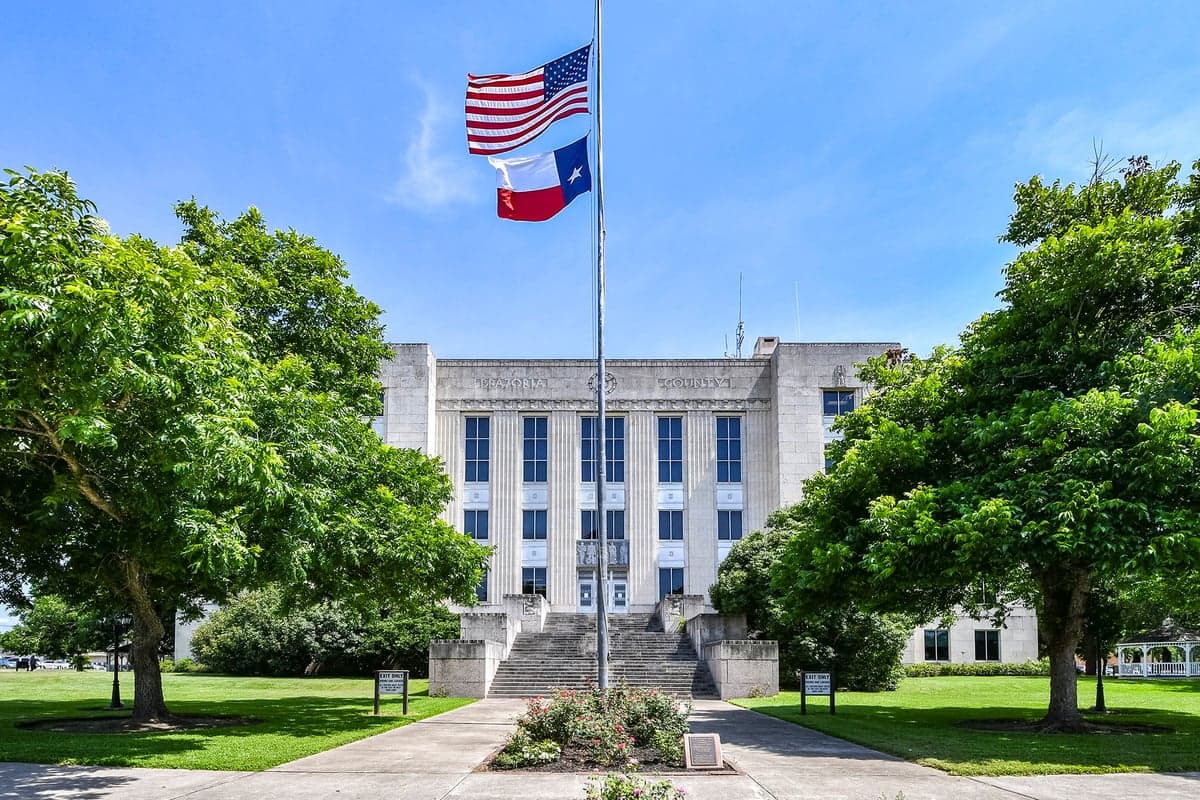
Photo: Wikipedia
Demographics of Brazoria County
Affluence Level in Brazoria County
A middle-class area roughly in line with national averages across income, home values, education, and employment.
People of Brazoria County
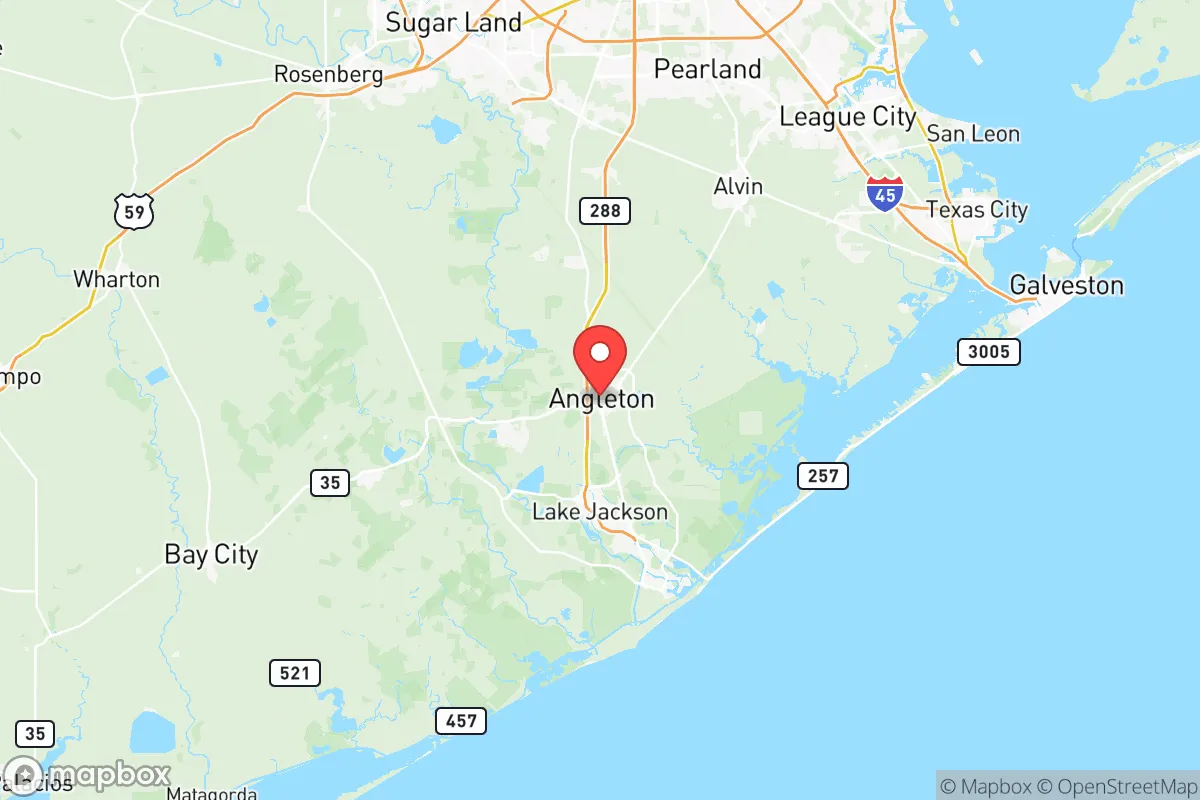
Brazoria County’s 381,650 residents form a diverse, fast-growing population anchored by the petrochemical corridor along the Gulf Coast and the suburban spillover from Houston. The county is 42.9% White, 31.4% Hispanic, 15.5% Black, 5.1% East/Southeast Asian, and 2.2% Indian, with a foreign-born share of just 6.4% — lower than the national average. Its identity is shaped by a deep-rooted ranching and plantation history, a strong blue-collar industrial workforce, and a recent wave of white-collar professionals moving into master-planned communities like those in Pearland and Sienna Plantation.
Settlement & growth (pre-1960)
Long before European arrival, the Karankawa people inhabited the coastal prairies and bays of what is now Brazoria County, living a nomadic hunter-gatherer lifestyle along the Brazos River. Spanish explorers made contact in the 16th century, but sustained colonization did not begin until the 1820s, when Stephen F. Austin’s Old Three Hundred colonists — primarily Anglo-Americans from the U.S. South — received land grants along the Brazos and San Bernard rivers. These early settlers founded the towns of Columbia (now West Columbia) and Brazoria, establishing cotton plantations worked by enslaved African Americans. By the 1830s, the region was the political and economic heart of the Texas Republic; Columbia served as the republic’s first capital in 1836.
After the Civil War and emancipation, many freed Black families remained in the county as sharecroppers and tenant farmers, forming communities like Angleton and Velasco. The late 19th century brought a second wave: German and Czech immigrants, drawn by railroad construction and agricultural opportunities, settled in Alvin and Danbury, where their descendants remain today. The discovery of oil at Spindletop in 1901 transformed the county’s economy. Boomtowns like Freeport and Clute sprang up to house refinery and chemical plant workers, drawing a mix of Anglo migrants from East Texas and the Deep South, as well as Mexican laborers who built the region’s first substantial Hispanic community. The Great Depression and Dust Bowl pushed additional Anglo and Black families from rural Oklahoma and Arkansas into the county’s growing industrial towns.
World War II accelerated the petrochemical build-out, with Dow Chemical expanding its Freeport operations dramatically. This brought a steady stream of engineers and skilled tradesmen from across the country, but the county remained overwhelmingly Anglo and Black through the 1950s. By 1960, Brazoria County’s population stood at roughly 76,000 — still small, but already anchored by the industrial corridor from Texas City (just over the county line) to Freeport.
Modern era (post-1965)
The 1965 Hart-Cellar Act, combined with the Sun Belt migration that accelerated after the 1970s oil crisis, reshaped Brazoria County’s demographics. The most visible change has been the growth of the Hispanic population, which rose from under 10% in 1970 to 31.4% today. This wave came primarily from Mexico and Central America, drawn by construction, refinery maintenance, and service jobs. Hispanic settlement is concentrated in Pearland’s older neighborhoods, Alvin, and the Freeport-Clute corridor, where bilingual signage and Mexican grocery stores are common.
The county’s Black population, historically centered in Angleton and the rural Brazos bottoms, has grown more suburban. Pearland — now the county’s largest city — has become a magnet for upwardly mobile Black professionals leaving Houston for newer housing and better schools, giving the city a Black population share near 20%. The East/Southeast Asian community (5.1%) is a more recent arrival, largely post-1990, with Vietnamese and Chinese families settling in Pearland and the Sienna Plantation area, drawn by the same suburban pull and by tech and medical jobs in the Texas Medical Center, a 30-minute commute away. The Indian community (2.2%) is even newer, clustering in Pearland’s master-planned subdivisions, where Indian grocery stores and temples have opened in the last decade.
Domestic migration has been the dominant driver of growth. Since 2000, the county has added over 150,000 residents, most of them Anglos and Asians moving from California, the Northeast, and other parts of Texas. The suburban build-out of Pearland, Manvel, and Rosharon has created a classic Sun Belt landscape: cul-de-sacs, megachurches, and strip malls, with a population that is more college-educated (32.1%) and white-collar than the county’s industrial core. Meanwhile, the older industrial towns of Freeport, Clute, and Lake Jackson have seen slower growth and a higher concentration of blue-collar and Hispanic residents.
The future
Brazoria County is moving toward a tripartite demographic structure. The northern suburbs — Pearland, Manvel, and the Sienna Plantation area — will continue to diversify, attracting Asian and Indian professionals alongside Anglos and Blacks, creating a multiethnic, middle-to-upper-middle-class corridor. The southern industrial zone (Freeport, Clute, Lake Jackson) will likely remain majority Hispanic and Anglo working-class, with slower growth and an aging housing stock. The rural interior — Angleton, West Columbia, Danbury — will see gradual Hispanic in-migration but retain a strong Anglo and Black rural identity.
The Hispanic population is projected to approach 40% by 2040, driven by both immigration and higher birth rates. The East/Southeast Asian and Indian communities are growing from a small base but are highly concentrated in Pearland, where they are already reshaping local schools and commerce. The White share will continue to decline as a percentage, but the county is not experiencing white flight; rather, Anglo in-migration from other states is keeping the absolute number of White residents stable. The county is not tribalizing into hostile enclaves — the master-planned suburbs are genuinely integrated by income and education — but distinct cultural zones are emerging: Vietnamese strip malls in Pearland, Mexican bakeries in Alvin, Black churches in Angleton.
For a newcomer, Brazoria County offers a choice. The northern suburbs provide a diverse, amenity-rich environment with strong schools and a Houston commute. The southern industrial towns offer lower housing costs and a more traditional Gulf Coast culture. The rural interior remains quiet and conservative. The county as a whole is absorbing its demographic change without the sharp polarization seen in some urban counties, largely because economic growth has been steady enough to keep housing affordable and jobs plentiful. The next decade will see continued suburban expansion, a gradual greening of the electorate, and a slow blending of the county’s Anglo, Black, and Hispanic traditions into a distinct Gulf Coast identity.

* Values derived from national, state, county, city and local statistics and may differ in a specific area. Last updated: 2026-05-28T00:46:39.000Z
Narrative content on this page is AI-generated and may contain mistakes. Verify any details that matter before acting on them.
ReloMaps may earn a commission from affiliate links at no extra cost to you.

