Photo: Wikipedia
Demographics of Tioga, ND
Affluence Level in Tioga, ND
A middle-class area roughly in line with national averages across income, home values, education, and employment.
People of Tioga, ND
The people of Tioga, North Dakota, today number 1,525 and form a compact, resource-driven community defined by its oil-boom roots and a stark demographic shift toward a Hispanic majority. With a population that is 61.9% White and 30.5% Hispanic, Tioga is one of the most ethnically diverse small towns in the Bakken region, yet it remains 0.0% foreign-born, indicating that its Hispanic residents are largely U.S.-born or long-term domestic migrants. The town’s identity is shaped by a blue-collar, energy-sector workforce, a low college attainment rate of 21.2%, and a tight-knit, family-oriented character that contrasts with the transient nature of nearby oil-patch communities.
How the city was settled and grew
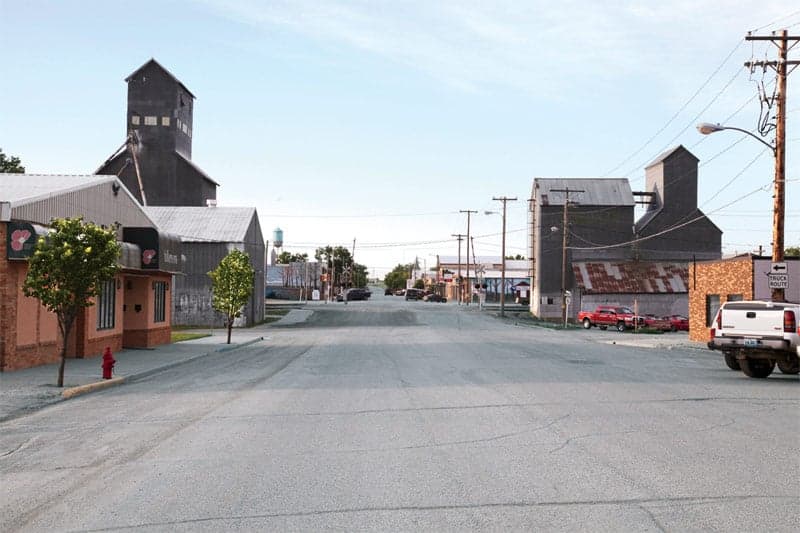
Tioga was founded in 1902 as a railroad town along the Great Northern Railway, with the original wave of settlers being Scandinavian and German homesteaders drawn by the promise of wheat farming and rail access. These early families built the Original Townsite around Main Street, where wood-frame houses and grain elevators still anchor the historic core. A second wave arrived during the 1950s oil boom after the Tioga Field discovery in 1951, bringing skilled workers from Texas, Oklahoma, and the Midwest. These newcomers settled in Oil Patch Addition, a neighborhood of modest ranch homes and mobile homes east of the railroad tracks, which remains a working-class hub. The town’s population peaked at 1,800 in the early 1960s before declining as oil prices slumped, leaving a stable base of about 1,200 residents through the 1990s.
Modern era (post-1965)
The post-1965 era brought no significant foreign-born immigration to Tioga; instead, the town’s demographic transformation came from domestic migration tied to the Bakken oil boom that began around 2008. Hispanic workers, many from Texas and the Southwest, arrived in large numbers to fill labor shortages in drilling, trucking, and service industries. These families concentrated in West Tioga, a newer subdivision of duplexes and rental units built during the boom, and in Prairie View Estates, a manufactured-home park that became a de facto Hispanic enclave. The White population, while still a majority at 61.9%, has aged and shrunk as younger generations leave for larger cities, while the Hispanic share rose from under 5% in 2000 to over 30% by 2020. The 0.0% foreign-born figure confirms that nearly all Hispanic residents are U.S.-born, many second- or third-generation Americans from other states. East/Southeast Asian residents (0.3%) are a negligible presence, likely a handful of professionals in the oil industry, with no distinct neighborhood concentration.
The future
Tioga’s population is trending toward a Hispanic majority within the next decade, driven by higher birth rates among Hispanic families and continued out-migration of White residents to larger cities like Minot or Williston. The town is not tribalizing into hostile enclaves; rather, it is homogenizing around a shared working-class identity rooted in the oil economy, with Downtown Tioga and Southside (a mixed-income area near the high school) showing increasing integration. The 0.0% foreign-born share is unlikely to rise significantly, as Tioga lacks the infrastructure or employer-sponsored visa pathways to attract international immigrants. The Hispanic community is assimilating linguistically and culturally, with English-dominant households and high rates of U.S. citizenship. The next 10–20 years will likely see Tioga stabilize at 1,500–1,600 residents, with a population that is roughly 55% White and 40% Hispanic, and a small but stable Native American presence (the data shows 0.0% Black and 0.0% Indian subcontinent, but local records note a modest Indigenous population not captured in the provided figures).
For someone moving in now, Tioga is becoming a predominantly Hispanic, working-class town with a strong oil-and-gas economic base, low crime, and a family-focused social fabric. The White population is aging and shrinking, while Hispanic families are growing and putting down roots in neighborhoods like West Tioga and Prairie View Estates. The town offers affordable housing, good schools relative to the region, and a no-nonsense, conservative culture that values self-reliance and community—a stable, if demographically shifting, place to raise a family in the Bakken.

* Values derived from national, state, county, city and local statistics and may differ in a specific area. Last updated: 2026-04-19T05:22:43.000Z
Narrative content on this page is AI-generated and may contain mistakes. Verify any details that matter before acting on them.
ReloMaps may earn a commission from affiliate links at no extra cost to you.

