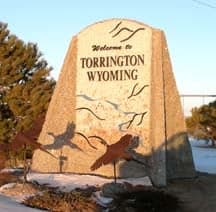
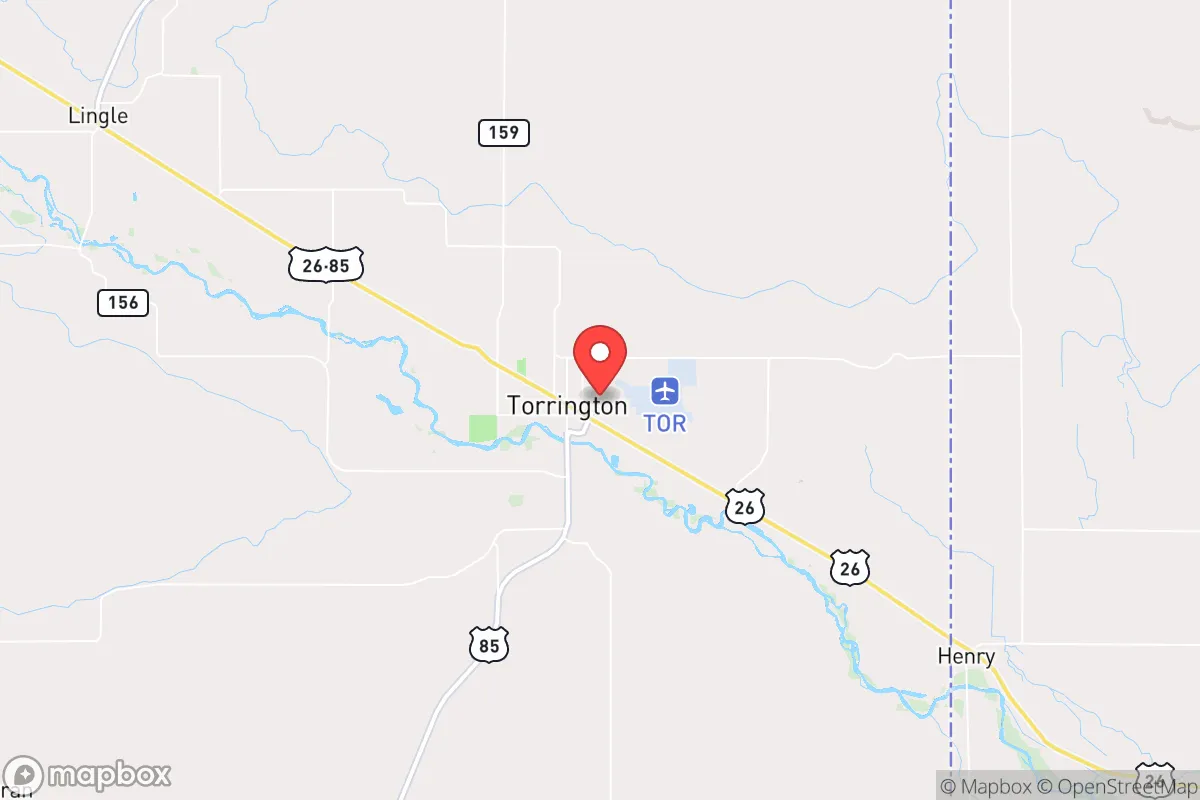
Photo: Wikipedia
Demographics of Torrington, WY
Affluence Level in Torrington, WY
A below-average socioeconomic profile. Incomes, home values, and educational attainment trail the U.S., with higher poverty and unemployment.
People of Torrington, WY
The people of Torrington, Wyoming, today number 6,174, forming a predominantly white (76.9%) and notably Hispanic (16.2%) community in the state’s eastern agricultural belt. The city is characterized by a low foreign-born population of just 1.5% and a modest college attainment rate of 20.3%, reflecting its roots as a working-class railroad and farming hub. Distinctive identity markers include a strong sense of local independence, a visible Hispanic presence concentrated in the older central districts, and a population that remains overwhelmingly native-born and culturally conservative.
How the city was settled and grew
Torrington was founded in 1900 as a railroad town on the Burlington and Missouri River Railroad line, replacing the earlier settlement of Rock Creek. The original population was drawn by the promise of irrigated agriculture following the construction of the Fort Laramie Canal, which opened the North Platte River valley to homesteaders. The first wave of settlers were predominantly Anglo-American homesteaders from the Midwest and Great Plains, who built the initial core around Main Street and the railroad depot. A second, smaller wave arrived in the 1910s and 1920s, composed of German-Russian immigrants fleeing conscription and land shortages in the Russian Empire. These families settled in what became known as the South Side district, south of the railroad tracks, where they established small farms and truck gardens. The city’s growth plateaued after the Dust Bowl and Great Depression, with the population hovering around 3,000 through the 1940s. The post-World War II era brought a modest influx of returning veterans and their families, who expanded into the West Torrington neighborhood, a grid of single-family homes built on former farmland west of Main Street.
Modern era (post-1965)
The most significant demographic shift in Torrington’s modern era began in the 1970s and accelerated through the 1990s, driven by the expansion of the local sugar beet industry and meatpacking plants in nearby communities. Hispanic workers, primarily of Mexican descent, were recruited to fill agricultural labor shortages, and many settled permanently in Torrington. This population concentrated in the East Torrington neighborhood, east of Main Street and south of the railroad, where older, more affordable housing stock and proximity to agricultural jobs created a distinct Hispanic enclave. By the 2020 census, the Hispanic share had reached 16.2%, while the white share declined to 76.9%. The foreign-born population, however, remained low at 1.5%, indicating that most Hispanic residents are U.S.-born citizens or long-term legal residents. The Black population (1.2%) and East/Southeast Asian population (0.0%) are negligible, and there is no measurable Indian subcontinent community. The North Torrington neighborhood, developed in the 1980s and 1990s with larger lots and newer homes, remains overwhelmingly white and is the preferred area for families moving in from rural Goshen County or out-of-state retirees.
The future
Torrington’s population is projected to remain stable or grow slowly, with the Hispanic share likely continuing to rise through natural increase rather than new immigration. The city is not homogenizing into a single identity; instead, it is tribalizing into distinct residential zones: the white, older, and more affluent North Torrington and West Torrington neighborhoods versus the younger, more Hispanic East Torrington and South Side districts. The immigrant community is plateauing, as the agricultural labor demand has stabilized and the foreign-born share is already very low. Assimilation is occurring gradually, with second- and third-generation Hispanic residents moving into the broader workforce and attending local schools, but residential clustering persists. Over the next 10–20 years, Torrington will likely become slightly more Hispanic (approaching 20–22%) and slightly less white, while remaining a low-diversity, low-immigration community by national standards. The college-educated share may inch upward as remote work and regional healthcare jobs grow, but the city will retain its working-class character.
For someone moving in now, Torrington is becoming a place where two distinct communities—a white, native-born majority and a Hispanic, largely native-born minority—coexist with minimal friction but also minimal integration. The city offers low crime, affordable housing, and a conservative social environment, but newcomers should expect a population that is culturally homogeneous in its values even as its ethnic composition gradually shifts. The best bet for a family seeking a traditional small-town Wyoming experience is the North Torrington or West Torrington neighborhoods, while those comfortable with a more diverse, working-class setting will find the East Torrington area more affordable and community-oriented.

* Values derived from national, state, county, city and local statistics and may differ in a specific area. Last updated: 2026-04-21T19:46:50.000Z
Narrative content on this page is AI-generated and may contain mistakes. Verify any details that matter before acting on them.
ReloMaps may earn a commission from affiliate links at no extra cost to you.

