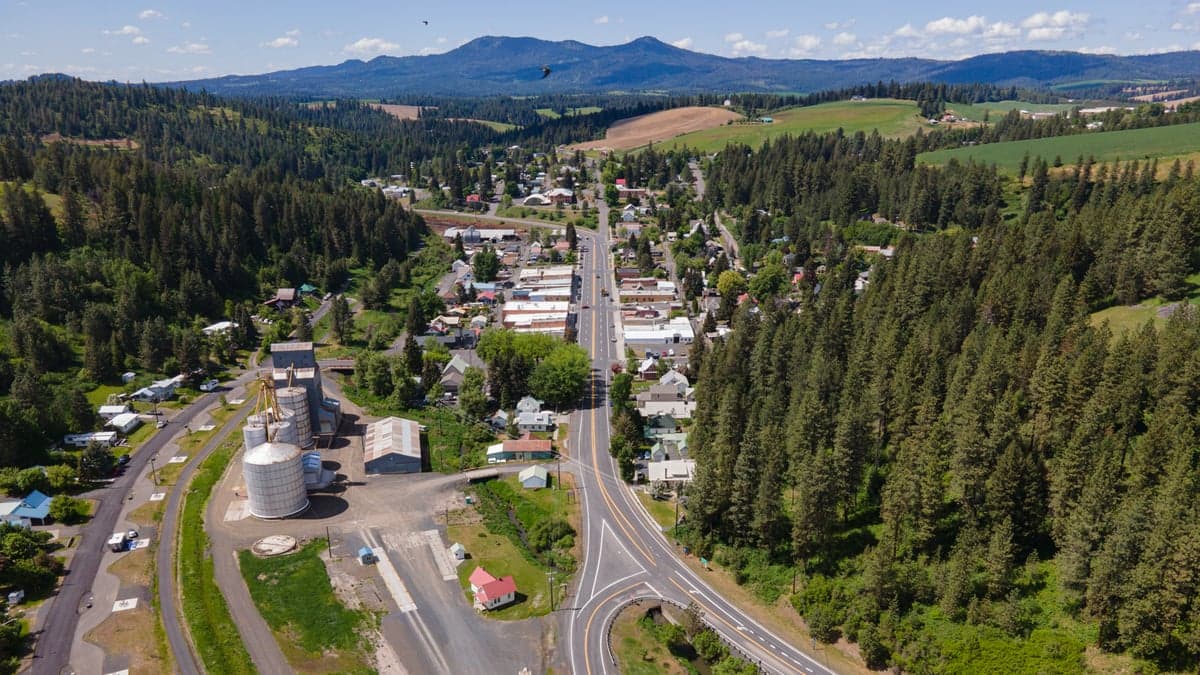
Photo: Wikipedia
Demographics of Troy, ID
Affluence Level in Troy, ID
A middle-class area roughly in line with national averages across income, home values, education, and employment.
People of Troy, ID
The people of Troy, Idaho, today number just 908 residents, forming a tight-knit, predominantly white community with a strong agricultural and educational identity. The city’s character is defined by its role as a rural service hub for the surrounding Palouse farmlands and its proximity to the University of Idaho in Moscow, which draws a modest share of college-educated residents (33.7%). With a foreign-born population of only 0.3% and a Hispanic share of 3.6%, Troy remains one of the least ethnically diverse towns in Latah County, a place where generational roots run deep and newcomers are often drawn by affordable land, small-town safety, and a conservative-leaning lifestyle.
How the city was settled and grew
Troy’s founding population arrived in the 1870s, drawn by the promise of fertile, rolling hills for wheat farming and the construction of the Northern Pacific Railroad. The original settlers were predominantly white homesteaders of Northern European descent—mostly German, English, and Scandinavian families—who established farms along the Potlatch River valley. The town was officially platted in 1882, and the Downtown Troy Historic District (centered on Main and Second Streets) became the commercial and social heart, housing the grain elevators, general stores, and the Troy Bank that served the surrounding agricultural community. A second wave of settlement came in the early 1900s with the expansion of the railroad and the timber industry, drawing workers to the Mill District along the river, where a sawmill and planing mill operated until the mid-20th century. The South Hill neighborhood, with its larger Victorian and Craftsman homes, was built by the town’s merchant class and farm owners, while the North End (north of Highway 8) housed railroad workers and mill hands in smaller cottages. By 1950, Troy’s population had stabilized around 700, with virtually no non-white residents—a pattern that held for decades.
Modern era (post-1965)
After the 1965 Hart-Cellar Act, Troy saw negligible immigration-driven change, unlike larger Idaho cities. The town’s population grew slowly, from 750 in 1970 to 908 today, driven almost entirely by domestic in-migration—primarily white families from California, Oregon, and Washington seeking lower housing costs and a rural lifestyle. The Mountain View Estates subdivision, developed in the 1990s on the eastern edge of town, absorbed most of these newcomers, offering larger lots and modern homes that appealed to remote workers and retirees. The West Side (along Highway 8 toward Moscow) saw infill development of duplexes and starter homes, attracting younger families priced out of Moscow’s housing market. The Hispanic population, now 3.6%, is a recent arrival, concentrated in the Riverbend area near the old mill site, where seasonal agricultural workers found rental housing. Troy’s East/Southeast Asian and Indian populations remain at 0.0%, reflecting the town’s lack of the tech-sector or university-adjacent diversity seen in Moscow or Pullman. The college-educated share (33.7%) is notably higher than the Idaho rural average, driven by commuters to the University of Idaho and Washington State University, but the town’s cultural identity remains firmly rooted in its agricultural and blue-collar heritage.
The future
Troy’s population is projected to grow modestly—perhaps to 1,100–1,200 by 2040—as spillover from Moscow’s housing crunch continues. The East Ridge area, currently undeveloped pastureland, is zoned for a 50-lot subdivision that will likely attract more white, middle-class families from out of state. The Hispanic share may rise to 5–7% as agricultural labor demand persists, but the town is unlikely to see significant Asian or Indian in-migration without a major employer shift. The population is becoming slightly more diverse in Hispanic representation, but the overall character will remain overwhelmingly white and conservative. The Downtown Historic District is seeing a slow revival of small businesses (a brewery, a coffee shop), which may attract younger, college-educated residents, but the town lacks the rental stock or cultural amenities to draw significant non-white populations. The cultural identity is evolving from purely agricultural to a blend of farming families and remote-work professionals, but the conservative social fabric—low crime, strong churches, and a focus on local schools—will likely persist.
For someone moving in now, Troy offers a stable, affordable, and safe rural community where the population is slowly diversifying in Hispanic representation but remains overwhelmingly white and conservative. The town’s future is one of gradual, managed growth—more families, more commuters, and a slightly broader economic base—but not a fundamental shift in its demographic or cultural identity. New arrivals will find a place where neighbors know each other, the pace is slow, and the values are traditional.

* Values derived from national, state, county, city and local statistics and may differ in a specific area. Last updated: 2026-07-30T14:47:14.000Z
Narrative content on this page is AI-generated and may contain mistakes. Verify any details that matter before acting on them.
ReloMaps may earn a commission from affiliate links at no extra cost to you.

