
Photo: Wikipedia
Demographics of Tupelo, MS
Affluence Level in Tupelo, MS
A middle-class area roughly in line with national averages across income, home values, education, and employment.
People of Tupelo, MS
The people of Tupelo, Mississippi today number 37,825, forming a community defined by its deep-rooted Southern identity and a demographic profile that is majority-white (52.2%) with a substantial Black minority (38.2%). The city is notably less diverse than the national average, with a foreign-born population of just 2.2% and small Hispanic (4.6%), East/Southeast Asian (0.7%), and Indian subcontinent (0.4%) communities. Tupelo’s population is characterized by a strong sense of place, a relatively high college attainment rate of 35.1%, and a cultural identity still shaped by its origin as a railroad town and the birthplace of Elvis Presley.
How the city was settled and grew
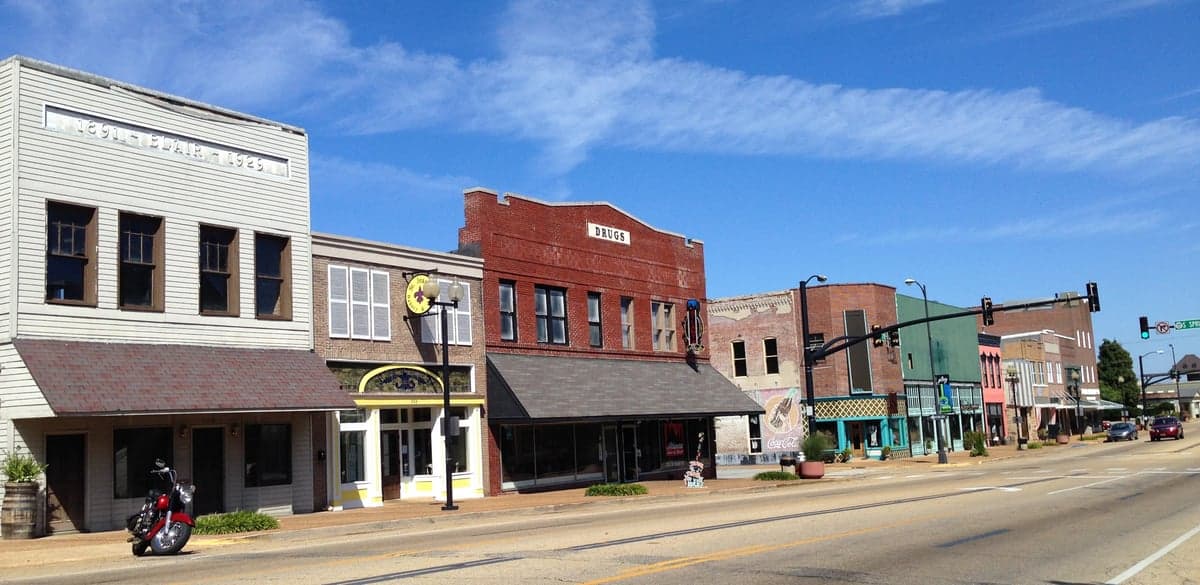
Tupelo was founded in the 1860s as a railroad junction, not as an antebellum plantation settlement. The original population was drawn by the Mobile and Ohio Railroad, which established a depot and repair shops here, creating the city’s first economic base. The earliest white settlers were largely Anglo-American farmers and merchants from the surrounding hill country, who built homes in what is now the Downtown Tupelo Historic District, centered around Main Street and Broadway. By the early 20th century, the railroad’s expansion brought a second wave: Black laborers and sharecroppers from rural Lee County and neighboring counties, who settled in the Shakerag and Happy Trails neighborhoods, historically the city’s primary African American enclaves. The 1930s and 1940s saw the rise of the furniture manufacturing industry, which attracted additional white and Black workers from the region, expanding residential areas like North Tupelo and West Tupelo. The city’s population grew steadily through the mid-20th century, reaching roughly 20,000 by 1960, with the railroad and furniture factories anchoring the economy and the social order remaining largely segregated.
Modern era (post-1965)
The post-1965 period brought significant demographic shifts, driven by the Civil Rights Movement and the decline of the railroad industry. The 1970s and 1980s saw a gradual suburbanization of the white population, who moved to newer subdivisions like Briarwood and Lake Hills in the city’s eastern and southern fringes, while the Black population remained concentrated in the older central neighborhoods of Shakerag and South Tupelo. The furniture industry’s peak in the 1980s and 1990s attracted a small number of Hispanic workers, primarily from Mexico and Central America, who settled in the West Main Street corridor and parts of South Tupelo. However, the foreign-born population has never exceeded 3%, and the city’s demographic story is overwhelmingly one of domestic migration. The 2000s and 2010s saw a modest influx of white retirees and remote workers drawn by the low cost of living and the presence of the North Mississippi Medical Center, a major employer. The Black population share has remained stable at around 38-40% since 1990, while the white share has declined slightly from 60% to 52%, largely due to an aging white population and out-migration of younger whites to larger metro areas. The East/Southeast Asian and Indian communities remain tiny, with no distinct ethnic enclaves, and are largely composed of professionals employed at the medical center or the Toyota plant in nearby Blue Springs.
The future
The population of Tupelo is heading toward a slow homogenization, with the white and Black populations both aging and the small Hispanic and Asian communities plateauing rather than growing rapidly. The city’s foreign-born share is unlikely to rise significantly, as Tupelo lacks the large immigrant-employing industries (e.g., meatpacking, agriculture) that drive growth in other Southern towns. The next 10-20 years will likely see continued suburbanization of the white population into the eastern and southern edges, while the central city neighborhoods—Shakerag, South Tupelo, and parts of Downtown—will remain predominantly Black. The Hispanic population may grow modestly through natural increase but will not form a large enclave. The city’s overall population is projected to remain flat or grow slowly, as out-migration of young adults to larger cities offsets any in-migration. The college-educated share may rise slightly as the medical center and Toyota attract more professionals, but Tupelo will remain a predominantly native-born, Southern city with a stable biracial character.
For someone moving in now, Tupelo offers a community that is culturally cohesive, politically conservative, and economically stable, but with limited ethnic diversity. The city is becoming more residentially stratified by income and race, with newer subdivisions on the east side attracting white families and older neighborhoods in the west and south remaining Black. The small Hispanic and Asian populations are integrated into the broader community without forming distinct enclaves. A new resident should expect a place where social networks are strong, but where the demographic future is one of slow, incremental change rather than rapid transformation.

* Values derived from national, state, county, city and local statistics and may differ in a specific area. Last updated: 2026-04-19T05:39:01.000Z
Narrative content on this page is AI-generated and may contain mistakes. Verify any details that matter before acting on them.
ReloMaps may earn a commission from affiliate links at no extra cost to you.

