Photo: Wikipedia
Demographics of Union City, NJ
Affluence Level in Union City, NJ
A middle-class area roughly in line with national averages across income, home values, education, and employment.
People of Union City, NJ
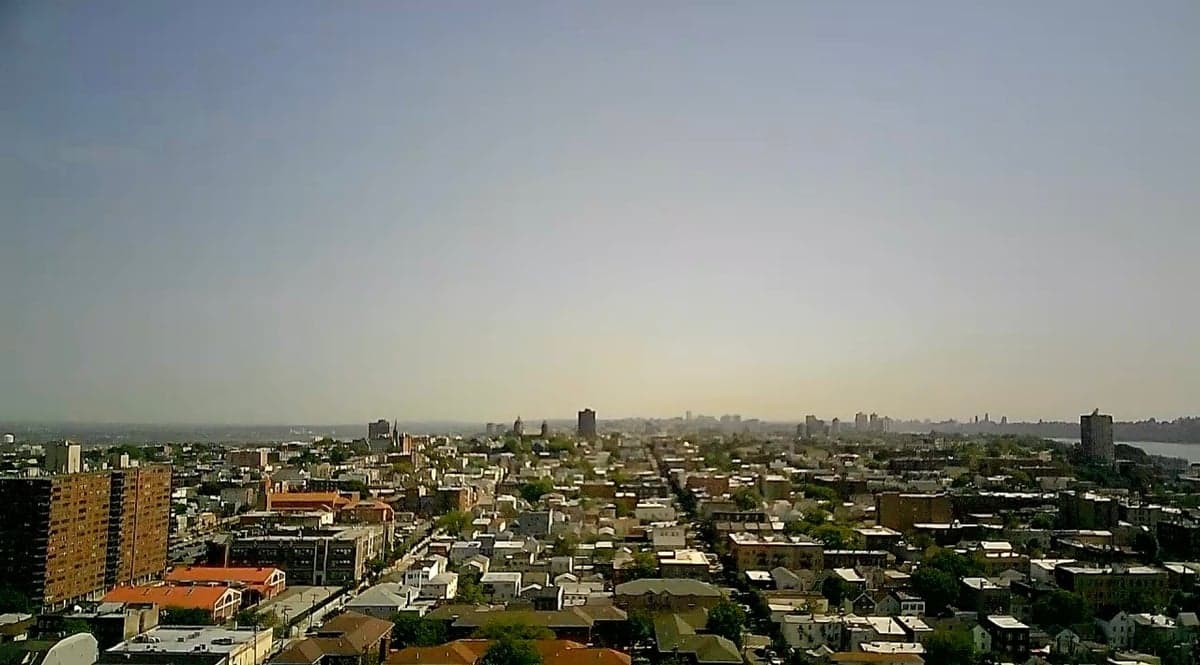
Union City, New Jersey, is one of the most densely populated cities in the United States, home to 66,375 residents packed into just 1.3 square miles. Its population is overwhelmingly Hispanic (81.6%), with a small White non-Hispanic remnant (9.9%), a modest Black community (3.1%), and growing East/Southeast Asian (2.1%) and Indian-subcontinent (1.6%) populations. The city’s identity is defined by its Cuban-American and Dominican-American majorities, a working-class character, and a foreign-born share of 28.9% that keeps its immigrant roots visible in daily life.
How the city was settled and grew
Union City was formed in 1925 by merging the towns of West Hoboken and Union Hill, but its human history begins earlier. The area was originally farmland settled by Dutch and German farmers in the 1600s and 1700s, with the first real population surge coming from German and Irish immigrants in the mid-1800s who worked in the nearby Hudson River docks and factories. By the late 1800s, the city’s Bergen Turnpike corridor and Central Avenue became commercial spines for a growing Italian and Eastern European Jewish population. These groups built the dense row-house neighborhoods—like the area around 30th Street and Bergenline Avenue—that still define the city’s urban fabric. The 1910s and 1920s saw a wave of Italian immigrants, who established a strong presence in what is now the “Little Italy” section near 18th Street, though that enclave has since largely dissolved. By 1930, Union City was a classic industrial immigrant city, with a population that was heavily White ethnic and Catholic.
Modern era (post-1965)
The 1965 Hart-Cellar Act and the Cuban Revolution reshaped Union City’s population dramatically. The first major post-1965 wave was Cuban exiles fleeing Castro, who began arriving in the late 1960s and 1970s. They settled heavily along Bergenline Avenue, which became the commercial heart of a Cuban-American community that eventually gave the city the nickname “Havana on the Hudson.” By the 1980s, the area around 45th Street and Bergenline was a dense Cuban enclave with bodegas, cafeterias, and Spanish-language signage. A second wave of Dominican immigrants arrived from the 1990s onward, settling in the southern end of the city near 10th to 20th Streets, where they now form a large and growing community. The White non-Hispanic population, which was still a majority in 1970, collapsed from white flight and suburbanization; today it stands at just 9.9%. The Black population, historically small, remains at 3.1%, concentrated in the area around 15th Street and Palisade Avenue. More recently, a small but visible East/Southeast Asian community (2.1%) has appeared, mostly Filipino and Vietnamese families drawn to the city’s affordability and transit access, settling in the northern end near 50th Street. The Indian-subcontinent population (1.6%) is newer still, with a handful of Gujarati and Punjabi families moving into the same northern neighborhoods.
The future
Union City’s population is likely to remain overwhelmingly Hispanic for the foreseeable future, but the internal composition is shifting. The Cuban-American cohort, which dominated for decades, is aging and slowly declining as younger generations move to New Jersey suburbs like Union County or Florida. The Dominican community is younger and growing, and will likely become the largest single ethnic group within the next 10–15 years. The East/Southeast Asian and Indian-subcontinent populations are small but growing, drawn by the city’s relatively lower housing costs compared to Jersey City and Hoboken. Gentrification pressure is minimal—the city’s density and lack of developable land limit new construction—so the population is more likely to stabilize than to see rapid demographic change. The foreign-born share (28.9%) is high but not rising sharply, suggesting that second-generation assimilation is underway. The city is not tribalizing into hostile enclaves; rather, it is a single, dense Hispanic-majority city with internal variation by national origin and generation.
For someone moving in now, Union City is a dense, transit-rich, overwhelmingly Hispanic city with a strong Cuban-Dominican character, a small but present non-Hispanic minority, and a stable population trajectory. It is not a gentrifying frontier or a declining industrial town—it is a mature immigrant city where the next generation is already American-born and upwardly mobile. The key trade-off is extreme density and limited space versus proximity to Manhattan and a vibrant, walkable street life.

* Values derived from national, state, county, city and local statistics and may differ in a specific area. Last updated: 2026-05-28T08:07:56.000Z
Narrative content on this page is AI-generated and may contain mistakes. Verify any details that matter before acting on them.
ReloMaps may earn a commission from affiliate links at no extra cost to you.

