
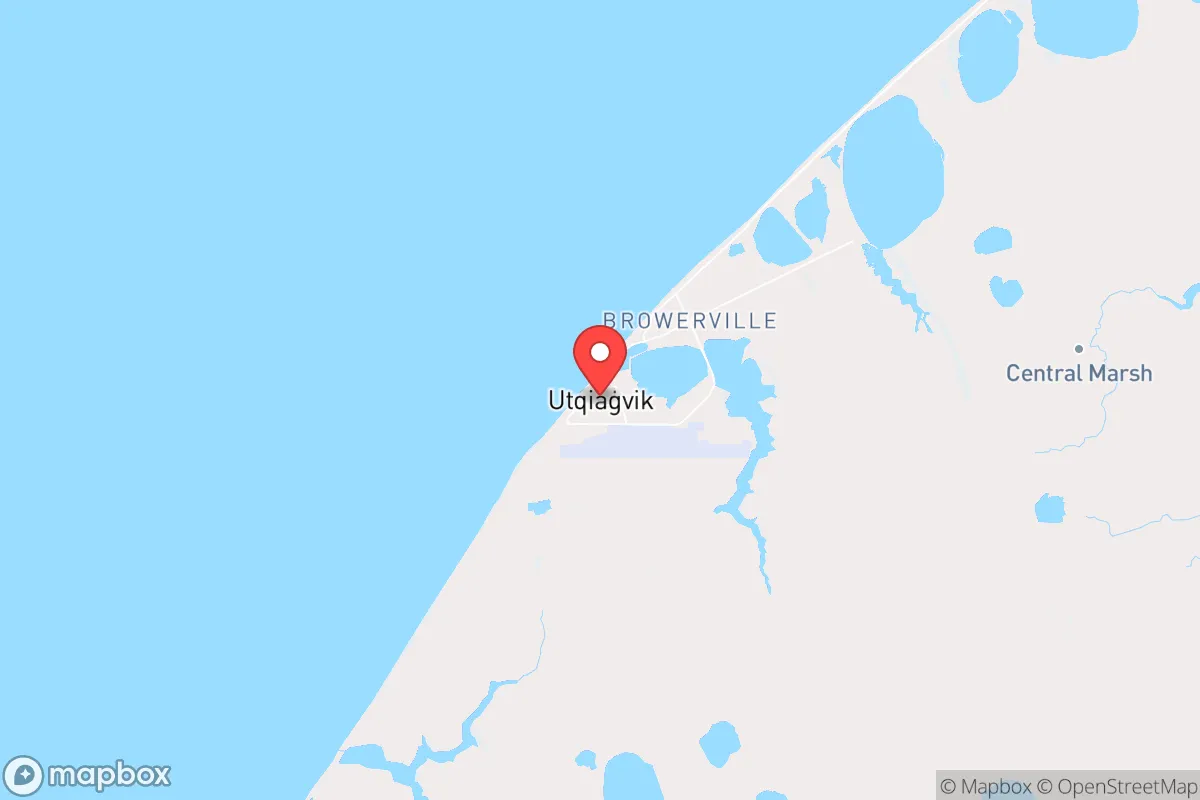
Photo by Caleb Riston on Unsplash
Demographics of Utqiavik, AK
Historical data isn't available for Utqiavik, AK. Trends shown are for North Slope County, AK.
Affluence Level in Utqiavik, AK
A middle-class area roughly in line with national averages across income, home values, education, and employment.
People of Utqiavik, AK
Today, Utqiavik is an overwhelmingly Iñupiat city where 14.3% of the 4,850 residents identify as White and the vast majority are Alaska Native, creating a cultural and political landscape unlike any other in the United States. The city’s character is defined by subsistence hunting and whaling traditions, a strong Iñupiaq language presence, and a dense, compact footprint along the Chukchi Sea coast. With only 13.8% of adults holding a college degree and a foreign-born population of just 3.1%, Utqiavik remains one of the most culturally homogeneous and geographically isolated communities in Alaska, where daily life revolves around extended family networks, seasonal harvests, and municipal governance through the North Slope Borough.
How the city was settled and grew
Utqiavik has been continuously inhabited by Iñupiat people for at least 1,500 years, long before any European contact. The original settlement, known as Ukpiagvik (“place where snowy owls are hunted”), was a seasonal whaling camp that became a permanent village due to the rich marine resources of the Beaufort and Chukchi Seas. The first non-Native arrivals were American whalers in the 1850s, followed by Presbyterian missionaries in the 1890s, who established a church and school in what is now the Browerville neighborhood. The U.S. government’s construction of a naval petroleum reserve and a Distant Early Warning (DEW) Line station during the 1940s and 1950s brought the first significant wave of non-Native workers—mostly White engineers and military personnel—who settled in the NARL (Naval Arctic Research Laboratory) area, a small enclave of government housing and research facilities on the northern edge of town. The discovery of oil at Prudhoe Bay in 1968 transformed Utqiavik into the administrative hub of the North Slope Borough, drawing a second wave of White professionals and a small number of Filipino and Southeast Asian workers to support the oil industry. These newcomers largely clustered in the Eben Hopson and Muktuk subdivisions, which feature modern single-family homes built for borough employees.
Modern era (post-1965)
Since the 1970s, Utqiavik’s population has remained remarkably stable in its ethnic composition, with Iñupiat residents consistently making up over 70% of the city. The post-1965 immigration reforms that reshaped most American cities had almost no effect here: the foreign-born share is just 3.1%, and the East/Southeast Asian population (7.7%) is almost entirely composed of Filipino and Vietnamese families who arrived in the 1980s and 1990s to work in healthcare, education, and retail. These Asian residents are concentrated in the Browerville neighborhood, where a small Filipino Catholic community maintains a church and cultural center. The Hispanic population (7.9%) is a recent development, growing from near zero in 2000 to nearly 400 residents today, largely Mexican and Central American workers employed in construction, hospitality, and the oil service industry; they are scattered throughout the NARL and Eben Hopson areas in rental housing. The Black population (1.6%) is tiny and transient, mostly military-affiliated or oil-field workers living in temporary quarters near the airport. The Indian subcontinent population is effectively zero. White residents (14.3%) are overwhelmingly concentrated in the Muktuk and Eben Hopson subdivisions, where borough and school district administrators, teachers, and healthcare professionals occupy the city’s newest and most expensive housing stock.
The future
Utqiavik’s population is slowly aging and slightly shrinking, with a net outflow of young Iñupiat adults moving to Anchorage or Fairbanks for college and employment. The Hispanic and East/Southeast Asian communities are growing modestly, but they remain small and are unlikely to significantly alter the city’s Iñupiat majority in the next decade. The city is not tribalizing into distinct ethnic enclaves in the way that larger American cities are; instead, the small population and harsh environment force daily interaction across groups, though social networks remain largely separate. The most significant demographic trend is the gradual outmigration of White professionals as oil industry employment plateaus and remote-work options expand, which could reduce the White share from 14.3% to below 10% by 2035. The Iñupiat population is expected to remain stable or grow slightly due to higher birth rates and a strong cultural attachment to the land.
For a conservative-leaning individual or family considering relocation, Utqiavik offers a rare environment of cultural continuity, low crime, and strong community bonds, but it demands a willingness to adapt to a subsistence-oriented, majority-Indigenous society where traditional values and extended family obligations shape daily life. The city is not becoming more diverse in the conventional American sense; it is becoming more Iñupiat, with a small but stable non-Native workforce serving essential government and industrial functions. Anyone moving here should expect to be a visible minority and to integrate into a community where Iñupiaq language, whaling traditions, and subsistence hunting are not cultural artifacts but living realities that govern the rhythm of the year.

* Values derived from national, state, county, city and local statistics and may differ in a specific area. Last updated: 2026-05-01T18:00:32.000Z
Narrative content on this page is AI-generated and may contain mistakes. Verify any details that matter before acting on them.
ReloMaps may earn a commission from affiliate links at no extra cost to you.

