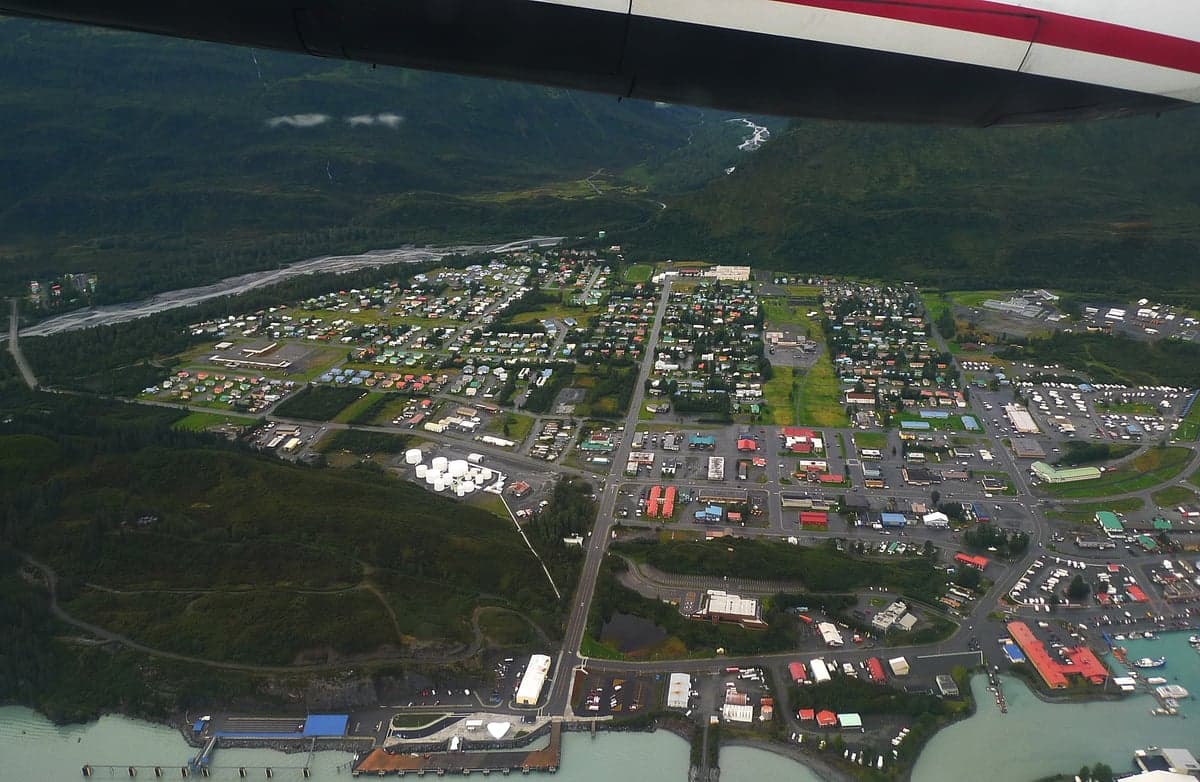
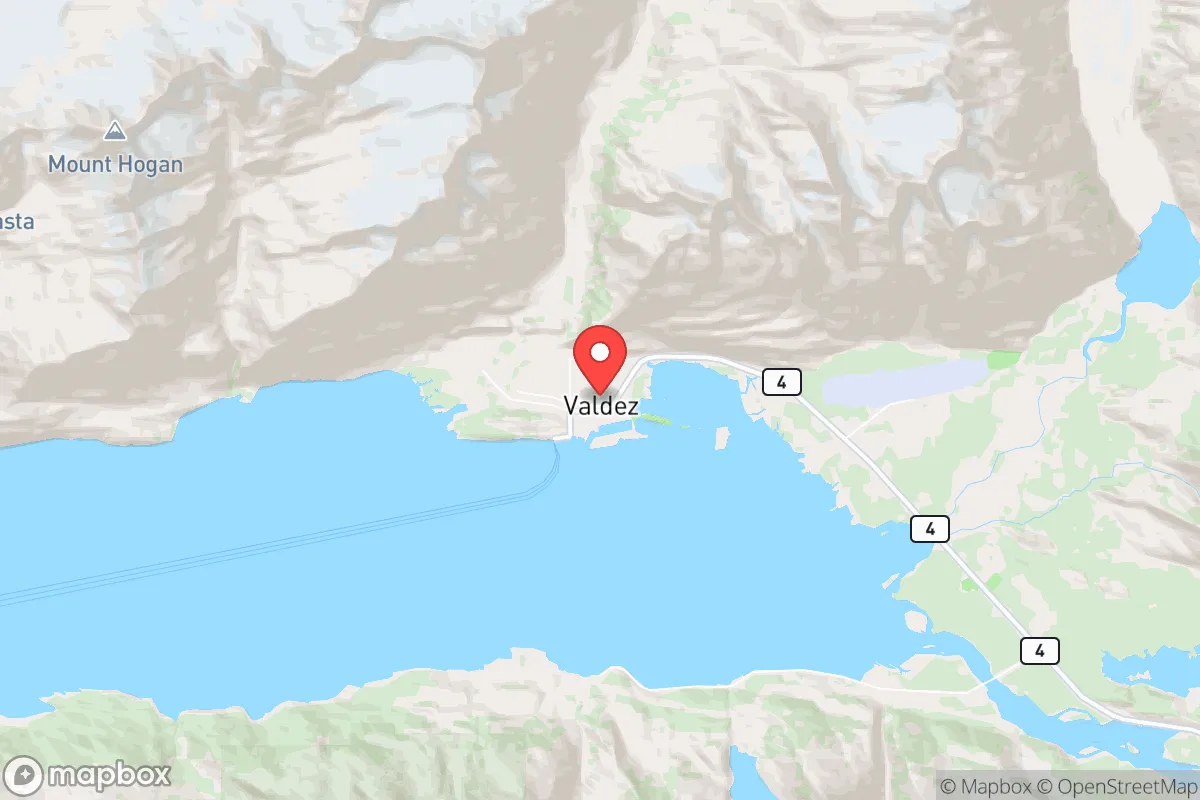
Photo: Wikipedia
Demographics of Valdez, AK
Affluence Level in Valdez, AK
A middle-class area roughly in line with national averages across income, home values, education, and employment.
People of Valdez, AK
The people of Valdez, Alaska, today number roughly 3,911, forming a tight-knit, predominantly white community with a distinctive blue-collar and resource-industry character. The city is notably less diverse than the state average, with a foreign-born population of just 0.8% and a Hispanic share of 6.9%. Valdez’s identity is shaped by its role as the southern terminus of the Trans-Alaska Pipeline System, a history of catastrophic natural disaster, and a population that remains deeply rooted in commercial fishing, oil terminal operations, and tourism.
How the city was settled and grew
Valdez was founded in 1898 as a tent city during the Klondike Gold Rush, serving as a primary entry point for prospectors heading to the Yukon goldfields via the Valdez Glacier Trail. The original population was a transient mix of American, Canadian, and European fortune-seekers, with a small number of Alaska Native families from the Chugach region already living in the area. By 1900, the gold rush had largely fizzled, and the town shrank to a few hundred hardy residents who turned to fishing, trapping, and small-scale mining. The historic Old Town Valdez district, located on the narrow spit of land at the head of Port Valdez, was the original settlement core, built on wooden pilings over tidal flats. After the devastating 1964 Good Friday earthquake and tsunami destroyed Old Town, the community relocated two miles east to its present site, rebuilding on higher ground in what is now the New Town area. This relocation effectively erased the original neighborhood and created a blank slate for modern development.
Modern era (post-1965)
The modern demographic character of Valdez was forged by two events: the 1964 earthquake and the 1977 completion of the Trans-Alaska Pipeline. The pipeline’s southern terminal brought a wave of construction workers, pipeline technicians, and maritime support staff, many of whom stayed permanently. This influx was overwhelmingly white and male, drawn by high-paying union jobs in a remote, harsh environment. The Dayville neighborhood, located near the pipeline terminal and the Alyeska tanker dock, became the hub for pipeline-era housing and remains a concentration of oil-industry workers and their families. The Harbor View area, overlooking the small-boat harbor, attracted the commercial fishing community—a mix of multi-generational Alaskan families and seasonal workers from the Pacific Northwest. Post-1965 immigration reform had virtually no impact on Valdez; the city’s isolation, cold winters, and lack of service-sector jobs meant that the national wave of Asian, Indian, and Latin American immigration bypassed the town entirely. Today, East/Southeast Asian residents make up just 0.3% of the population, and Indian-subcontinent residents are statistically zero. The Black population (2.4%) is small and concentrated among pipeline and maritime workers, with no distinct ethnic neighborhood. The Hispanic population (6.9%) is the largest minority group, with families primarily working in fish processing and hospitality, living scattered across New Town and the Airport Heights subdivision.
The future
Valdez’s population is aging and slowly declining, down from a peak of roughly 4,300 in the 1990s. The city is not homogenizing into enclaves—it is too small and too geographically constrained for that—but it is tribalizing along occupational lines: oil terminal workers, commercial fishermen, and tourism operators form distinct social circles with limited crossover. The immigrant community is not growing; the foreign-born share (0.8%) is among the lowest in Alaska, and there is no evidence of a new wave arriving. The Hispanic population has plateaued, and the small Black and Asian populations are stable but not expanding. The next 10-20 years will likely see continued slow decline as pipeline employment shrinks and younger residents leave for Anchorage or the Lower 48. The city’s future depends on whether it can attract remote workers or retirees seeking a low-crime, high-scenery lifestyle—a demographic that would reinforce the white, college-educated minority (31.0% have a bachelor’s degree or higher) rather than diversify it.
For someone moving in now, Valdez offers a stable, safe, and overwhelmingly white community where social networks are built around work and outdoor recreation. It is not a place of demographic change or cultural mixing—it is a place where the population is slowly contracting, and where newcomers will need to integrate into established occupational and social structures. The city’s character remains that of a resource-extraction outpost that survived a cataclysm and rebuilt, and that resilience is the defining trait of its people.

* Values derived from national, state, county, city and local statistics and may differ in a specific area. Last updated: 2026-04-19T19:41:21.000Z
Narrative content on this page is AI-generated and may contain mistakes. Verify any details that matter before acting on them.
ReloMaps may earn a commission from affiliate links at no extra cost to you.

