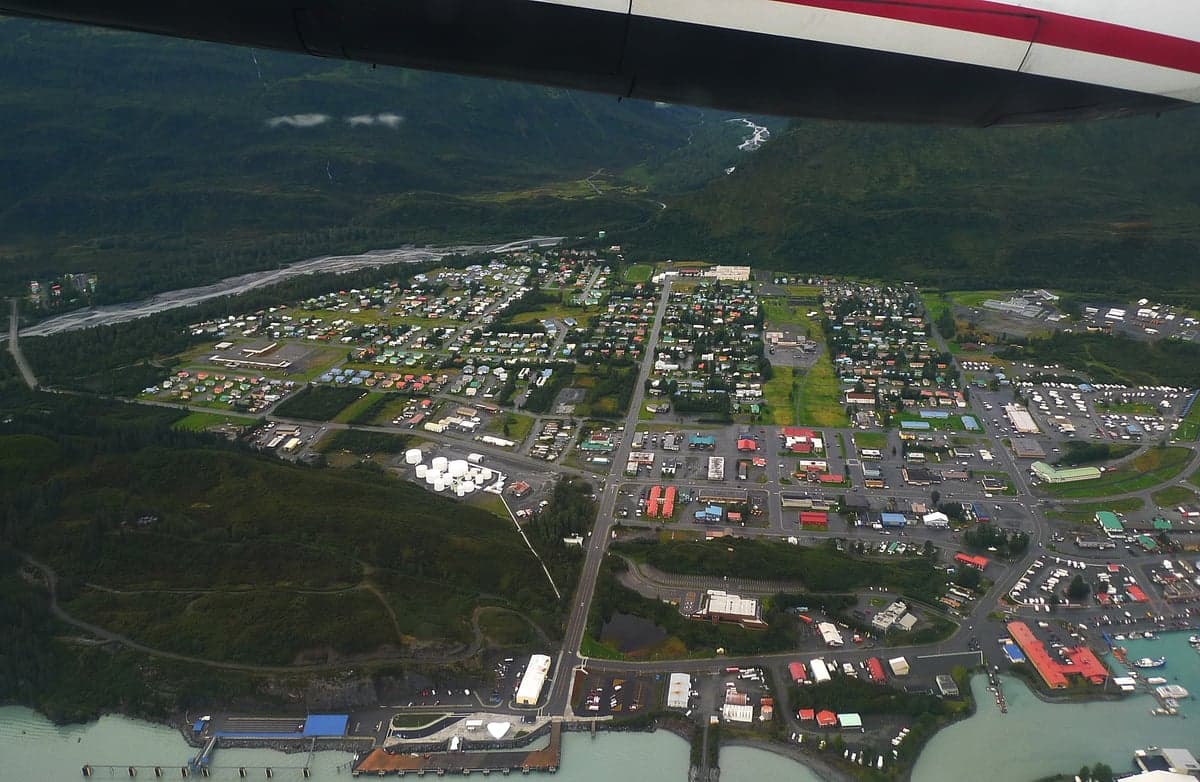
Photo: Wikipedia
Political ClimatePolitical Climate in Valdez, AK
District shown is the primary district for this city’s centroid. Cities may span multiple districts.
Inherited from parent state — no local data available.
Local Political AnalysisPolitical Analysis of Valdez, AK
Valdez, Alaska, has long been a place where folks value their independence and don't take kindly to being told how to live their lives, and that's reflected in its solidly conservative lean. The Cook PVI of R+6 tells the story pretty clearly—this is a community that consistently votes for candidates who prioritize local control, resource development, and keeping government out of the way. Over the last decade or so, you've seen that conservative streak hold steady, even as some of the bigger towns in the state, like Anchorage or Juneau, have drifted leftward. If anything, the trajectory here is one of cautious resistance to the progressive wave that's washing over other parts of the country, with locals doubling down on the idea that the best solutions come from the people who actually live and work in a place, not from bureaucrats in D.C. or even Juneau.
How it compares
When you stack Valdez up against its neighbors, the contrast is pretty stark. Head west to Anchorage, and you're looking at a city that's become a battleground, with a mayor who's pushed progressive policies on everything from homelessness to land use that feel like a world away from Valdez's hands-off approach. Down the coast in Cordova, you've got a more mixed bag—still some old-school Alaska independence, but a stronger environmentalist streak that can make resource development a tough sell. Up in Fairbanks, you'll find a similar conservative vibe, but it's a bigger, more transient population with military and university influences that can swing things. Valdez, though, is more of a tight-knit community where everyone knows each other, and that keeps the politics grounded in practical, local concerns. The R+6 rating puts it squarely in the "reliably red" camp, but it's not a rabid, partisan place—it's more about a shared skepticism of government overreach and a belief that people should be free to run their own lives, their own businesses, and their own town without a bunch of red tape.
What this means for residents
For the folks who call Valdez home, this political climate means a few things in daily life. First off, you're not going to see the kind of heavy-handed zoning or business regulations that can choke a small town—the city council and borough assembly generally take a "let the market work" approach, which keeps the cost of living from being even more insane than it already is. Second, there's a strong emphasis on personal responsibility and freedom, which means you're trusted to make your own choices about things like property use, hunting, and fishing, without a bunch of nanny-state rules. That said, there's a growing concern among long-time residents about the slow creep of progressive ideology, especially through state-level mandates on education or environmental restrictions that feel disconnected from Valdez's reality as a working port and energy hub. The worry is that if those outside influences keep pushing, they'll erode the very independence that makes this place worth living in. For now, though, most folks feel like their vote still counts and their voice still matters, and that's a big deal in a state where rural communities often get steamrolled by the urban vote.
One thing that really sets Valdez apart culturally is its no-nonsense attitude toward resource development—this is a town that lives and breathes the oil industry, the fishing industry, and the port, and there's little patience for the kind of environmental activism that would shut down a pipeline or restrict a fishery without a solid, local reason. You'll see that in local elections, where candidates who talk about "sustainability" or "green energy" without a practical plan get laughed out of the room. There's also a strong sense of community self-reliance here; when the state government drags its feet on road maintenance or emergency services, locals just step up and get it done themselves. That's the Valdez way—keep the government out of your business, take care of your neighbors, and don't let anyone tell you how to live your life. It's a perspective that's getting harder to find, and the folks here aim to keep it that way for as long as they can.

State Political ClimatePolitical Climate in Alaska
State Political AnalysisPolitical Environment in the State
Alaska has long been a politically unique state, leaning Republican in presidential elections but with a fiercely independent, libertarian streak that makes it less predictable than many red states. Over the last 20 years, the state has shifted from a solidly red stronghold (voting +21 points for Bush in 2004) to a more competitive lean-red state (voting +13 for Trump in 2020, then +11 for Trump in 2024). The dominant coalition remains a mix of rural conservatives, resource-industry workers, and fiscally conservative independents, but the Anchorage metro area has become a key battleground, while the Mat-Su Valley and Kenai Peninsula have hardened into deep-red territory. The biggest change? A slow but steady influx of out-of-state transplants, particularly to Anchorage and Fairbanks, is nudging the state’s politics toward a more suburban, moderate-conservative posture.
Urban vs. rural divide
The political map of Alaska is stark. Anchorage, home to 40% of the state’s population, is the swing region. In 2024, Anchorage’s House districts were split nearly evenly—Republicans held a slim majority, but Democrats flipped two seats in the city’s core. The Mat-Su Borough (Wasilla, Palmer) is the state’s conservative engine, voting +35 for Trump in 2024, fueled by a booming population of families fleeing Anchorage’s rising costs and crime. The Kenai Peninsula (Soldotna, Homer) is similarly red but with a libertarian edge—Homer itself is a blue dot in a sea of red, driven by artists and fishermen. Fairbanks leans red but is more moderate than the Valley, with a strong military and university presence. The rural bush—villages like Barrow (Utqiaġvik) and Nome—votes heavily Democratic due to tribal and subsistence issues, but turnout is low. The divide isn’t just urban vs. rural; it’s between the resource-dependent interior and the service-driven Anchorage bowl.
Policy environment
Alaska’s policy environment is a mixed bag for conservatives. On the plus side: no state income tax and no state sales tax, funded by oil revenues and the Permanent Fund. The state has some of the weakest property rights protections in the nation—the Alaska National Interest Lands Conservation Act (ANILCA) and federal land ownership (60% of the state) create constant friction. Education policy is locally controlled, but the state has seen a push for school choice; in 2024, a bill to expand charter schools and fund education savings accounts (ESAs) failed in the legislature by a single vote. Healthcare is a bright spot: Alaska has a robust telehealth network and a high rate of direct-primary care, but Medicaid expansion under the ACA (accepted in 2015) remains controversial. Election laws are relatively free—no voter ID requirement at the polls (though you must register with an ID), and the state uses a top-four open primary system (passed by ballot initiative in 2020) that has weakened party control but also confused some voters. The Permanent Fund Dividend (PFD) is the sacred cow—any politician who threatens it faces immediate backlash.
Trajectory & freedom
Alaska’s trajectory on personal freedom is a tug-of-war. On the positive side: constitutional carry (no permit needed to carry a concealed firearm) has been law since 2003, and in 2024, the legislature passed a law prohibiting state enforcement of federal gun bans (HB 61), a direct challenge to ATF overreach. Parental rights are strong—Alaska has a robust homeschool law and no mandatory vaccine requirements for school attendance (though COVID-era mandates caused a brief uproar). On the concerning side: the state’s medical autonomy took a hit in 2023 when the legislature failed to override the governor’s veto of a bill that would have banned COVID-19 vaccine mandates for private employers. Property rights are under constant threat from federal land-use restrictions; the proposed “Alaska Roadless Rule” litigation has dragged on for years, limiting access to timber and mining. The biggest freedom concern is the PFD clawback—in 2023, the legislature approved a $1,300 PFD (down from the statutory formula of $3,000+), effectively a hidden tax. This has sparked a growing “PFD Party” movement that wants to lock the dividend into the constitution.
Civil unrest & political movements
Alaska has seen relatively little civil unrest compared to the Lower 48, but there are flashpoints. The “Save the PFD” protests in Juneau in 2023 drew thousands, with signs reading “Don’t Steal My Dividend”—a populist, anti-establishment movement that crosses party lines. The Mat-Su Borough has been a hotbed of election integrity activism; in 2022, the borough assembly passed a resolution calling for a forensic audit of the 2020 election (though no state-level action followed). The Anchorage School Board has been a battleground over critical race theory and transgender policies—in 2023, a recall effort against two progressive board members failed, but the issue remains alive. Immigration politics are muted (Alaska has a small foreign-born population), but the state has no sanctuary policies. The Alaska Independence Party (AIP) still exists, advocating for a vote on secession, but it’s a fringe group—its last serious candidate, Joe Vogler, died in 1993. The most visible political movement is the “Alaska First” coalition, a mix of libertarians and conservatives pushing for resource development, PFD restoration, and reduced federal control.
Projection
Over the next 5-10 years, Alaska is likely to become more conservative in the Valley and Kenai, but more purple in Anchorage. The in-migration pattern is key: people moving to Alaska are overwhelmingly coming for jobs in oil, mining, and fishing—industries that lean conservative—but they’re settling in Anchorage and Fairbanks, where they encounter higher taxes (municipal) and more progressive local politics. The Mat-Su Borough is growing fast (projected to add 20,000 residents by 2030), and it will become the state’s political center of gravity. The biggest wildcard is the Permanent Fund—if oil revenues continue to decline, the state will face a fiscal crisis that could force an income tax, which would be a massive blow to freedom. The top-four primary system will likely weaken both parties, producing more independent-minded legislators. For a conservative moving in now, expect the state to remain a red-leaning libertarian haven, but with increasing friction between the Anchorage establishment and the Valley populists.
Bottom line for a new resident: If you’re moving to Alaska for freedom, head to the Mat-Su Valley or Kenai Peninsula—that’s where the culture and politics align with limited government. Anchorage offers jobs but comes with higher crime, higher local taxes, and a school board that’s more progressive than the state average. The state’s biggest threat to your liberty isn’t the legislature—it’s the federal government’s grip on 60% of the land and the looming fiscal cliff. Keep an eye on the PFD fight; that’s the canary in the coal mine for Alaska’s future as a low-tax, high-freedom state.
* Values derived from national, state, county, city and local statistics and may differ in a specific area. Last updated: 2026-04-19T19:41:21.000Z
Narrative content on this page is AI-generated and may contain mistakes. Verify any details that matter before acting on them.
ReloMaps may earn a commission from affiliate links at no extra cost to you.

