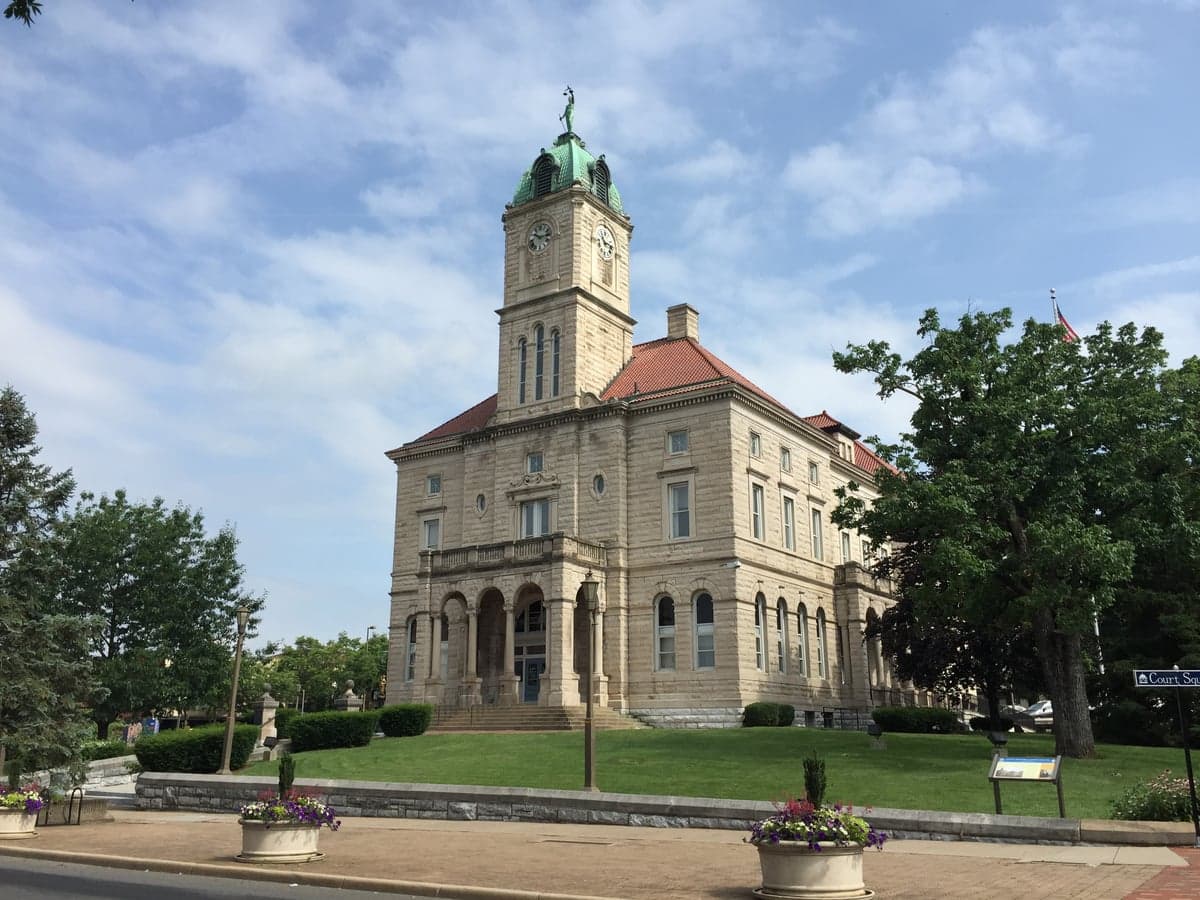
Photo: Wikipedia
Personal Sovereignty in Rockingham County
Viable for self-reliance. Generally workable, though some barriers may limit total independence.
What does Personal Sovereignty tell us?
Personal Sovereignty measures your capacity for self-reliance and independence with minimal government friction. Higher scores mean fewer barriers between you and the way you want to live... but it assumes you have the space you need and good neighbors.
What does this tell us?
Personal Sovereignty measures your capacity for self-reliance and independence with minimal government friction. Higher scores mean fewer barriers between you and the way you want to live... but it assumes you have the space you need and good neighbors.
State Policy
Energy independence: Importer (20% of energy produced in-state)
Personal Liberty
Homesteading

Personal Liberty Analysis
Rockingham County, Virginia offers a notably high degree of personal sovereignty relative to much of the Mid-Atlantic, driven by a combination of low tax burden, permissive gun laws, and a regulatory environment that generally favors individual choice over government mandate. The county's political culture, shaped by its agricultural heritage and Shenandoah Valley independence, creates a space where residents can exercise significant control over their property, families, and daily lives. While not a libertarian free-for-all, the area consistently ranks as one of the more freedom-oriented jurisdictions in Virginia, particularly when compared to the Northern Virginia suburbs or the Richmond metro area.
Tax burden and regulatory posture in Rockingham County
Rockingham County's tax structure is a primary draw for those seeking financial autonomy. The county's real estate tax rate is $0.56 per $100 of assessed value, one of the lowest in Virginia and far below the state average. Combined with no county-level personal property tax on vehicles (a significant savings compared to most other Virginia localities), the overall tax burden is light. The regulatory posture is similarly restrained. The county's zoning ordinance is less restrictive than many urban counterparts, with agricultural and rural districts allowing a wide range of uses without special permits. In towns like Dayton and Bridgewater, the local governments tend toward a hands-off approach, while Harrisonburg (an independent city within the county's orbit) has a more traditional municipal code. For a reader comparing to states like New York or California, the difference is stark: no state income tax on the first several thousand dollars of income, no onerous business licensing requirements for home-based enterprises, and a general presumption that residents can manage their own affairs unless a clear public harm is demonstrated.
Self-defense and gun law specifics in the Shenandoah Valley
Virginia is a shall-issue state for concealed carry permits, and Rockingham County's sheriff's office processes applications efficiently, typically within 45 days. The county is home to a strong gun culture, with multiple shooting ranges and gun shops in Elkton and Timberville. Importantly, Virginia law preempts local firearm ordinances, meaning Rockingham County cannot enact its own bans on open carry or magazine capacity—a protection that residents in places like Harrisonburg (which has attempted local restrictions) do not fully enjoy. Stand-your-ground principles apply under Virginia's self-defense statutes, and there is no duty to retreat in one's home or vehicle. For those prioritizing the right to keep and bear arms, Rockingham County offers a legal environment where that right is exercised with minimal friction. The county's rural character also means that discharging firearms on private property is generally permitted, subject to basic safety and noise ordinances, which is a significant advantage over more densely populated areas.
Self-reliance and homesteading viability: lot sizes, zoning, and off-grid feasibility
Rockingham County is one of the most viable areas in Virginia for homesteading and off-grid living. Agricultural zoning allows for minimum lot sizes as small as 2 acres in some districts, while rural areas commonly permit parcels of 5 to 10 acres for residential use. The county's zoning code explicitly allows for accessory dwelling units, home occupations, and the keeping of livestock (including chickens, goats, and horses) on properties of sufficient size. In Broadway and Linville, residents routinely operate small farms, sell produce at roadside stands, and maintain private wells and septic systems without excessive permitting. Off-grid feasibility is high: the county does not require connection to municipal water or sewer, and solar panel installations are permitted by right in most zoning districts. The Shenandoah Valley's moderate climate and fertile soil further support self-reliance, with a growing season of roughly 170 days. For those seeking to reduce dependence on supply chains, Rockingham County's regulatory environment actively enables—rather than hinders—such efforts.
Personal liberties: parental rights, medical autonomy, speech, and property
Rockingham County's culture strongly supports parental rights in education and healthcare. The county's school board has resisted certain state-level mandates, and parents in Pleasant Valley and Mount Crawford report a high degree of involvement in curriculum decisions. Virginia law allows for religious and philosophical exemptions to school vaccination requirements, and the county's health department processes these without undue friction. Medical autonomy is further supported by the presence of Sentara RMH Medical Center in Harrisonburg, which offers a range of services without the bureaucratic hurdles common in larger hospital systems. Free speech protections are robust, with no local ordinances restricting political signage or public assembly beyond standard time-place-manner rules. Property rights are particularly strong: the county's comprehensive plan emphasizes the protection of agricultural and forestal lands, and eminent domain is rarely used. For a reader concerned about government overreach, Rockingham County's track record of respecting individual property decisions—from building a workshop to subdividing land—is a concrete advantage over more regulated jurisdictions.
Overall, Rockingham County ranks among the top 20% of Virginia localities for personal sovereignty, offering a balance of low taxes, permissive gun laws, and homesteading viability that is rare in the eastern United States. While it does not match the extreme libertarian environments of rural Idaho or Alaska, it provides a practical, livable freedom that appeals to families and individuals who want to control their own lives without constant government interference. The key differentiator is the county's agricultural zoning and cultural independence, which create a buffer against the regulatory creep seen in more urbanized areas. For a relocation decision focused on autonomy, Rockingham County represents a solid, data-backed choice.

* Values derived from national, state, county, city and local statistics and may differ in a specific area. Last updated: 2026-09-23T20:13:59.000Z
Narrative content on this page is AI-generated and may contain mistakes. Verify any details that matter before acting on them.
ReloMaps may earn a commission from affiliate links at no extra cost to you.

