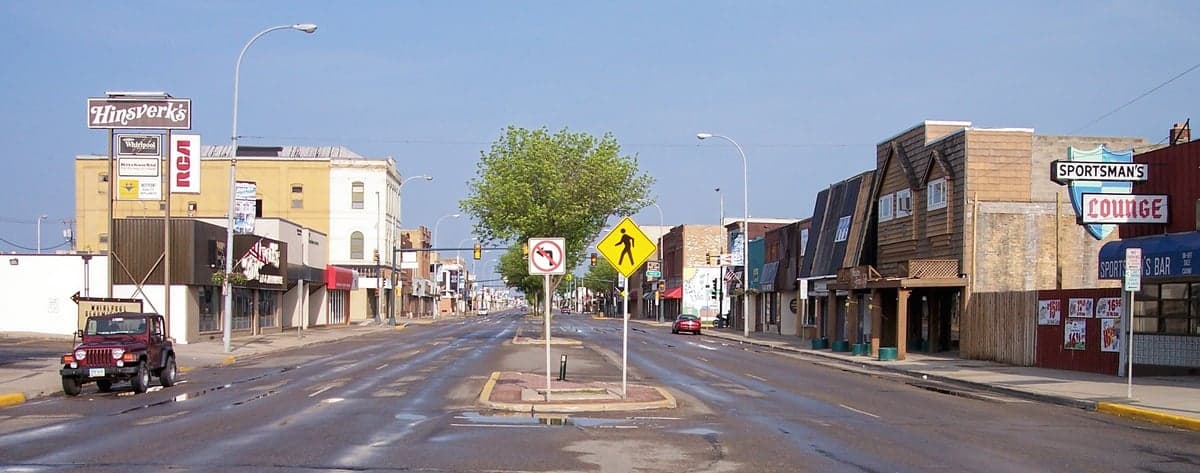
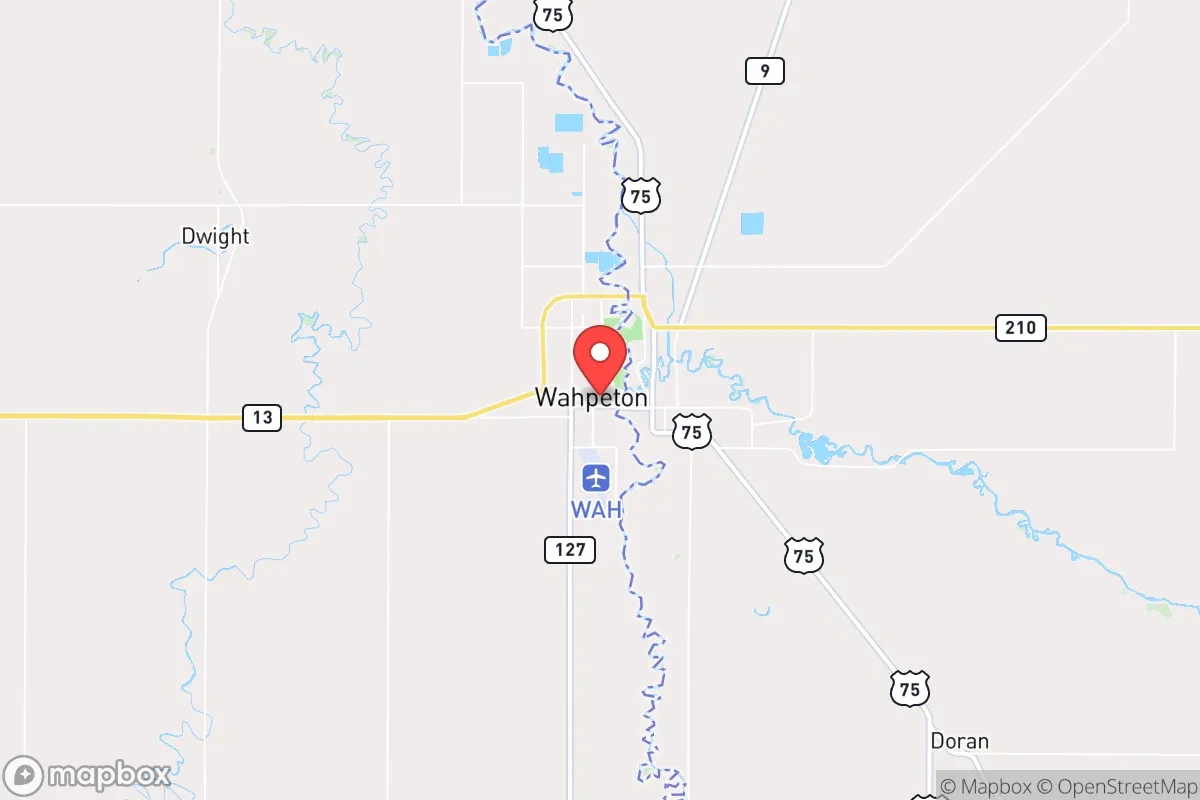
Photo: Wikipedia
Demographics of Wahpeton, ND
Affluence Level in Wahpeton, ND
A middle-class area roughly in line with national averages across income, home values, education, and employment.
People of Wahpeton, ND
The people of Wahpeton, North Dakota, today number 7,996 and form a predominantly white, working-class community with a strong regional identity rooted in agriculture and manufacturing. The city’s population is notably homogenous — 86.5% white, 5.0% Hispanic, 1.8% Black, and 0.2% East/Southeast Asian — with a foreign-born share of just 0.5%, far below the national average. Only 22.9% of adults hold a college degree, reflecting a blue-collar character that prizes self-reliance and local ties. Wahpeton is a place where families have lived for generations, and newcomers are often drawn by steady industrial jobs rather than urban amenities.
How the city was settled and grew
Wahpeton’s founding population arrived in the 1870s and 1880s, drawn by the Northern Pacific Railroad’s push through the Red River Valley and the promise of fertile farmland. The city was platted in 1873 and named after the Wahpeton Sioux band, though the indigenous population was displaced by the time Euro-American settlers arrived. The first major wave consisted of German-Russian immigrants from the Black Sea region, along with Norwegian and Swedish homesteaders, who built the city’s early economy around grain elevators and the Red River Lumber Company. These groups settled in what is now North Wahpeton, a working-class neighborhood of small frame houses near the railroad tracks and the river. A second wave of Polish and Czech immigrants arrived around 1900 to work in the brickyards and the new sugar beet processing plant, clustering in Southside, a district south of Main Avenue that still contains older duplexes and modest bungalows. By 1920, Wahpeton’s population had reached roughly 3,000, and the city’s ethnic enclaves were firmly established: Germans in North Wahpeton, Scandinavians in the central grid around Dakota Avenue, and Eastern Europeans in Southside.
Modern era (post-1965)
After the 1965 Hart-Cellar Act, Wahpeton saw virtually no immigration from Asia, Africa, or Latin America — the foreign-born share remained below 1% through the 1990s. Instead, the city’s modern growth came from domestic in-migration from rural North Dakota and Minnesota, as small family farms consolidated and younger workers moved to town for jobs at Wil-Rich (a farm equipment manufacturer) and Bobcat Company’s nearby plant in Gwinner. These new residents, overwhelmingly white and native-born, settled in the Westside Addition, a post-1970 subdivision of ranch-style homes and cul-de-sacs west of Highway 81. The Hispanic population, now 5.0%, began arriving in the 1990s as seasonal labor for the sugar beet harvest, with many settling in Southside and the Airport Road area, where older rental housing is concentrated. The Black population (1.8%) is small and largely composed of military families stationed at the nearby North Dakota Air National Guard base in Fargo, with no distinct neighborhood concentration. The East/Southeast Asian community (0.2%) is negligible, consisting of a handful of professionals at the North Dakota State College of Science (NDSCS) campus in the College District along 6th Street North.
The future
Wahpeton’s population is projected to remain stable or decline slightly over the next decade, as the city’s birth rate falls and out-migration of young adults to Fargo (45 miles east) continues. The Hispanic share is likely to grow modestly — perhaps to 7-8% by 2035 — as second-generation families stay and new seasonal workers arrive, but the city shows no signs of becoming a multi-ethnic hub. The white population will remain dominant, and the East/Southeast Asian and Black shares will likely plateau below 2% each. The city is not tribalizing into distinct ethnic enclaves; rather, it is slowly homogenizing as older ethnic neighborhoods (North Wahpeton, Southside) age and younger families move to the Westside Addition or newer subdivisions like Prairie Heights near the golf course. The main demographic tension is not racial but generational: retirees staying put while young adults leave for college and careers elsewhere.
For someone moving in now, Wahpeton offers a stable, safe, and culturally uniform environment where neighbors know each other and the pace of life is slow. The city is becoming older and more settled, not more diverse or dynamic. New residents will find a community that values continuity over change, and where the biggest population shifts are driven by the local economy — not by immigration or rapid growth.

* Values derived from national, state, county, city and local statistics and may differ in a specific area. Last updated: 2026-04-19T07:14:37.000Z
Narrative content on this page is AI-generated and may contain mistakes. Verify any details that matter before acting on them.
ReloMaps may earn a commission from affiliate links at no extra cost to you.

