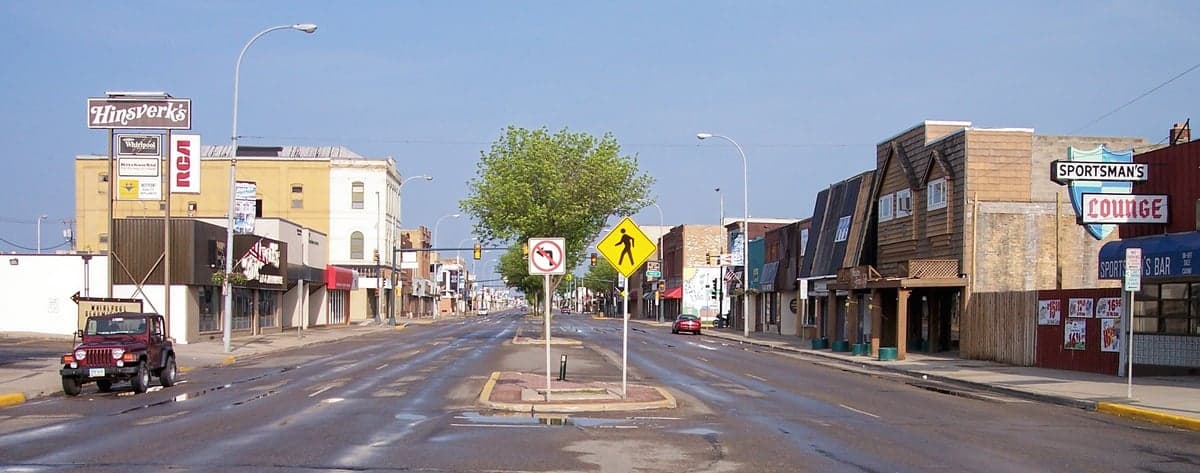
Photo: Wikipedia
Political ClimatePolitical Climate in Wahpeton, ND
District shown is the primary district for this city’s centroid. Cities may span multiple districts.
Inherited from parent state — no local data available.
Local Political AnalysisPolitical Analysis of Wahpeton, ND
Wahpeton, North Dakota, is about as solidly conservative as it gets, with a Cook PVI of R+18 that reflects a deep-rooted, no-nonsense political culture. This isn't a place that's drifted leftward over the years; it's held its ground, and if anything, the surrounding rural areas have only gotten more red as the state's oil boom and agricultural backbone reinforce a live-and-let-live, small-government ethos. You won't find much hand-wringing over progressive social experiments here—folks are more concerned with keeping taxes low, schools focused on fundamentals, and the government out of their day-to-day lives.
How it compares
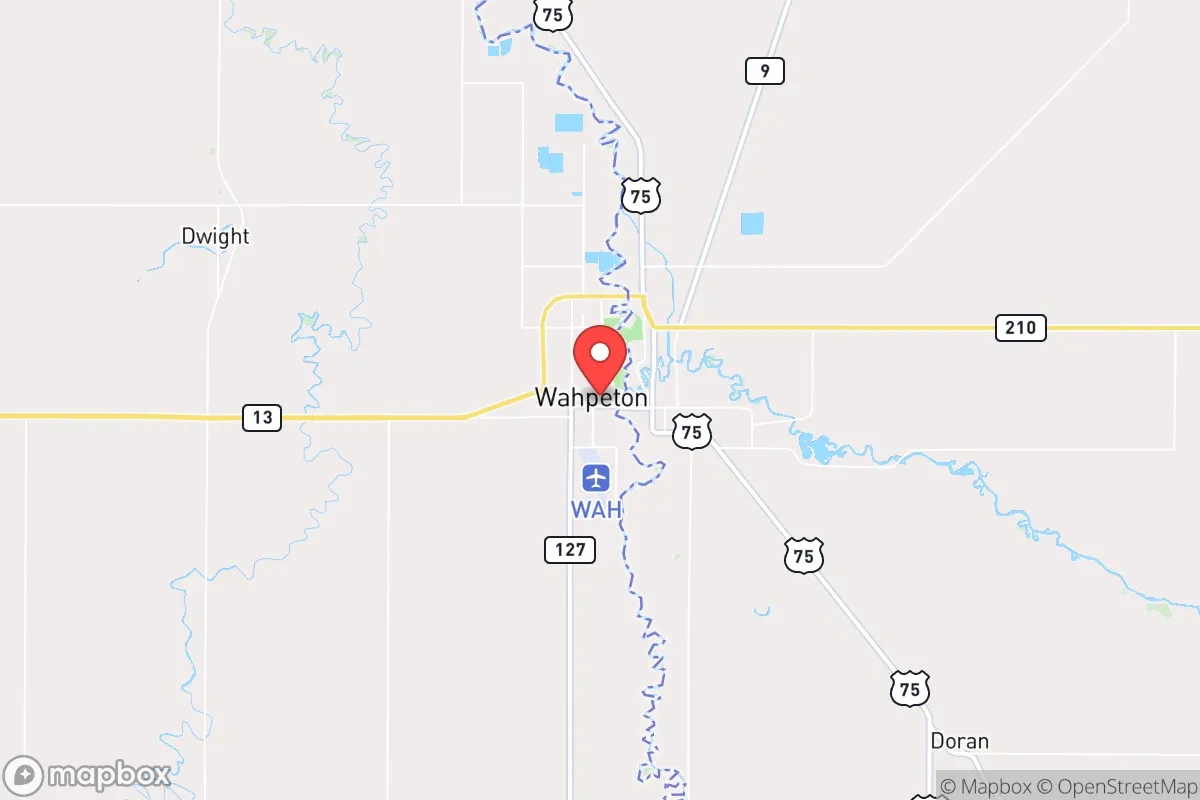
Drive 30 minutes south to Breckenridge, Minnesota, and you'll notice a subtle shift—Minnesota's state politics lean more toward the progressive side, with higher taxes and more regulations that can feel like a slow creep of government overreach. Wahpeton, by contrast, benefits from North Dakota's generally more restrained approach. Head west to Fargo, about an hour away, and you'll find a more mixed bag: a growing city with a younger, slightly more liberal tilt, especially in its downtown core. But Wahpeton remains a bastion of traditional values, where the local county commission and school board elections are dominated by candidates who prioritize fiscal responsibility and individual liberty. The contrast with the Twin Cities metro area, a four-hour drive east, is night and day—Wahpeton feels like a different country, and for many residents, that's a good thing.
What this means for residents
For the people who live here, the political climate translates into a tangible sense of freedom. You're not constantly looking over your shoulder for new zoning rules, mask mandates, or business-killing regulations. The local government tends to take a hands-off approach, trusting residents and business owners to make their own decisions. That said, there's a growing concern among longtime locals about the slow drip of progressive ideology seeping in through state-level initiatives or federal mandates. Things like diversity, equity, and inclusion programs in schools or pushes for "green" energy mandates are met with skepticism—most folks see them as unnecessary distractions from real issues like infrastructure and economic stability. The general attitude is: if it ain't broke, don't fix it, and don't let outsiders tell us how to live.
One thing that stands out is the strong sense of community self-reliance. When the pandemic hit, Wahpeton largely resisted the heavy-handed lockdowns seen elsewhere. Local businesses stayed open, and neighbors looked out for each other without waiting for government handouts. That spirit is still alive today. The biggest political battles here aren't about national culture wars—they're about local control: keeping the county's zoning laws flexible, protecting property rights, and ensuring that any new development doesn't come with a laundry list of bureaucratic strings attached. If you're someone who values personal responsibility over government dependency, Wahpeton feels like a breath of fresh air. But if you're hoping for a shift toward more progressive policies, you'll likely be disappointed—and that's exactly how most residents want it.

State Political ClimatePolitical Climate in North Dakota
State Political AnalysisPolitical Environment in the State
North Dakota has long been a reliably conservative state, but its political climate is more nuanced than a simple red-state label suggests. The state leans heavily Republican in presidential elections — Donald Trump won it by 33 points in 2020 and by a similar margin in 2024 — but the dominant coalition is a mix of traditional prairie populists, libertarian-leaning ranchers, and a growing number of conservative transplants fleeing blue states. Over the past 10-20 years, the state has shifted rightward on cultural issues while maintaining a pragmatic, low-tax approach to governance. However, the oil boom in the Bakken region has brought demographic change, and the eastern cities like Fargo and Grand Forks are slowly trending more moderate, creating a subtle but real urban-rural tension.
Urban vs. rural divide
The political map of North Dakota is starkly divided between its handful of small cities and the vast, sparsely populated rural expanse. Fargo, the largest city, is the state’s most politically moderate area — it voted for Trump by only 8 points in 2020, compared to 33 points statewide. The city’s growth, driven by tech and healthcare jobs, has attracted younger, more college-educated residents who lean slightly left on social issues. Grand Forks, home to the University of North Dakota, shows a similar but less pronounced pattern, with precincts near campus voting Democratic in local races. In contrast, the rural counties — especially in the oil-rich northwest around Williston and Dickinson — are deeply conservative, often voting 80%+ Republican. The southwest, around Bismarck and Mandan, is reliably red but with a more establishment, business-friendly flavor. The northeast, including the Turtle Mountain and Spirit Lake reservations, is a Democratic stronghold due to tribal voting patterns, but these areas have little statewide influence. The real political energy is in the rural-urban friction: Fargo’s growth is slowly diluting the state’s conservative dominance, but the rural vote still carries every statewide election.
Policy environment
North Dakota’s policy environment is a conservative’s dream on paper, but with some pragmatic wrinkles. The state has no state income tax — a major draw for relocators — and relies on sales tax, property tax, and oil revenue. Property taxes are moderate but vary by county; Cass County (Fargo) is higher than rural areas. The regulatory posture is light-touch: no state-level occupational licensing for many trades, and the oil and gas industry operates with minimal red tape. Education policy is a mixed bag: the state has a robust school choice program through open enrollment and charter schools, but rural districts struggle with funding and teacher shortages. Healthcare is a sore spot — the state has a high uninsured rate (around 8%) and limited options in rural areas, though the state did expand Medicaid under the Affordable Care Act in 2013, a decision that still rankles some conservatives. Election laws are solid: voter ID is required, early voting is limited to in-person absentee, and there’s no same-day registration. The state has not adopted widespread mail-in voting, which many conservatives see as a safeguard. Overall, the policy environment is friendly to individual freedom, but the Medicaid expansion and some local property tax burdens are reminders that North Dakota isn’t a pure libertarian paradise.
Trajectory & freedom
North Dakota has been on a trajectory of expanding personal freedom over the past decade, particularly on gun rights and parental rights. In 2021, the state passed constitutional carry (permitless concealed carry), and in 2023 it enacted a “Second Amendment Preservation Act” that prohibits state enforcement of federal gun laws deemed unconstitutional — a bold nullification-style move. On parental rights, the 2023 “Parents’ Bill of Rights” (HB 1205) requires schools to notify parents of any medical or mental health services offered to their children and bans instruction on gender identity and sexual orientation in K-3 classrooms. The state also passed a near-total abortion ban in 2023, with exceptions only for rape, incest, and life of the mother. On the flip side, the state has expanded government power in some areas: the 2023 “Critical Race Theory” ban in public schools (SB 2240) restricts teaching about systemic racism, which some see as overreach into curriculum. Property rights remain strong — no statewide rent control, and eminent domain is rarely abused. Taxation has become more friendly: the 2023 legislative session cut the individual income tax rate from 2.9% to 1.95% (though it’s being phased out entirely by 2027). The trajectory is clearly toward more freedom on guns, family, and taxes, but the education restrictions show a willingness to use state power to enforce cultural conservatism.
Civil unrest & political movements
North Dakota has seen its share of political flashpoints, most notably the Dakota Access Pipeline protests at the Standing Rock Reservation in 2016-2017. That was a major national event, drawing thousands of activists from across the country and resulting in clashes with law enforcement. The state’s response — heavy-handed policing, mass arrests, and the use of military-style tactics — was controversial but ultimately upheld the rule of law and the pipeline was completed. Since then, the state has seen smaller protests over abortion rights (especially after the 2023 ban) and a growing “Parents’ Rights” movement that has been effective in local school board elections, particularly in Fargo and Bismarck. On the right, the state has a strong “constitutional sheriff” movement, with several sheriffs refusing to enforce federal gun laws. Immigration politics are muted — North Dakota has a tiny foreign-born population (about 4%), and there are no sanctuary cities. Election integrity controversies have been minimal; the state uses paper ballots and has a clean record. The most visible flashpoint for a new resident would be the cultural divide between Fargo’s growing progressive activism and the rural areas’ staunch conservatism, but overall, political unrest is low compared to coastal states.
Projection
Over the next 5-10 years, North Dakota will likely remain a conservative stronghold, but with a slow, steady drift toward purple in the eastern cities. The state’s population is aging and rural areas are shrinking, while Fargo and Grand Forks are growing — Fargo alone added 20,000 people between 2010 and 2020, many of them younger and more moderate. This demographic shift will make statewide races tighter, but the rural vote still carries outsized weight due to the state’s legislative map. The oil boom has leveled off, so the influx of out-of-state workers has slowed, but the state is now attracting remote workers and retirees from high-tax states like California and Minnesota, who tend to be conservative on taxes but may be more moderate on social issues. The biggest wildcard is the state’s education system: if rural schools continue to struggle, it could drive families to Fargo or out of state, accelerating the urban-rural divide. Expect the state to double down on cultural conservatism — more parental rights laws, tighter abortion restrictions, and possibly a push for school vouchers. For a new resident, the bottom line is that North Dakota will remain a place where individual freedom is respected, taxes are low, and government stays out of your life — but the cultural battles will intensify, especially in the growing cities. If you’re looking for a state that values personal liberty and traditional values, North Dakota is a solid bet, but don’t expect it to stay exactly the same as it is today.
For someone moving to North Dakota, the practical takeaway is straightforward: you’ll enjoy low taxes, strong gun rights, and a government that generally leaves you alone. The state is safe, clean, and family-friendly, with good schools in the cities and a strong sense of community in rural areas. But be aware of the growing cultural divide — Fargo is not the same as Williston, and the state’s politics are becoming more polarized. If you’re conservative, you’ll feel at home almost everywhere; if you’re moderate, you’ll find your people in the cities. Either way, North Dakota offers a level of personal freedom that’s increasingly rare in America, and that’s worth a lot.
* Values derived from national, state, county, city and local statistics and may differ in a specific area. Last updated: 2026-04-19T07:14:37.000Z
Narrative content on this page is AI-generated and may contain mistakes. Verify any details that matter before acting on them.
ReloMaps may earn a commission from affiliate links at no extra cost to you.

