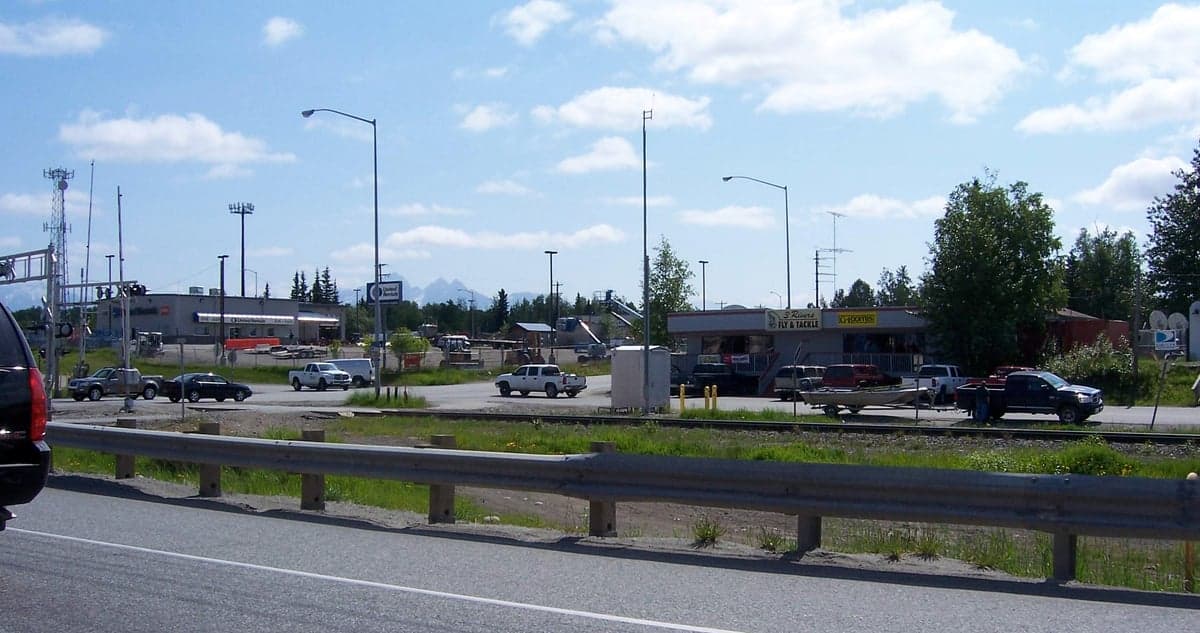
Photo: Wikipedia
Demographics of Wasilla, AK
Affluence Level in Wasilla, AK
A below-average socioeconomic profile. Incomes, home values, and educational attainment trail the U.S., with higher poverty and unemployment.
People of Wasilla, AK
The people of Wasilla, Alaska, today number 9,435, forming a predominantly white (74.9%), family-oriented community with a distinctly rural-Alaskan character. The city is notably less diverse than the state as a whole, with a foreign-born population of just 1.2% and a college attainment rate of 18.5%, reflecting a blue-collar, resource-driven demographic. Wasilla’s identity is shaped by its history as a railroad and mining supply hub, later a bedroom community for Anchorage, and more recently a magnet for conservative-leaning families seeking space, self-reliance, and lower costs.
How the city was settled and grew
Wasilla’s founding population arrived in the early 20th century, drawn by the construction of the Alaska Railroad (1915–1923) and the promise of homesteading land. The town was officially established in 1917 as a supply point for miners working the Willow Creek gold district. The original settlers were overwhelmingly white, working-class Americans—many from the Midwest and Pacific Northwest—who staked claims in areas that now form the Historic Wasilla Downtown district and the Lake Lucille neighborhood. The railroad brought a small influx of Scandinavian and Finnish immigrants, who worked as track layers and miners, settling along the rail corridor near Knik-Goose Bay Road. By 1950, Wasilla’s population was still under 500, almost entirely white, with a handful of Dena’ina Athabascan families living on the outskirts. The town remained a quiet agricultural and mining service center until the 1970s.
Modern era (post-1965)
The post-1965 era in Wasilla was defined not by international immigration but by explosive domestic in-migration, particularly after the completion of the George Parks Highway in 1971. This road connected Wasilla to Anchorage (45 miles south), transforming it into a commuter suburb. The population surged from roughly 300 in 1970 to over 5,000 by 1990. New arrivals were overwhelmingly white families from Anchorage and the Lower 48, seeking affordable land and a slower pace. They built subdivisions in Meadow Lakes and Cottonwood Creek, areas that remain predominantly white and middle-class today. The Hispanic share (4.9%) and East/Southeast Asian share (2.0%) grew modestly during this period, largely through service-industry workers and military-affiliated families connected to nearby Joint Base Elmendorf-Richardson. The Black population (0.9%) and Indian subcontinent population (0.4%) remain very small, concentrated in newer subdivisions like Parkside and Wasilla Lakes. The city’s foreign-born rate of 1.2% is among the lowest in Alaska, reflecting limited international migration and a strong pull for native-born Americans seeking a conservative, rural lifestyle.
The future
Wasilla’s population is projected to continue growing slowly, driven by domestic in-migration of white families from Anchorage and the Lower 48, as well as retirees. The city is not homogenizing into a single bloc but rather tribalizing into distinct enclaves: long-time residents cluster around Lake Lucille and the historic core, while newer arrivals fill subdivisions in Meadow Lakes and Knik-Fairview. The Hispanic and East/Southeast Asian communities are growing slowly, primarily through natural increase and a trickle of service-sector workers, but they are not forming large ethnic enclaves. The Indian subcontinent population is plateauing, with most families assimilating into predominantly white neighborhoods. The next 10–20 years will likely see Wasilla become slightly more diverse, but it will remain a heavily white, conservative-leaning community. The biggest demographic shift will be aging: the median age is rising as retirees move in and younger families struggle with housing costs. For someone moving in now, Wasilla offers a stable, low-diversity environment where community ties are strong and newcomers are expected to integrate into existing social structures.
Wasilla is becoming a more settled, suburban version of its frontier self—still overwhelmingly white and native-born, but slowly absorbing modest Hispanic and Asian growth. For a conservative-leaning family or individual, this means a community where traditional values and self-reliance remain central, and where demographic change is gradual enough to feel manageable. The city’s future is one of steady, moderate growth, not transformation.

* Values derived from national, state, county, city and local statistics and may differ in a specific area. Last updated: 2026-04-19T09:55:04.000Z
Narrative content on this page is AI-generated and may contain mistakes. Verify any details that matter before acting on them.
ReloMaps may earn a commission from affiliate links at no extra cost to you.

