Photo: Wikipedia
Demographics of West Des Moines, IA
Affluence Level in West Des Moines, IA
A middle-class area roughly in line with national averages across income, home values, education, and employment.
People of West Des Moines, IA
Today, West Des Moines is a predominantly white, highly educated, and affluent suburban city of nearly 70,000 residents, where 54.6% of adults hold a college degree and the population is 78.3% white. It is a place shaped by successive waves of domestic migration—first by railroad workers and farmers, then by corporate transferees and professionals fleeing urban cores—rather than by large-scale international immigration. The city’s identity is rooted in its role as a white-collar employment hub and a family-oriented suburb, with a modest but growing Hispanic and Asian presence that is concentrated in specific newer subdivisions.
How the city was settled and grew
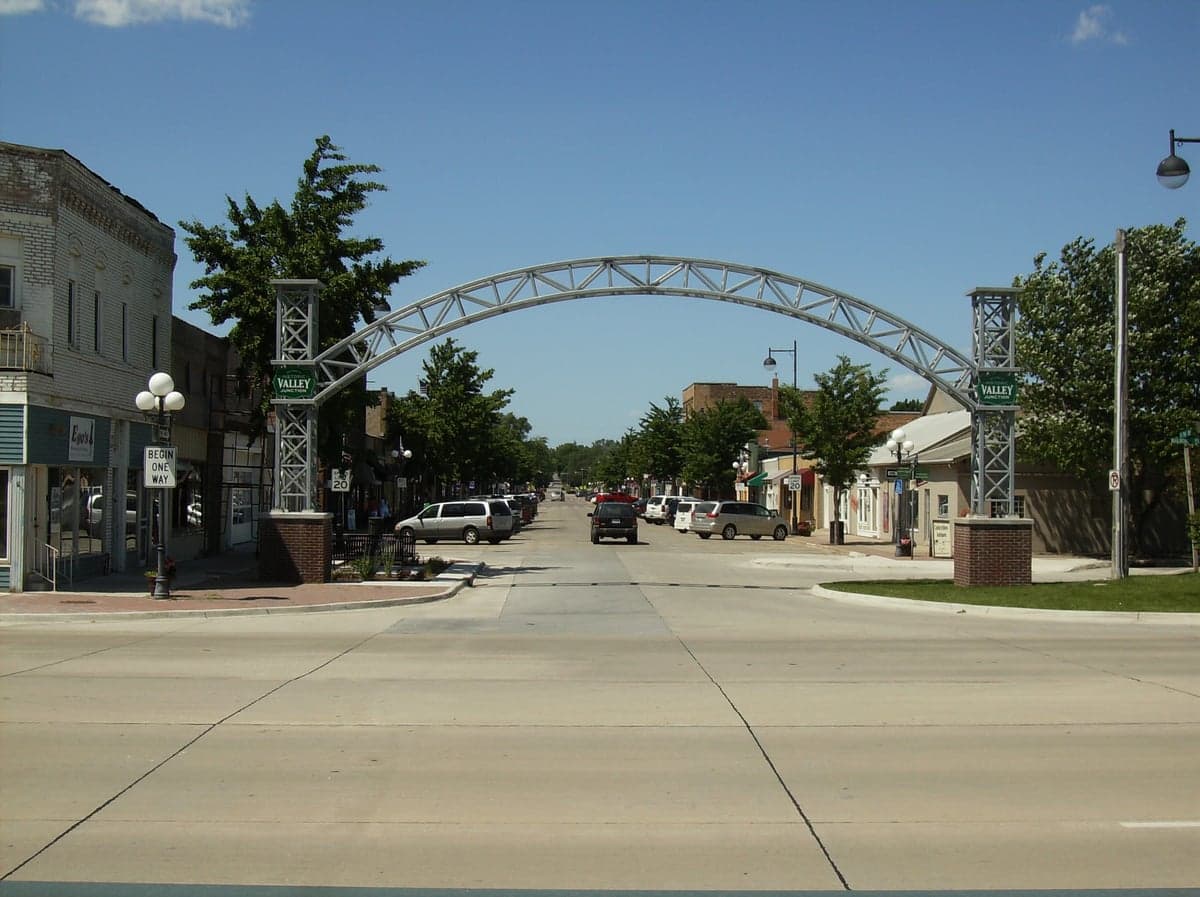
West Des Moines began as a railroad town called Valley Junction, platted in 1867 at the junction of the Chicago, Rock Island and Pacific and the Des Moines Valley railroads. The original population was almost entirely native-born white Americans—farmers, railroad laborers, and small merchants—who built modest homes in the Historic Valley Junction district, which remains the city’s original commercial core. A second wave came during the 1920s and 1930s as Des Moines’s streetcar lines extended west, drawing middle-class families to bungalow neighborhoods like Ashworth Park and Westwood. These early residents were overwhelmingly of Northern European Protestant stock—German, Swedish, and English—and the city remained a small, sleepy suburb of about 5,000 people through World War II. No significant immigrant enclaves formed during this period; the population was nearly 100% white until the 1960s.
Modern era (post-1965)
The city’s modern demographic transformation began after 1965, driven not by the Hart-Cellar Act but by corporate relocations and white flight from Des Moines proper. The opening of the Valley West Mall in 1975 and the expansion of the Westown Parkway corridor turned West Des Moines into a regional retail and office hub, attracting thousands of middle- and upper-middle-class families from across the metro. These newcomers were still overwhelmingly white, but they were more diverse in religious background—including a growing number of Catholic and Jewish families—and they settled in master-planned subdivisions like West Glen and Southwoods. The city’s population surged from 11,000 in 1970 to 46,000 by 2000. The foreign-born share remained low (under 5%) through the 1990s, with the first notable non-white arrivals being a small number of East/Southeast Asian professionals—primarily Vietnamese and Korean—who moved into the Western Hills area for tech and insurance jobs. The Indian subcontinent community, now 3.0% of the population, began arriving in the 2000s, drawn by positions at Wells Fargo, Principal Financial, and other corporate headquarters along the I-235 corridor; they concentrated in newer subdivisions near Jordan Creek Town Center, where home prices and school ratings are highest. The Hispanic population (6.1%) grew more slowly, largely through domestic migration from other Midwestern states, and is more dispersed across the city’s older apartment complexes and starter-home neighborhoods near Valley Junction.
The future
West Des Moines is not homogenizing; rather, it is tribalizing into distinct income- and ethnicity-based enclaves. The white, college-educated majority continues to dominate the western half of the city—the Jordan Creek and West Glen areas—while the eastern half, closer to the original Valley Junction core, is becoming more ethnically mixed and economically diverse. The Hispanic share is projected to rise to 8–9% by 2035, driven by natural increase and continued domestic migration, but the city is unlikely to see large-scale international immigration because it lacks the industrial or agricultural jobs that attract foreign-born workers elsewhere in Iowa. The East/Southeast Asian and Indian communities are plateauing as corporate hiring stabilizes; their children are assimilating into the white professional class through high educational attainment. The overall population is expected to grow slowly—to roughly 75,000 by 2035—as developable land runs out and housing prices push younger families to adjacent suburbs like Waukee and Van Meter. The city will remain a predominantly white, affluent, and politically moderate enclave, with a small but stable non-white minority concentrated in specific neighborhoods.
For a conservative-leaning mover, West Des Moines offers a low-crime, high-amenity environment where the population is largely native-born, English-dominant, and family-oriented. The city’s demographic trajectory is one of slow, managed growth rather than rapid diversification, and the main cultural divide is between older, established residents in historic neighborhoods and newer, wealthier arrivals in the western subdivisions—not between racial or ethnic groups. It is a place where a newcomer can expect to find a community that looks and votes much like the one they left behind, with the added benefit of strong schools and a stable job market.

* Values derived from national, state, county, city and local statistics and may differ in a specific area. Last updated: 2026-04-19T08:47:25.000Z
Narrative content on this page is AI-generated and may contain mistakes. Verify any details that matter before acting on them.
ReloMaps may earn a commission from affiliate links at no extra cost to you.

