Photo: Wikipedia
Demographics of West Fargo, ND
Affluence Level in West Fargo, ND
A middle-class area roughly in line with national averages across income, home values, education, and employment.
People of West Fargo, ND
West Fargo, North Dakota, is a rapidly growing suburban city of 39,325 residents that has transformed from a railroad and agricultural service hub into a predominantly white, family-oriented bedroom community with a strong conservative character. The population is notably young and educated, with 45.2% holding college degrees, and remains overwhelmingly white at 85.9%, with small but distinct minority communities. The city’s identity is shaped by its roots as a working-class railroad town and its recent evolution into a sought-after suburb for families seeking newer housing, good schools, and a quieter alternative to neighboring Fargo.
How the city was settled and grew
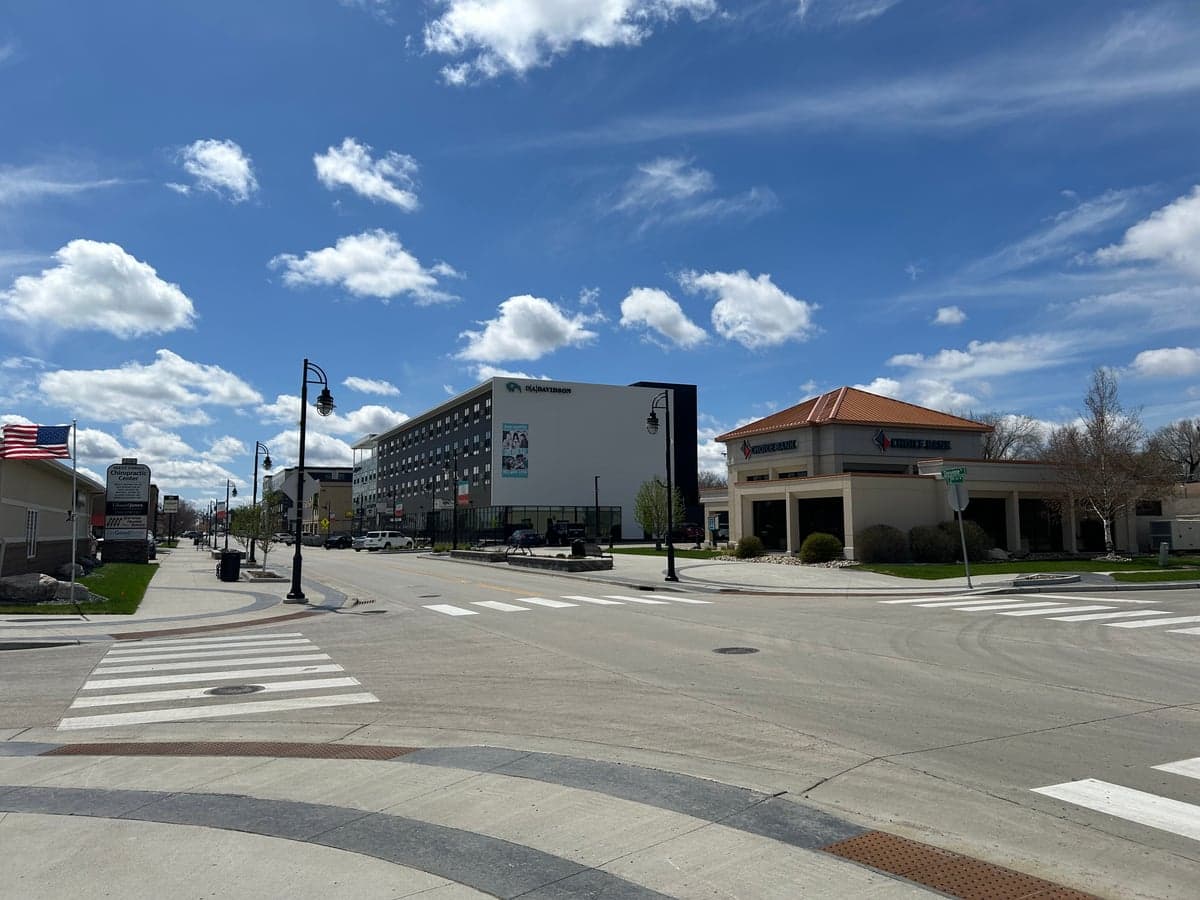
West Fargo’s human history begins not with homesteaders but with the railroad. Founded in the 1870s as a stop on the Northern Pacific Railway, the settlement was originally called “Haggart” before being renamed West Fargo in 1935. The first residents were overwhelmingly Northern European immigrants—Norwegians, Germans, and Swedes—who arrived to work the railroad and farm the surrounding Red River Valley flatlands. These early settlers built their homes in what is now the Historic Downtown West Fargo district, centered along Main Avenue and Sheyenne Street, where modest wood-frame houses and grain elevators defined the landscape. The city remained a small, ethnically homogeneous railroad and farm service town through the mid-20th century, with population hovering around 1,500 as late as 1950. The original Scandinavian families established the Lutheran and Catholic churches that still anchor the community, and their descendants remain a visible presence in the older neighborhoods near the downtown core.
Modern era (post-1965)
The post-1965 era brought no major immigration wave to West Fargo; instead, the city’s growth came from domestic in-migration, primarily white families moving from rural North Dakota and Minnesota. The 1970s and 1980s saw the first suburban subdivisions appear, with the Shadow Wood and Prairie Rose neighborhoods drawing young families seeking larger lots and newer schools. The city annexed farmland to the south and west, creating the Southpointe and Eagle Run subdivisions in the 1990s and 2000s, which filled with commuters working in Fargo’s healthcare, education, and technology sectors. The foreign-born population remains very low at 2.5%, and the city’s minority communities are small: Black residents make up 3.6%, Hispanic residents 2.3%, East/Southeast Asian residents 1.3%, and Indian-subcontinent residents 0.8%. These groups are not concentrated in any single neighborhood but are scattered across newer subdivisions, with no distinct ethnic enclaves forming. The city’s growth has been almost entirely driven by white domestic migration, with the population surging from roughly 12,000 in 1990 to nearly 40,000 today.
The future
West Fargo’s population is heading toward continued growth and homogenization rather than diversification. The city is projected to reach 50,000 residents by 2035, with most new arrivals expected to be white families from within the region, drawn by the West Fargo School District’s reputation and the availability of new construction in developments like River Ridge and Sheyenne Crossing. The small Black, Hispanic, and Asian communities are likely to grow slowly through natural increase and limited new migration, but they will remain small percentages of the total population. There is no evidence of tribalization into distinct ethnic enclaves; instead, the city is becoming more uniformly middle-class and family-oriented. The Indian-subcontinent community, at 0.8%, is too small to form a visible cluster, and East/Southeast Asian residents are similarly dispersed. The next decade will likely see West Fargo become an even more homogeneous, conservative-leaning suburb, with little demographic change beyond continued white in-migration.
For someone moving in now, West Fargo is a stable, growing, and culturally uniform community where the population is overwhelmingly white, family-focused, and politically conservative. The city offers new housing, good schools, and low crime, but little ethnic or cultural diversity. New residents will find a place that is becoming more suburban and less connected to its railroad past, with a population that is likely to remain demographically similar for the foreseeable future.

* Values derived from national, state, county, city and local statistics and may differ in a specific area. Last updated: 2026-04-19T05:31:29.000Z
Narrative content on this page is AI-generated and may contain mistakes. Verify any details that matter before acting on them.
ReloMaps may earn a commission from affiliate links at no extra cost to you.

