 Popular
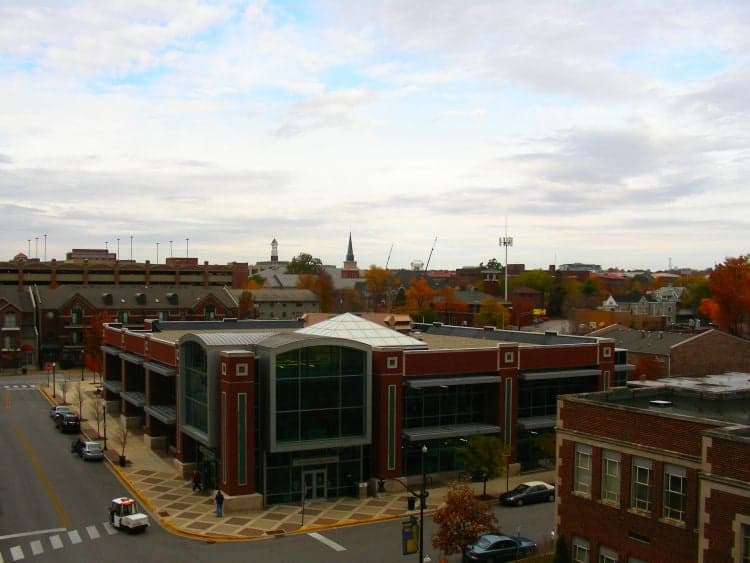
Photo: Wikipedia
Demographics of West Lafayette, IN
Affluence Level in West Lafayette, IN
A middle-class area roughly in line with national averages across income, home values, education, and employment.
People of West Lafayette, IN
West Lafayette, Indiana, is a compact, highly educated college town of 44,802 residents, dominated by Purdue University’s faculty, staff, and student body. The city is notably diverse for the Midwest, with a foreign-born population of 14.4%, and its character is defined by a sharp divide between transient student neighborhoods and established family enclaves. The population is overwhelmingly college-educated at 71.2%, and the largest non-white groups are East/Southeast Asian communities at 12.1% and Indian-subcontinent residents at 8.2%, creating a distinctly international, STEM-oriented atmosphere.
How the city was settled and grew
West Lafayette was platted in 1888, directly across the Wabash River from Lafayette, specifically to serve the newly established Purdue University (founded 1869). The original population was overwhelmingly native-born white, drawn by academic and agricultural-extension jobs. The first major residential district, Chauncey Village (centered on State Street), grew as a walkable student and faculty neighborhood with modest frame houses and boarding houses. The Hills and Dales neighborhood, developed in the 1910s and 1920s, attracted university administrators and local professionals with larger homes and tree-lined streets. A second wave came with the post-WWII GI Bill, which swelled Purdue’s enrollment from 6,000 to over 20,000 by the 1960s. This era saw the construction of the Wabash Shores neighborhood, a planned subdivision of ranch homes for returning veterans and their families, and the expansion of Stadium Avenue as a commercial corridor. The city remained overwhelmingly white through the mid-20th century, with the 1960 census showing a population that was 98.7% white.
Modern era (post-1965)
The 1965 Immigration and Nationality Act fundamentally reshaped West Lafayette’s population. Purdue’s engineering and computer science programs became a global draw, and the university actively recruited international graduate students and faculty. The first significant wave of East/Southeast Asian immigrants—primarily Chinese, Taiwanese, and Korean—arrived in the 1970s and 1980s, settling in the Northwestern Avenue corridor and the McCormick Road area near campus, where apartment complexes catered to graduate students. A second wave of Indian-subcontinent immigrants, largely from Gujarat and Andhra Pradesh, began arriving in the 1990s and accelerated after 2000, drawn by Purdue’s strong engineering and management programs. These families concentrated in the Yeager Road and Lindberg Road neighborhoods, where newer single-family subdivisions offered good school access. The Hispanic population, at 5.6%, is smaller and more dispersed, with a notable cluster in the South River Road area near mobile home parks and service-industry jobs. The Black population, at 3.7%, remains modest and is primarily composed of Purdue staff and graduate students, with no single dominant neighborhood. Domestic in-migration from other states has been steady, driven by Purdue’s research expansion and the broader Lafayette-West Lafayette metro’s manufacturing base (Subaru, Caterpillar, Wabash National).
The future
West Lafayette’s population is trending toward greater internationalization and educational stratification. The East/Southeast Asian and Indian-subcontinent communities are both growing, but they are not merging into a single "Asian" bloc; they maintain distinct cultural institutions, grocery stores, and religious centers. The Indian community, in particular, is expanding rapidly through both graduate-student inflow and H-1B visa holders who stay after graduation, and they are increasingly buying homes in the Klondike area (unincorporated Tippecanoe County, just west of the city limits) and the West Lafayette South district near Cumberland Avenue. The white population, while still the majority at 66.4%, is aging and shrinking in the student-heavy wards, while the family-oriented Hills and Dales and Wabash Shores neighborhoods remain stable and predominantly white. The Hispanic and Black populations are growing slowly, primarily through natural increase and service-sector migration. The next decade will likely see the foreign-born share rise above 18%, with the city becoming a more pronounced two-tier society: a transient, highly international student body and a settled, professional class of university employees and tech workers.
For a conservative-leaning individual or family considering relocation, West Lafayette offers a stable, low-crime environment with excellent public schools and a strong tax base, but the cultural and political atmosphere is firmly shaped by the university’s liberal academic tilt. The city is becoming more diverse and more international, not less, and the neighborhoods that feel most "traditional Midwestern" are the older, established districts like Hills and Dales and Wabash Shores. New arrivals should expect a community that values education, order, and civic engagement, but where the dominant social and political conversations are driven by a transient, globally-minded population.

* Values derived from national, state, county, city and local statistics and may differ in a specific area. Last updated: 2026-04-22T07:27:17.000Z
Narrative content on this page is AI-generated and may contain mistakes. Verify any details that matter before acting on them.
ReloMaps may earn a commission from affiliate links at no extra cost to you.

