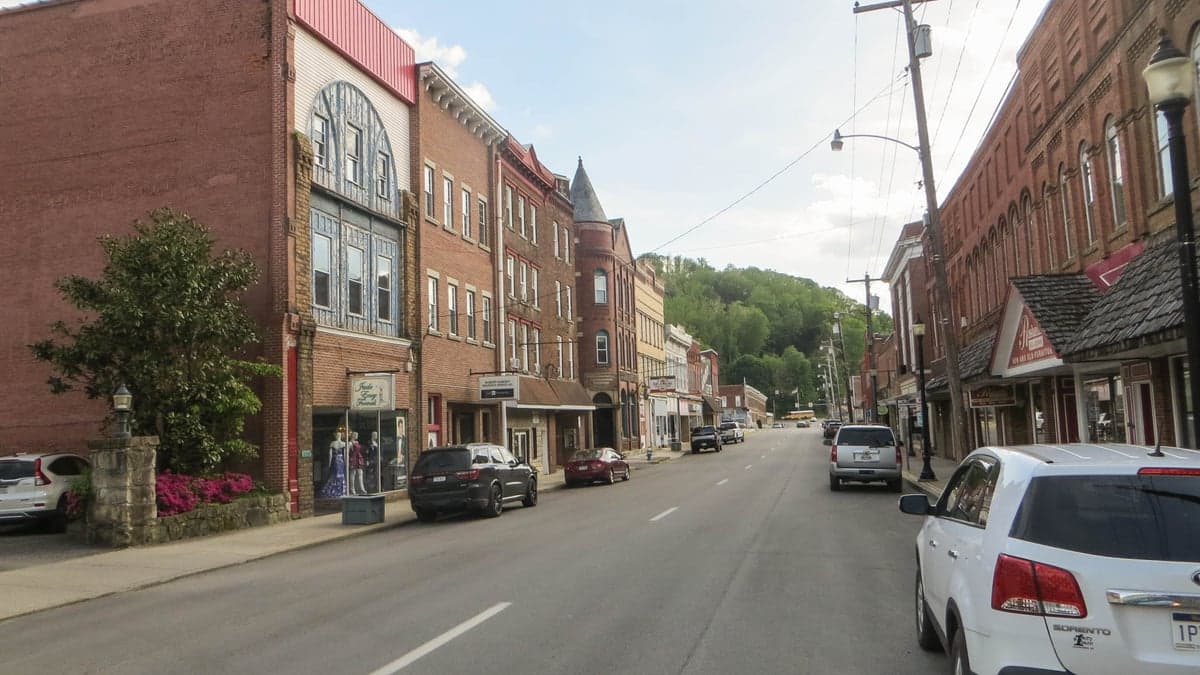
Photo: Wikipedia
Personal Sovereignty in Weston, WV
Viable for self-reliance. Generally workable, though some barriers may limit total independence.
What does Personal Sovereignty tell us?
Personal Sovereignty measures your capacity for self-reliance and independence with minimal government friction. Higher scores mean fewer barriers between you and the way you want to live... but it assumes you have the space you need and good neighbors.
What does this tell us?
Personal Sovereignty measures your capacity for self-reliance and independence with minimal government friction. Higher scores mean fewer barriers between you and the way you want to live... but it assumes you have the space you need and good neighbors.
State Policy
Energy independence: Net exporter (200% of energy produced in-state)
Personal Liberty
Homesteading

Personal Liberty Analysis
Weston, West Virginia, offers a level of personal sovereignty that is increasingly rare in the modern United States, making it a serious consideration for those prioritizing autonomy over convenience. Nestled in Lewis County, this small town operates within a state framework that has deliberately pushed back against federal overreach, particularly in the realms of gun rights, medical freedom, and property use. For the individual or family looking to minimize government entanglement while maximizing self-reliance, Weston presents a strategic environment where the law largely stays out of your way—provided you are prepared to handle the practical realities of rural living.
Tax burden and regulatory posture: How Weston keeps government off your back
West Virginia’s tax structure is one of the most favorable in the nation for those seeking to keep more of what they earn. The state has no gross receipts tax on business, and its corporate net income tax is a flat 6.5%, which is competitive for small operations. For individuals, the personal income tax is a graduated rate topping out at 6.5% on income over $60,000—a far cry from the double-digit rates in neighboring states like Maryland or Pennsylvania. Property taxes in Lewis County are exceptionally low, with the effective rate on residential real estate hovering around 0.5% to 0.7% of assessed value, and assessments are typically well below market value. This means a modest home on a few acres might cost you a few hundred dollars annually in property tax. The regulatory posture at the county level is equally lean. Weston does not have the kind of zoning overlay that plagues suburban communities; most unincorporated land in Lewis County is subject to minimal land-use regulation. There is no county-wide building code for agricultural structures, and the state’s right-to-farm law provides strong protections against nuisance lawsuits if you keep livestock or operate a small farm. The biggest regulatory hurdle is the state-level sales tax of 6%, which applies to most goods, but there is no local option to add more. For a prepper or survivalist, the message is clear: the government takes a small, predictable cut and otherwise leaves you alone.
Self-defense and gun law specifics: Constitutional carry and castle doctrine in practice
Weston sits in a state that treats the Second Amendment as a fundamental right, not a privilege to be licensed. West Virginia is a constitutional carry state, meaning any law-abiding adult 21 or older can carry a concealed firearm without a permit. There is no state-level firearm registration, no waiting periods for purchase, and no restrictions on magazine capacity or "assault weapon" features. The state preempts all local gun ordinances, so the city of Weston cannot impose its own restrictions—what is legal in the county is legal on Main Street. The castle doctrine is robust: you have no duty to retreat from your home, vehicle, or place of business, and the use of deadly force is presumed justified if an intruder has unlawfully and forcibly entered. Stand-your-ground protections extend to any place you are lawfully present. For the survivalist, this means your defensive preparations—whether a sidearm for daily carry or a rifle for home defense—are entirely unencumbered by the kind of permitting schemes found in blue states. The only notable limitation is that carrying on school property is restricted without specific authorization, but the state does allow for the storage of firearms in locked vehicles on school grounds. If self-defense is a cornerstone of your sovereignty calculus, Weston offers near-maximum legal latitude.
Self-reliance and homesteading viability: Lot sizes, zoning, and off-grid feasibility
The physical environment around Weston is where the sovereignty concept truly meets the ground. Lewis County is predominantly rural, with large tracts of undeveloped land available at prices that are a fraction of national averages. A typical building lot in the county can range from one to five acres, with raw land selling for $2,000 to $5,000 per acre depending on proximity to town and road access. Zoning is virtually nonexistent outside the city limits; you can build a home, erect a barn, or set up a workshop without navigating a planning board. Off-grid living is entirely feasible. There are no county-level restrictions on rainwater collection, and the state has no laws prohibiting the use of solar panels, composting toilets, or propane generators as primary utilities. The main practical consideration is well and septic: you will need to drill a well (typically $5,000 to $10,000) and install a septic system (another $5,000 to $15,000), but once those are in place, you are independent of municipal water and sewer. The county does not require building permits for structures under 200 square feet, so a small cabin or storage shed can go up without any government paperwork. For the prepper focused on food production, Lewis County Extension Service reports that the growing season runs roughly from mid-April to mid-October, and the soil in the area is generally suitable for gardens and small orchards. Raising chickens, goats, or even a few head of cattle is common and unregulated. The biggest challenge is not the law but the logistics: Weston is about 90 minutes from any major hospital or big-box retailer, so self-reliance here means being prepared for long supply lines and limited emergency services.
Personal liberties: Parental rights, medical autonomy, speech, and property
West Virginia has become a battleground for personal liberties in recent years, and the outcomes have largely favored individual sovereignty. Parental rights are strongly protected by state law; parents have the explicit right to direct the upbringing, education, and healthcare of their children, including the right to opt out of any school curriculum or activity they find objectionable. The state does not mandate vaccines for school attendance—medical and religious exemptions are available, and the process is straightforward. Medical autonomy extends to adults as well: West Virginia has no state-level vaccine passport requirement, and the legislature has passed laws prohibiting discrimination based on vaccination status for public services and employment. The state also has a robust conscience clause for healthcare providers, but for the individual, the key point is that you are not forced to accept medical interventions you oppose. Free speech is protected under the state constitution, and there are no hate speech laws or social media censorship mandates at the state level. Property rights are secured by a strong eminent domain statute that requires "public use" in the traditional sense—economic development takings are prohibited. The state also has a right-to-repair law that covers agricultural equipment, which is a practical benefit for anyone maintaining their own machinery. The one area where Weston falls short of full sovereignty is in the realm of land-use appeals: if you do run afoul of the few regulations that exist, the county commission has final say, and there is no state-level property rights ombudsman to intervene. But for the vast majority of daily life—what you teach your kids, what medical choices you make, what you say in public, and what you do on your own land—the government is a distant observer, not an active participant.
In the broader landscape of American personal sovereignty, Weston, WV, ranks as a strong contender for those willing to trade urban convenience for genuine autonomy. Compared to the heavily regulated environments of the Northeast or West Coast, this town offers a legal and cultural framework that respects the individual's right to live, defend, and provide for themselves without constant state oversight. The trade-offs are real: limited economic opportunity, distance from specialized medical care, and a slower pace of life that can feel isolating. But for the survivalist or the conservative-minded parent who sees the state as a potential threat rather than a provider, Weston represents a place where the law is on your side—and where the biggest obstacle to your freedom is not the government, but your own willingness to take responsibility for your life.

* Values derived from national, state, county, city and local statistics and may differ in a specific area. Last updated: 2026-05-01T06:56:29.000Z
Narrative content on this page is AI-generated and may contain mistakes. Verify any details that matter before acting on them.
ReloMaps may earn a commission from affiliate links at no extra cost to you.

