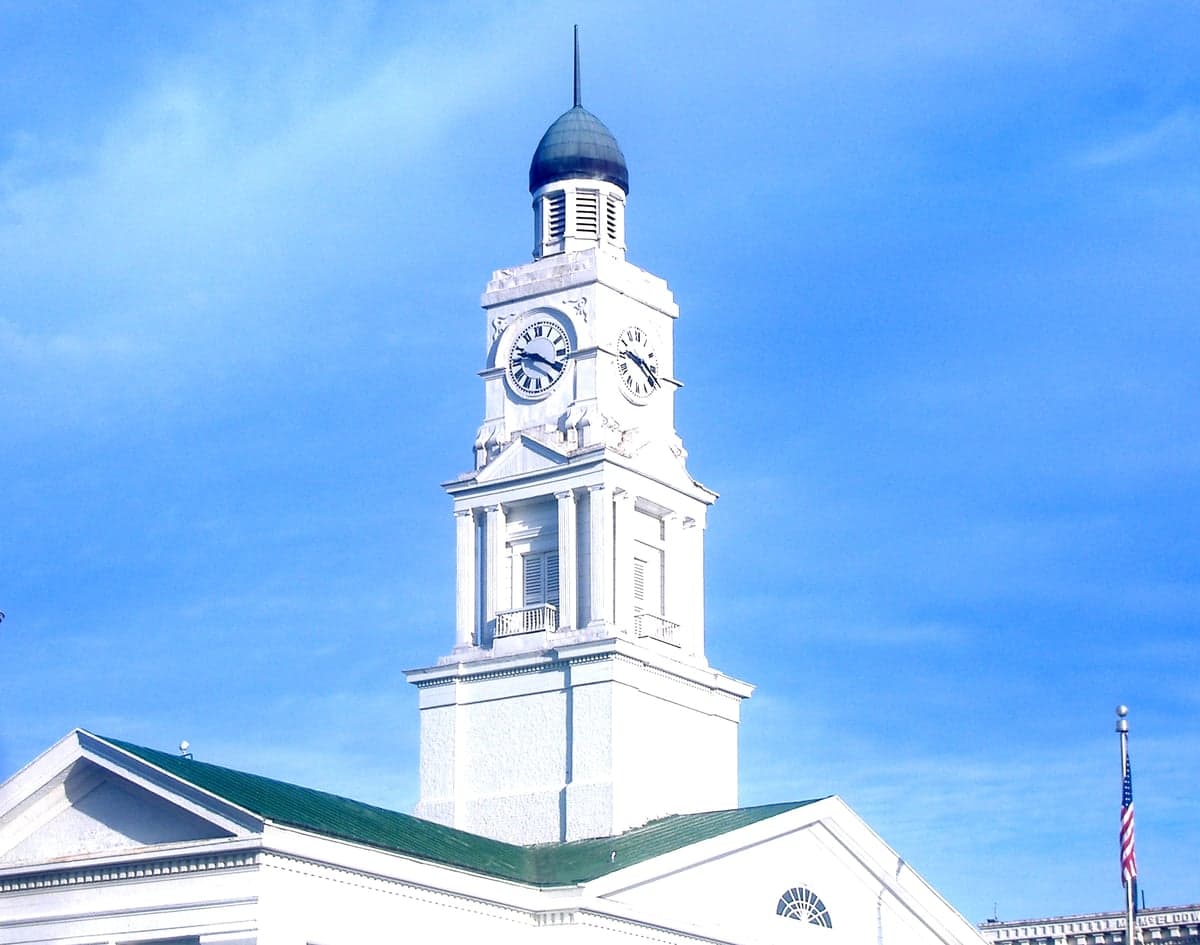
Photo: Wikipedia
Demographics of Winchester, KY
Affluence Level in Winchester, KY
A middle-class area roughly in line with national averages across income, home values, education, and employment.
People of Winchester, KY
The people of Winchester, Kentucky, today form a predominantly white, native-born community of just over 19,000 residents, characterized by a strong sense of local identity and a slower pace of life than the nearby Lexington metro area. With a foreign-born population of only 0.5% and a college attainment rate of 21.0%, the city is notably less diverse and less educated than the national average, reflecting its roots as a manufacturing and agricultural hub. Distinctive markers include a deep connection to the region's bourbon and horse heritage, a visible Black community concentrated in the historic West End, and a small but growing Hispanic presence, primarily in newer subdivisions on the city's southern edge.
How the city was settled and grew
Winchester's population story begins with European-American settlers moving through the Cumberland Gap in the late 18th century, drawn by land grants awarded to veterans of the Revolutionary War. The city was formally established in 1792 as the seat of Clark County, named for George Rogers Clark, and its early growth was fueled by the fertile Bluegrass soil and the establishment of a courthouse square. The original settlers were largely of English, Scots-Irish, and German stock, building the first homes and businesses around what is now the Downtown Historic District, centered on Main Street and the Clark County Courthouse. By the mid-19th century, the arrival of the Louisville and Nashville Railroad spurred a second wave, bringing Irish and German laborers who settled in the Railroad Addition neighborhood near the depot, working on the tracks and in the early distilleries that dotted the creeks. The post-Civil War era saw a small but significant migration of freed African Americans from surrounding farms into Winchester, who established a tight-knit community in the West End, centered on West Broadway and North Main Street, where churches, schools, and businesses served the Black population through the Jim Crow era.
Modern era (post-1965)
The post-1965 period brought subtle but notable shifts. The Hart-Cellar Act had minimal direct impact on Winchester's foreign-born population, which remains at just 0.5% today, but domestic migration patterns reshaped the city. The decline of small-scale farming and the rise of manufacturing—particularly at the GE Lighting plant (now Current Lighting) and the Ale-8-One bottling facility—drew white working-class families from rural Clark County and eastern Kentucky into neighborhoods like Oakwood Estates and Sunset Park, built in the 1970s and 1980s on the city's north and east sides. The Black population, which had been concentrated in the West End, began a slow dispersal into other parts of the city, though the West End remains the cultural heart of the African American community, anchored by First Baptist Church and the historic Oliver Street School. The Hispanic population, now at 3.5%, began arriving in the 1990s, drawn by jobs in construction, landscaping, and the Winchester Farm processing plant. These families initially settled in rental housing near the industrial corridor along Bypass Road, but have since moved into starter homes in the Southgate subdivision, a newer development near the Clark County Fairgrounds. The East/Southeast Asian community (1.2%) is small and largely professional, with families often connected to the University of Kentucky in Lexington, choosing Winchester for its lower housing costs and settling in the Meadowbrook area near Interstate 64.
The future
Winchester's population is projected to grow modestly, driven by spillover from Lexington's expanding metro area, but the city is unlikely to see rapid diversification. The white population (84.4%) remains dominant, and the foreign-born share is so low that even a doubling would still leave it below 2%. The Hispanic community is the fastest-growing segment, with families in Southgate and newer developments like Hunter's Trace likely to increase as construction and service-sector jobs persist. The Black population has stabilized at around 7.2%, with younger generations often leaving for larger cities, while the Indian subcontinent community (0.4%) is tiny and transient, typically tied to short-term professional assignments. The city is not tribalizing into distinct enclaves; rather, it is slowly homogenizing as new subdivisions attract a mix of white and Hispanic families, while the historic West End remains a stable Black neighborhood. The next 10-20 years will likely see Winchester become a slightly more diverse, still predominantly white bedroom community for Lexington, with a population that values affordability, local schools, and a conservative social fabric.
For someone moving in now, Winchester offers a stable, low-diversity community with a strong sense of place, where newcomers are welcomed but expected to integrate into existing local traditions. The city is becoming a quieter, more suburban version of its manufacturing-era self, with growth concentrated in new housing developments rather than in demographic transformation. It is a place where the past—pioneer, railroad, and bourbon—still shapes the present, and where the future looks much like today, only a bit larger.

* Values derived from national, state, county, city and local statistics and may differ in a specific area. Last updated: 2026-04-21T09:55:06.000Z
Narrative content on this page is AI-generated and may contain mistakes. Verify any details that matter before acting on them.
ReloMaps may earn a commission from affiliate links at no extra cost to you.

