

Photo: Wikipedia
Political ClimatePolitical Climate in Winchester, KY
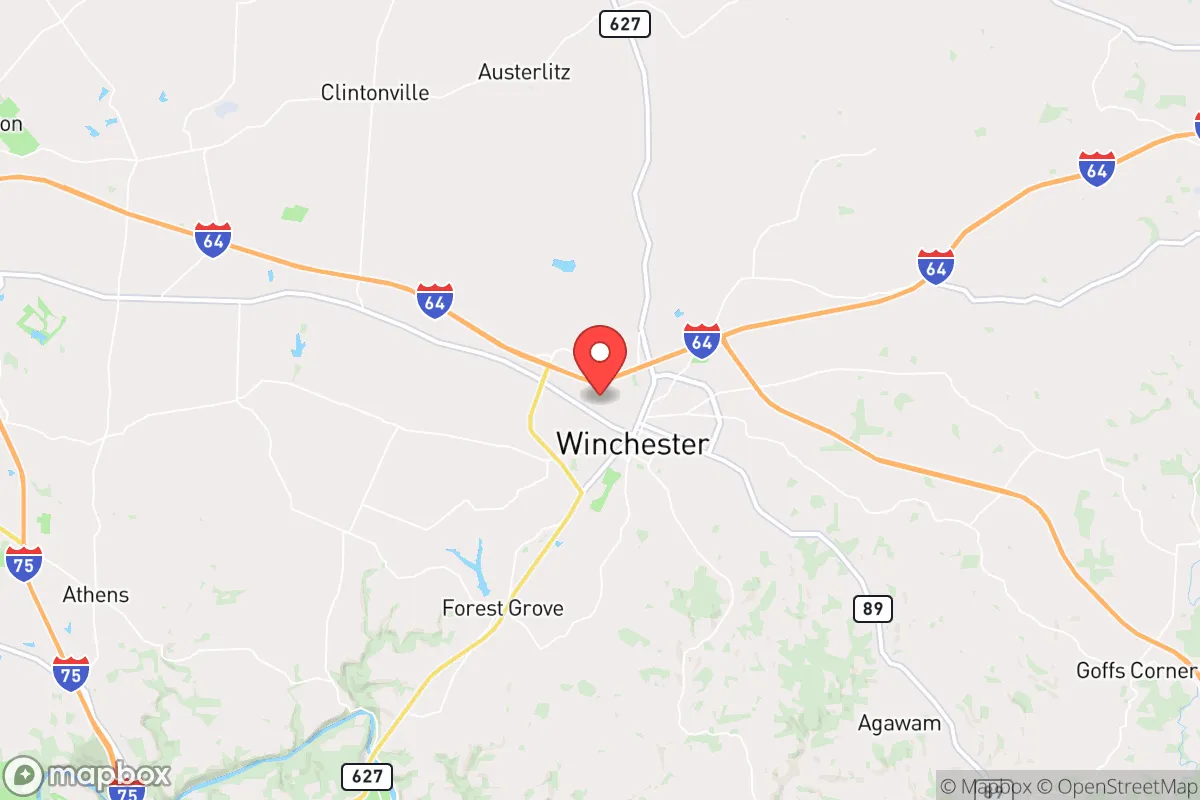
District shown is the primary district for this city’s centroid. Cities may span multiple districts.
Local Political AnalysisPolitical Analysis of Winchester, KY
Winchester, Kentucky, has long been a solidly conservative community, and that hasn't changed much even as the rest of the country has gotten more divided. The Cook PVI rating of R+7 tells you the basics—this area leans Republican by a comfortable margin—but it doesn't capture the local flavor. People here still value personal responsibility and don't take kindly to government telling them how to run their lives, whether it's about business, property, or family decisions. That said, you can feel a subtle shift in the air, especially as more folks move in from Lexington and other bigger cities, bringing with them a more progressive mindset that rubs some of us the wrong way.
How it compares
Drive twenty minutes west to Lexington, and you're in a completely different world—politically, culturally, and economically. Lexington leans blue, with a lot of university influence and younger transplants who push for things like higher taxes, more regulations, and social policies that feel out of step with Winchester's values. Meanwhile, towns like Mount Sterling to the east and Richmond to the south are more in line with Winchester's conservative roots, though even Richmond has started to feel the pull of Lexington's sprawl. Winchester sits right on that edge, and you can see the tension in local elections: the old guard fighting to keep taxes low and government small, while newer residents push for more spending on parks, bike lanes, and "equity" initiatives that sound nice but often come with strings attached. The contrast is real, and it's something to watch if you're thinking about moving here.
What this means for residents
For now, Winchester remains a place where you can still breathe without the government breathing down your neck. Property taxes are reasonable, zoning is minimal, and you won't find a lot of red tape if you want to start a small business or build a shed in your backyard. But the creeping influence of progressive ideology is something to keep an eye on. There's been talk about adopting more stringent building codes and environmental regulations that sound good on paper but would drive up costs for everyone. The school board has also seen some heated debates over curriculum and library books, with a vocal minority pushing for changes that many of us see as unnecessary government overreach into what our kids are taught. If you value personal freedoms and want to live somewhere that still respects the idea of limited government, Winchester is a solid bet—but it's not immune to the trends sweeping the country.
One thing that sets Winchester apart is its strong sense of local identity. People here still wave the flag, go to church, and look out for their neighbors without needing a government program to do it. The annual Clark County Fair and the local farmers market are more than just events—they're reminders that community works best when it's voluntary, not mandated. That said, the long-term trajectory depends on who shows up to vote and who decides to run for office. If you're considering a move, just know that Winchester is a place where conservative values still hold strong, but you'll need to stay engaged to keep it that way. The alternative is watching it turn into another Lexington, and nobody here wants that.

State Political ClimatePolitical Climate in Kentucky
State Political AnalysisPolitical Environment in the State
Kentucky has long been a reliably red state in federal elections, but its political climate is more nuanced than a simple partisan label suggests. The state has voted Republican in every presidential election since 2000, with Donald Trump carrying it by over 25 points in both 2016 and 2020. However, the state’s political trajectory over the past 10-20 years has been one of steady conservative consolidation, driven by a rural-urban divide that has widened considerably. The dominant coalition is a mix of rural and suburban conservatives, with the state’s two major metro areas—Louisville and Lexington—pulling in opposite directions, while the rest of the state has become increasingly Republican.
Urban vs. rural divide
The political map of Kentucky is a study in contrasts. Jefferson County, home to Louisville, is the state’s most populous county and a Democratic stronghold, consistently voting blue by double digits. Fayette County, home to Lexington, is more of a purple-to-blue area, though it has trended leftward in recent cycles. These two counties are the only real Democratic anchors in the state. Meanwhile, the rest of Kentucky is overwhelmingly Republican. The eastern Appalachian counties—like Pike, Floyd, and Harlan—were once reliably Democratic but have flipped hard red, driven by cultural conservatism and opposition to national Democratic policies on energy and coal. The western part of the state, including counties like McCracken (Paducah) and Warren (Bowling Green), is solidly Republican. The northern suburbs of Cincinnati, in Boone and Kenton counties, are also deeply red. The rural-urban divide is stark: Louisville and Lexington are islands of blue in a sea of red, and the gap is widening as rural areas become more conservative and urban areas become more progressive.
Policy environment
Kentucky’s policy environment is broadly conservative, with a strong emphasis on limited government and individual freedom. The state has a flat income tax rate of 4.5%, which is being phased down from 5% with a goal of eventually eliminating it entirely. Property taxes are low, and there is no state-level estate or inheritance tax. The regulatory posture is business-friendly, with right-to-work laws and a tort reform system that caps non-economic damages in medical malpractice cases. Education policy has been a flashpoint: the state has a robust school choice movement, with charter schools legalized in 2017 (though none have opened yet) and a growing number of private school scholarship tax credit programs. Healthcare is a mixed bag—Kentucky expanded Medicaid under the Affordable Care Act, which was a rare bipartisan move, but the state has since imposed work requirements and premiums for able-bodied adults. Election laws are moderately restrictive: voter ID is required, early voting is limited to three days before Election Day, and absentee voting requires an excuse. The state has not gone as far as some others in tightening election security, but there is ongoing debate about mail-in voting and ballot drop boxes.
Trajectory & freedom
Kentucky is trending toward more personal freedom in several key areas, though not without controversy. On gun rights, the state passed constitutional carry in 2019, allowing law-abiding citizens to carry concealed firearms without a permit. This was a major win for Second Amendment advocates. On parental rights, the state passed a law in 2022 requiring schools to notify parents of any changes to a student’s health or well-being, including gender identity or sexual orientation, and prohibiting instruction on sexual orientation or gender identity in elementary schools. This has been a flashpoint, with critics calling it anti-LGBTQ and supporters saying it protects parental authority. On medical autonomy, Kentucky has some of the most restrictive abortion laws in the country, with a near-total ban that took effect after the Dobbs decision. There is no exception for rape or incest, only to save the mother’s life. On property rights, the state has a strong tradition of protecting landowners, though there have been disputes over eminent domain for pipeline projects. Taxation is moving in a freer direction, with the flat tax phase-down and a gradual reduction in the corporate income tax rate. Overall, the trajectory is toward more conservative governance, but there are ongoing battles over education and healthcare that could shift the balance.
Civil unrest & political movements
Kentucky has seen its share of political activism, but it has been less intense than in some other states. The most visible flashpoint in recent years was the 2020 protests in Louisville following the death of Breonna Taylor, which led to widespread demonstrations, property damage, and a heavy police presence. The protests were largely confined to Louisville and did not spread to the rest of the state. On the right, there is a strong grassroots movement focused on election integrity, with activists pushing for stricter voter ID laws and audits of the 2020 election. There have been calls for a constitutional convention to propose term limits and a balanced budget amendment, but these have not gained mainstream traction. Immigration politics are relatively quiet, as Kentucky is not a border state and has a small immigrant population. There is no sanctuary city policy anywhere in the state. Secession or nullification rhetoric is minimal, though there is a small but vocal group of constitutionalists who advocate for state sovereignty. Overall, the political climate is stable, with most activism centered on education and healthcare policy rather than street-level unrest.
Projection
Over the next 5-10 years, Kentucky is likely to become even more conservative, driven by two main factors: demographic shifts and in-migration. The state is seeing an influx of retirees and remote workers from more expensive and more liberal states, particularly from the Midwest and Northeast. These newcomers tend to be conservative-leaning, drawn by low taxes, low crime, and a slower pace of life. Meanwhile, the urban centers of Louisville and Lexington are growing but not fast enough to offset the rural and suburban gains. The state’s Republican supermajority in the legislature is likely to continue, with further tax cuts, school choice expansion, and additional restrictions on abortion and transgender rights. The biggest wildcard is the coal industry: as coal continues to decline, the eastern part of the state could face economic hardship that might shift political allegiances, but for now, those areas remain deeply red. A new resident moving in now should expect to find a state that is increasingly conservative, with a government that is friendly to business and protective of traditional values, but with a persistent urban-rural divide that will continue to shape local politics.
For a new resident, the bottom line is that Kentucky offers a high degree of personal freedom, low taxes, and a government that is generally aligned with conservative values. The state is not without its challenges—the urban-rural divide is real, and the education system has room for improvement—but for someone looking to escape the high costs and progressive policies of states like California, New York, or Illinois, Kentucky is a solid choice. The political climate is stable, the trajectory is toward more freedom, and the people are generally friendly and welcoming. Just be aware that if you move to Louisville or Lexington, you’ll be in a blue bubble, while the rest of the state is solidly red. Pick your county wisely, and you’ll find a place that fits your values.
* Values derived from national, state, county, city and local statistics and may differ in a specific area. Last updated: 2026-04-21T09:55:06.000Z
Narrative content on this page is AI-generated and may contain mistakes. Verify any details that matter before acting on them.
ReloMaps may earn a commission from affiliate links at no extra cost to you.

