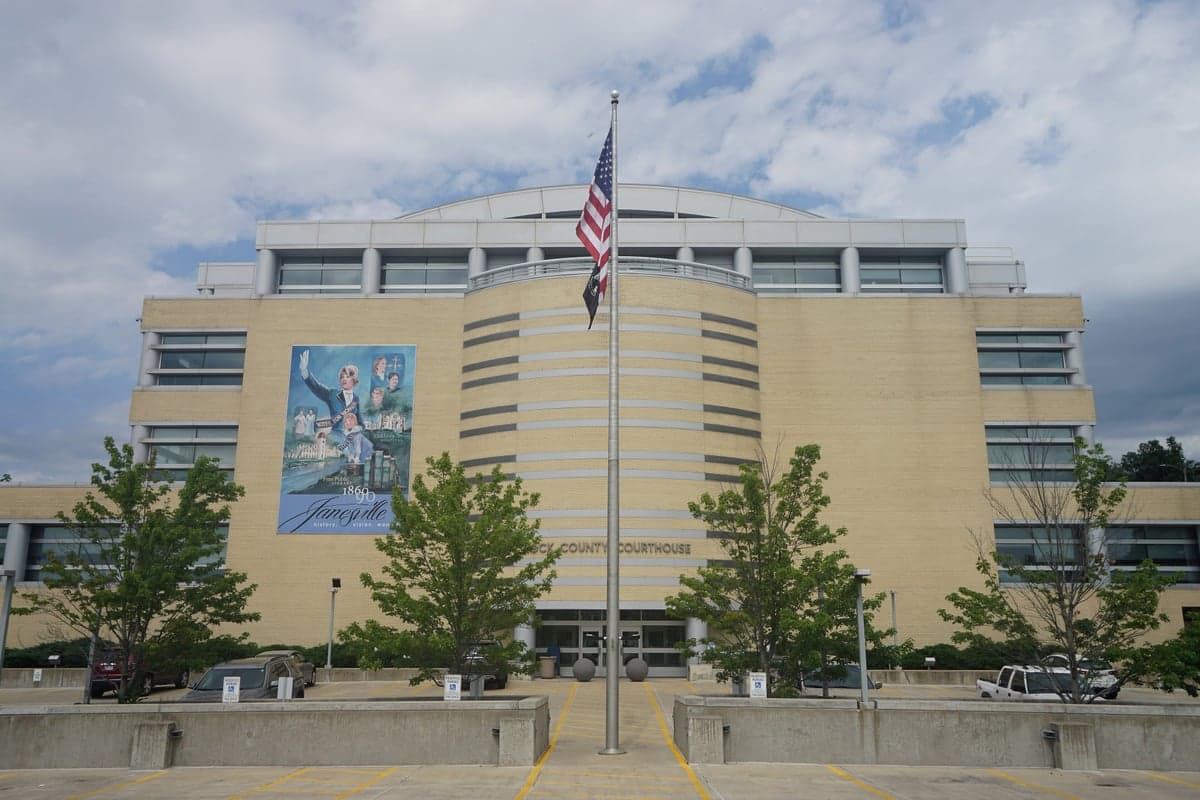
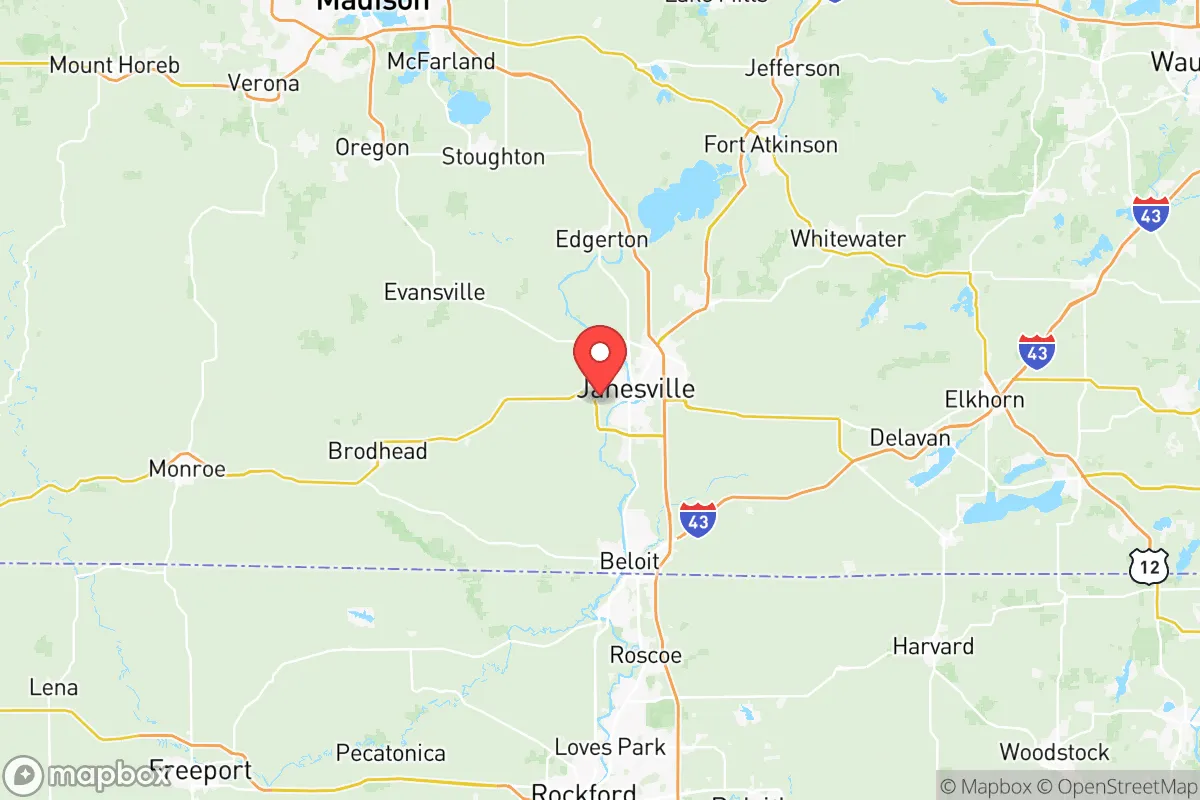
Photo: Wikipedia
Demographics of Rock County
Affluence Level in Rock County
A middle-class area roughly in line with national averages across income, home values, education, and employment.
People of Rock County
Rock County, Wisconsin, is home to 163,944 residents who reflect a predominantly white, historically rooted population with a growing Hispanic presence and modest diversity. The county’s identity is shaped by its agricultural and manufacturing heritage, anchored by the city of Janesville and the town of Beloit, where distinct waves of European settlement and later domestic migration have left lasting imprints. With 80.2% of the population identifying as white, 9.9% as Hispanic, 4.6% as Black, and 1.1% as East/Southeast Asian, Rock County remains less diverse than the national average but is gradually shifting as new groups arrive. The foreign-born share stands at just 2.9%, well below the U.S. average, indicating a population that is overwhelmingly native-born and rooted in generations of Midwestern tradition.
Settlement & growth (pre-1960)
Before American settlement, the Rock County area was inhabited by the Ho-Chunk (Winnebago) people, who lived in villages along the Rock River and its tributaries. French fur traders and missionaries passed through the region in the 17th and 18th centuries, but no permanent European settlements took hold until after the 1832 Black Hawk War, which forced the Ho-Chunk to cede their lands. The first permanent American settlers arrived in the 1830s and 1840s, primarily Yankees from New England and New York, drawn by the fertile prairies and the promise of land under the federal land-grant system. They founded the county’s earliest towns, including Janesville (1835), Beloit (1836), and Milton (1838), establishing a Yankee cultural and political dominance that would persist for decades.
The next major wave came in the 1840s through the 1860s, when German immigrants arrived in large numbers, fleeing economic hardship and political unrest in the German states. They settled heavily in the towns of Clinton, Edgerton, and Evansville, where they established farms, breweries, and Lutheran churches. The Germans were followed by Irish immigrants, who came in the 1850s and 1860s, many working on the railroad lines that connected Janesville and Beloit to Chicago and Milwaukee. The Irish concentrated in Janesville’s south side and in the village of Orfordville, where they found work in the railroad yards and as day laborers.
By the late 19th century, Rock County’s economy diversified beyond agriculture. The arrival of the Chicago & North Western Railway and the Milwaukee Road spurred industrial growth, particularly in Janesville, which became a manufacturing hub. The 1900s saw a smaller influx of Scandinavian immigrants—Swedes and Norwegians—who settled in rural areas around Footville and Brodhead, working as dairy farmers and tradesmen. The county’s population grew steadily, reaching 92,000 by 1950, with the vast majority being of Northern European descent. The post-World War II era brought a wave of domestic migrants from the rural Upper Midwest, drawn by jobs at General Motors’ Janesville Assembly Plant (opened 1919) and the Beloit Corporation’s heavy-equipment factories. This period solidified Rock County’s character as a blue-collar, union-leaning region with a strong manufacturing base.
Modern era (post-1965)
The 1965 Hart-Cellar Act had a limited immediate impact on Rock County, as the region did not attract the large-scale immigrant flows seen in major cities. However, the 1970s and 1980s saw the first significant arrival of Hispanic workers, primarily from Mexico and Puerto Rico, who came to fill labor shortages in agriculture and food processing. These families settled in Janesville and Beloit, where they formed small but growing enclaves near the industrial corridors. By 2000, the Hispanic share of the county’s population had risen to 4.5%, and it has since more than doubled to 9.9% as of 2025. The growth has been driven by both immigration and higher birth rates, with the Hispanic population now concentrated in Janesville’s south side and Beloit’s east side.
The Black population in Rock County has a longer history, dating to the Great Migration of the 1910s–1960s, when African Americans from the South moved north for industrial jobs. Beloit, in particular, became a destination for Black workers at the Beloit Corporation and other factories. The Black share of the population peaked at around 6% in the 1970s but has since declined to 4.6%, partly due to out-migration of younger families to larger cities. The East/Southeast Asian community, at 1.1%, is small and primarily composed of Hmong refugees who resettled in Janesville in the 1980s and 1990s, along with a smaller number of Vietnamese and Chinese families. The Indian-subcontinent population is negligible at 0.1%.
Domestic migration has reshaped the county in recent decades. The closure of the General Motors plant in Janesville in 2008 was a demographic shock, leading to a population decline from 160,000 in 2000 to 163,944 today (a modest recovery). Many former GM workers moved to Sun Belt states like Texas and Florida, while others commuted to jobs in Madison or Milwaukee. Suburbanization has been limited, with most growth occurring in the outer-ring towns of Milton and Evansville, where new subdivisions have attracted families seeking lower taxes and larger lots. The county’s college-educated share is 25.7%, below the national average, reflecting the region’s manufacturing and agricultural roots.
The future
Rock County’s population is likely to continue its slow growth, driven primarily by natural increase among the Hispanic population and modest in-migration from other parts of Wisconsin and the Midwest. The Hispanic share is projected to reach 12–14% by 2035, making it the county’s largest minority group and gradually diversifying the cultural landscape. The white population is aging and declining in absolute numbers, as younger white residents move to larger cities for education and white-collar jobs. The Black and East/Southeast Asian populations are expected to remain stable or grow slightly, but no major new enclaves are forming.
The county is not tribalizing into distinct ethnic enclaves; rather, the Hispanic population is dispersing across Janesville and Beloit, with some second-generation families moving to Milton and Edgerton. The cultural identity of Rock County is absorbing these changes slowly—Hispanic-owned businesses are appearing in downtown Janesville, and bilingual signage is becoming more common, but the overall character remains Midwestern and conservative. The next 10–20 years will likely see a continuation of these trends: a grayer, more Hispanic, but still predominantly white county, with a manufacturing base that is slowly being replaced by logistics and healthcare jobs.
For someone moving in now, Rock County offers a stable, affordable, and safe environment with a strong sense of local identity, but it is not a place of rapid demographic change or cultural dynamism. The population is rooted, the growth is incremental, and the future is one of gradual diversification rather than transformation. New arrivals—whether domestic or foreign—will find a community that is welcoming but expects assimilation into the existing Midwestern norms of self-reliance, neighborliness, and respect for tradition.

* Values derived from national, state, county, city and local statistics and may differ in a specific area. Last updated: 2026-05-12T08:22:18.000Z
Narrative content on this page is AI-generated and may contain mistakes. Verify any details that matter before acting on them.
ReloMaps may earn a commission from affiliate links at no extra cost to you.

