Photo: Wikipedia
Demographics of Worland, WY
Affluence Level in Worland, WY
A middle-class area roughly in line with national averages across income, home values, education, and employment.
People of Worland, WY
The people of Worland, Wyoming, today number 4,788, forming a tight-knit community where a strong white majority (74.2%) coexists with a significant Hispanic population (21.1%) and a very small foreign-born share (2.1%). The city’s identity is rooted in its agricultural and energy heritage, with a lower college attainment rate (20.8%) reflecting a workforce oriented toward farming, oil and gas, and manufacturing. Worland is a place where family ties run deep, and the population is notably stable, with little of the rapid turnover seen in larger Wyoming towns.
How the city was settled and grew
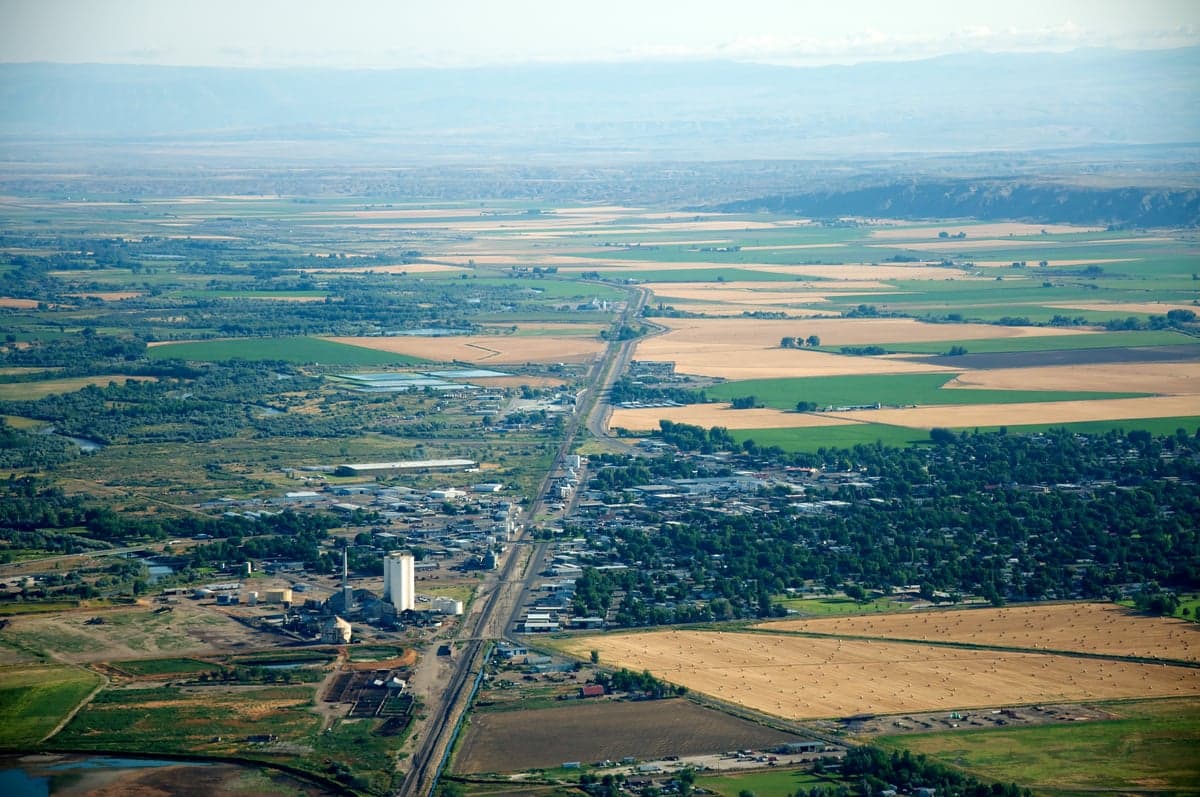
Worland’s human history begins not with colonial settlement but with the arrival of the railroad and irrigation. Founded in 1900 as a stop on the Chicago, Burlington and Quincy Railroad, the town was named after C.H. "Worland," a railroad official. The original settlers were a mix of Anglo-American homesteaders drawn by the promise of irrigated farming along the Big Horn River, and a smaller number of German and Scandinavian immigrants who worked the land. The earliest residential area, Old Town Worland, clustered around the railroad depot and the main commercial strip on Big Horn Avenue. By the 1910s, the discovery of oil in the nearby Big Horn Basin brought a second wave of workers, many of whom settled in the South Side neighborhood, a working-class area of modest homes near the refinery and rail yards. The town’s growth remained steady through the mid-20th century, fueled by sugar beet processing and the Holly Sugar plant, which attracted a small number of Mexican laborers in the 1940s and 1950s—the earliest Hispanic arrivals. These families initially lived in West Worland, a district west of the railroad tracks that became the informal Hispanic enclave, with its own small grocery stores and churches.
Modern era (post-1965)
After the 1965 Immigration Act, Worland’s Hispanic population grew more noticeably, though the city never experienced the large-scale immigration seen in larger Western cities. The Hispanic share rose from a negligible percentage in 1970 to 21.1% by 2020, driven primarily by domestic migration from other parts of Wyoming and the Southwest, rather than direct foreign immigration. The foreign-born share remains very low at 2.1%, meaning nearly all Hispanic residents are U.S.-born or long-term residents. The West Worland neighborhood continued to absorb most of this growth, while newer subdivisions like Big Horn Estates and Riverbend Addition attracted white families moving out of older core areas. The city’s black, Asian, and Indian populations are effectively zero, reflecting the area’s lack of the economic diversity or university presence that draws those groups to other parts of the state. The college-educated share (20.8%) is below the Wyoming average, as many young adults leave for college and do not return, reinforcing a demographic profile that is older, more blue-collar, and more rooted than the state as a whole.
The future
Worland’s population is projected to remain stable or decline slightly over the next decade, as out-migration of young adults and low birth rates among the white population offset modest Hispanic family growth. The Hispanic community is not tribalizing into a separate enclave; rather, it is slowly assimilating, with younger generations moving into mixed neighborhoods like North Worland and East Side, where newer housing developments are attracting both white and Hispanic families. The city is not becoming more diverse in the broader sense—the black, Asian, and Indian populations are expected to remain negligible—but the Hispanic share may rise to around 25-28% by 2040 through natural increase. The biggest demographic challenge is the aging of the white population, with many residents over 55, and the lack of a major employer or university to attract new in-migrants. The Downtown area, once the commercial heart, has seen some reinvestment but remains a low-density retail zone rather than a draw for young professionals.
For someone moving to Worland now, the city offers a stable, family-oriented community where neighbors know each other and the pace of life is slow. The population is becoming slightly more Hispanic but remains overwhelmingly white and native-born, with little of the cultural friction seen in faster-growing towns. The trade-off is limited economic opportunity and a demographic profile that skews older—a place best suited for those seeking quiet, affordable living and strong community ties, rather than career growth or diversity.

* Values derived from national, state, county, city and local statistics and may differ in a specific area. Last updated: 2026-04-21T11:31:26.000Z
Narrative content on this page is AI-generated and may contain mistakes. Verify any details that matter before acting on them.
ReloMaps may earn a commission from affiliate links at no extra cost to you.

