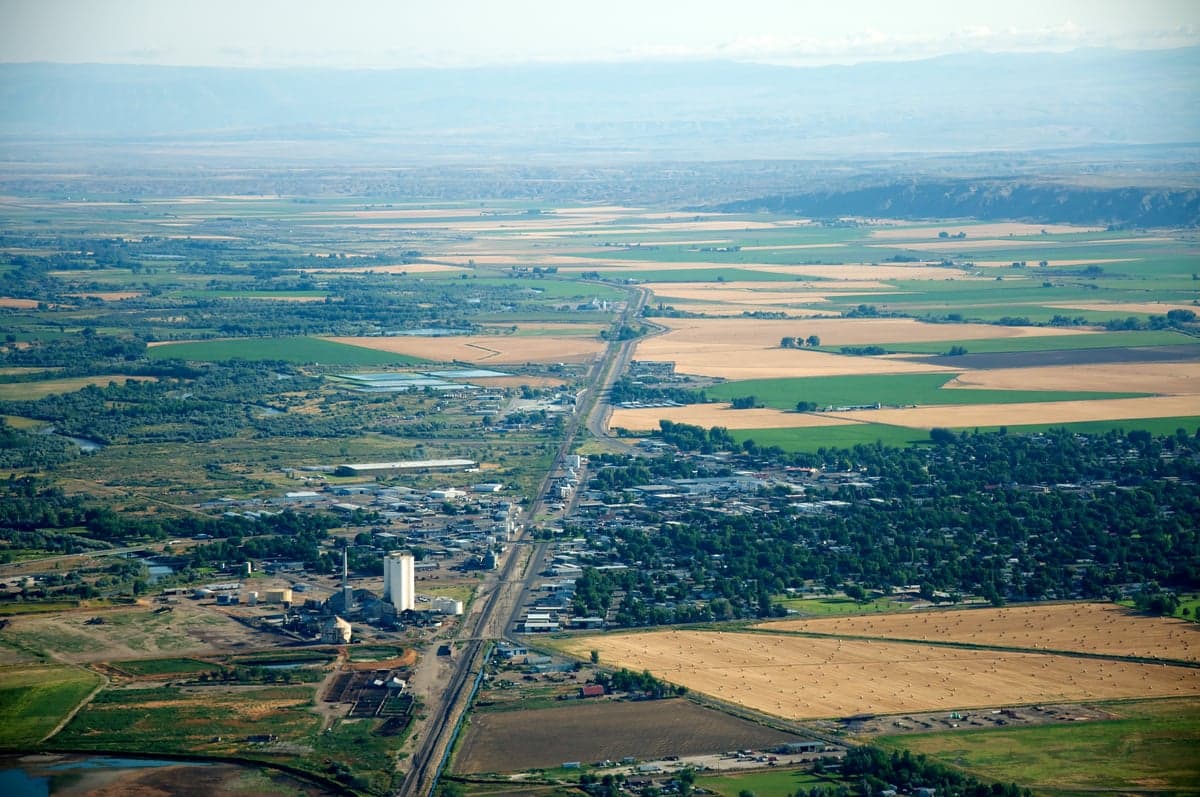
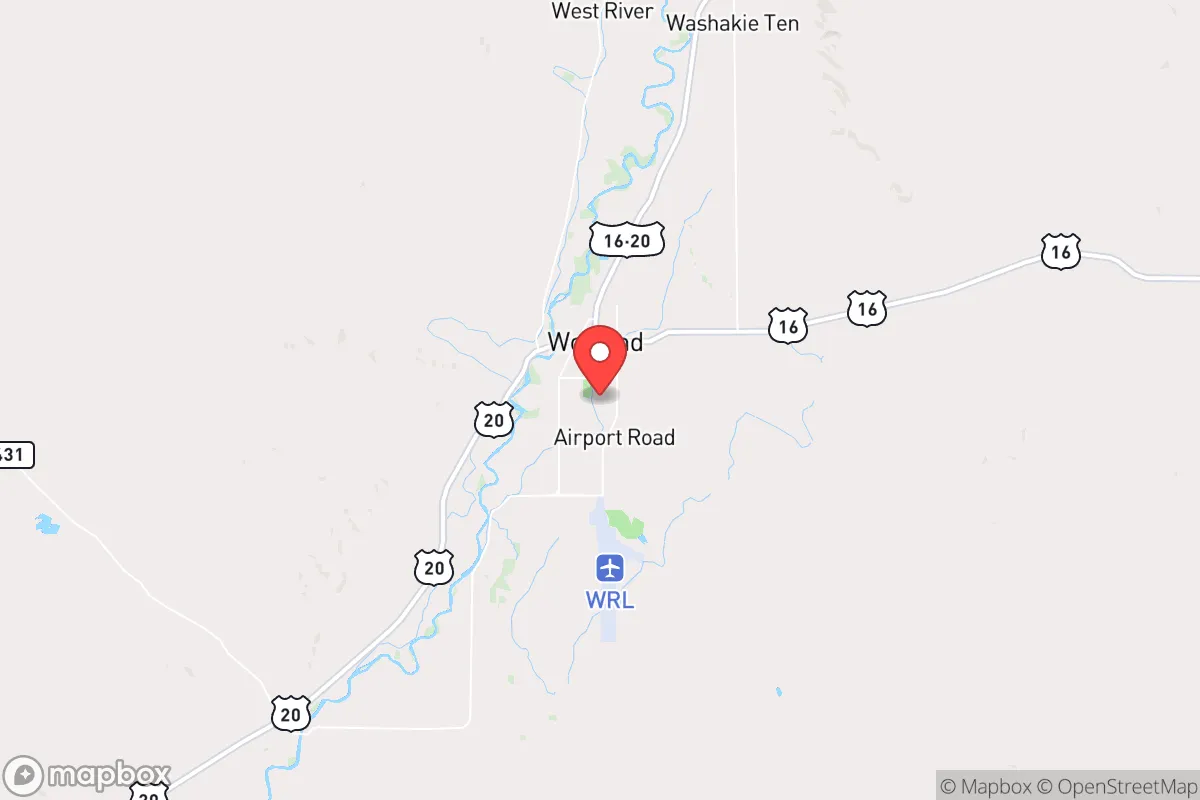
Photo: Wikipedia
Political ClimatePolitical Climate in Worland, WY
District shown is the primary district for this city’s centroid. Cities may span multiple districts.
Inherited from parent state — no local data available.
Local Political AnalysisPolitical Analysis of Worland, WY
Worland, Wyoming, is about as solidly conservative as it gets, and that's not changing anytime soon. The town sits in Washakie County, which carries a Cook PVI of R+23, meaning it votes nearly a quarter more Republican than the national average. In the 2024 election, the county went for the GOP candidate by a margin of roughly 80% to 18%, a spread that dwarfs even the state's already deep-red baseline. If you're looking for a place where the political winds haven't shifted toward the progressive coast, Worland is still holding the line.
How it compares
Drive an hour east to Thermopolis, and you'll find a similar conservative bent, though Hot Springs County is a touch less reliable, hovering around R+20. Head south to Riverton in Fremont County, and the picture gets muddier—Fremont County is still red, but it's closer to R+15, with a notable Native American population that tilts the local Democratic vote higher. The real contrast is west, over the mountains in Jackson Hole. Teton County is one of the most liberal places in the state, voting Democratic by double digits in recent cycles. That's a different world entirely—think $2 million condos and organic grocery stores. Worland, by contrast, is still a place where folks wave at each other on the street and the biggest political debate is whether the county commission should spend money on a new road grader. The trajectory here is steady: no signs of the progressive drift that's creeping into places like Laramie or even parts of Cody. If anything, the local sentiment has hardened against federal overreach, especially on land use and energy regulations.
What this means for residents
For someone living in Worland, the political climate translates directly into daily life. You don't have to worry about your local school board pushing critical race theory or gender ideology—those fights are mostly happening in other states or in Wyoming's college towns. The city council and county commissioners are focused on keeping taxes low, maintaining the water system, and supporting the local sugar beet and oil and gas industries. There's a deep skepticism of government mandates, whether it's mask requirements from the state health department or BLM restrictions on grazing permits. Most folks here own guns, and there's no talk of red flag laws or magazine bans gaining traction. The local sheriff's office is known for taking a "we'll handle it ourselves" approach to federal overreach, and that's a point of pride. If you value personal freedom—the kind where you can build a shed on your own land without three permits and an environmental review—Worland delivers.
One cultural distinction worth noting: Worland is a dry county by default, meaning you can't buy liquor in grocery stores, but the local bars and the state-run liquor store keep things simple. There's a strong Mormon and Catholic influence that keeps the social fabric conservative, but it's not the kind of place that polices your personal choices. The real dividing line here isn't between left and right—it's between people who want to be left alone and those who think the government should have a say in everything. Worland is firmly in the first camp, and as long as that holds, it'll stay a refuge for anyone tired of the culture wars being fought in bigger cities. The long-term outlook is stable, with the biggest threat being an influx of out-of-state retirees who might bring different voting habits, but so far, that wave hasn't hit Washakie County like it has Park or Teton counties.

State Political ClimatePolitical Climate in Wyoming
State Political AnalysisPolitical Environment in the State
Wyoming is, and has long been, one of the most reliably conservative states in the Union, with a Republican Party registration advantage that has only grown over the last two decades. The state hasn’t voted for a Democratic presidential candidate since 1964, and in 2024, Donald Trump carried it by a margin of roughly 40 points. The dominant coalition is a mix of rural ranchers, energy-sector workers, and a growing number of freedom-minded transplants fleeing blue states, all united by a deep skepticism of federal overreach. Over the last 10-20 years, the trajectory has been a steady march rightward, with the legislature becoming more aggressively conservative on everything from gun rights to education, even as the state’s population has remained small and stable.
Urban vs. rural divide
The political map of Wyoming is not a story of urban vs. rural in the way you see in Colorado or Texas. The entire state is functionally rural, but there are subtle gradients. Laramie County, home to Cheyenne, is the most populous and leans Republican by about 25 points, but it’s also the most moderate part of the state, with a slight government-employee tilt due to the state capital and F.E. Warren Air Force Base. Natrona County (Casper) is reliably red but has a small pocket of blue around the oil-and-gas industry’s more transient workforce. The real engine of Wyoming’s conservatism is the vast, empty expanse of Sublette, Fremont, and Park counties, where ranching and energy extraction dominate and voters routinely deliver 80%+ margins for Republicans. The only notable exception is Teton County (Jackson Hole), which is a deep blue outlier—wealthy, tourist-driven, and full of Californians. It votes like a Boulder or Aspen, but its population is too small to shift the statewide balance. The rest of the state, from Gillette in the coal-rich Powder River Basin to Rock Springs in the southwest, is solidly conservative, with a libertarian streak that’s stronger than in most red states.
Policy environment
Wyoming’s policy environment is a dream for anyone who values limited government. There is no state income tax, and the sales tax is a low 4% (with local options pushing it to around 6% in some towns). Property taxes are among the lowest in the nation, though they’ve been a flashpoint recently as valuations have risen in places like Laramie and Teton County. The regulatory posture is aggressively pro-business, especially in energy—permitting for oil, gas, and coal is streamlined, and the state has fought federal land-use restrictions tooth and nail. Education policy is a mixed bag: the state spends generously per pupil (thanks to mineral royalties), but the curriculum is increasingly focused on parental rights and school choice. In 2023, the legislature passed a robust school choice program, allowing families to use state funds for private or homeschool expenses. Healthcare is a sore spot—Medicaid expansion was rejected for years, though it was finally adopted in 2021 under a conservative framework that includes work requirements. Election laws are among the strictest in the nation: voter ID is required, same-day registration is not allowed, and the state has a closed primary system. There is no mail-in voting unless you have an approved excuse. This is a state that takes election integrity seriously, and there’s no sign of that changing.
Trajectory & freedom
Wyoming is becoming more free, not less, and that’s a big part of why people are moving here. The state has been on a libertarian-leaning tear in recent years. In 2021, it passed a constitutional carry law, allowing anyone over 21 to carry a concealed firearm without a permit. In 2023, it enacted a “Second Amendment Protection Act” that purports to nullify any federal gun control measures. On medical freedom, Wyoming was one of the first states to ban COVID-19 vaccine mandates for both public and private employers, and it passed a law prohibiting discrimination based on vaccination status. Parental rights are enshrined in statute, with a 2023 law requiring school districts to notify parents of any curriculum involving sexuality or gender identity. Property rights are strong—the state has a robust “right to farm” law and has fought federal land grabs in places like the Red Desert and the Bridger-Teton National Forest. The only area where freedom has arguably contracted is on abortion: the state has a near-total ban, with exceptions only for rape, incest, or the life of the mother. That’s a line-in-the-sand issue that most new conservative residents are fine with. Overall, the trajectory is toward more personal autonomy, less government interference, and a fierce defense of state sovereignty.
Civil unrest & political movements
Wyoming is not a place where you see much civil unrest. The political temperature is cool, and most disagreements are settled at the ballot box or in court. That said, there have been flashpoints. The Bureau of Land Management (BLM) protests in 2020 were small and largely confined to Cheyenne and Jackson, with counter-protests significantly larger. The state’s political movements are dominated by the Wyoming Liberty Group and the Wyoming Republican Party, which has been split between establishment and more hardline freedom caucus factions. The most visible flashpoint in recent years has been over federal land management. In 2022, the state legislature passed a resolution calling for the transfer of federal lands to state control, and there’s a simmering nullification movement around federal environmental regulations. Election integrity is a live issue—the 2020 and 2022 cycles saw no major controversies, but the legislature has preemptively tightened laws to prevent any future issues. Immigration politics are less heated here than in border states, but the legislature passed a law in 2023 requiring law enforcement to cooperate with federal immigration authorities. You won’t see sanctuary cities in Wyoming—the idea would be dead on arrival in any town outside of Jackson.
Projection
Over the next 5-10 years, Wyoming is likely to become even more conservative, but with a growing libertarian edge. The demographic shift is driven by in-migration from states like California, Colorado, and Washington—people who are fleeing high taxes, crime, and government overreach. These new residents tend to be even more conservative than the native population, especially on gun rights and economic freedom. The biggest wildcard is the energy transition: as coal declines, the state is leaning into carbon capture and advanced nuclear, but if the federal government cracks down on fossil fuels, the economic base could take a hit. That could push the state toward even more aggressive tax cuts and deregulation to attract new industries. The political culture will remain deeply skeptical of federal authority, and you can expect more nullification-style laws, more school choice expansion, and continued resistance to any federal mandates on health or education. The one area of potential tension is the growing divide between the libertarian wing (which wants to legalize marijuana and reduce property taxes) and the social conservative wing (which is more focused on abortion and religious liberty). But both factions agree on the core principle: Wyoming should be left alone to govern itself.
For a new resident, the bottom line is this: Wyoming offers one of the highest levels of personal freedom in the country, with a government that is genuinely small and a culture that values self-reliance. You will not find the political drama of a swing state or the overreach of a blue state. The trade-offs are real—limited job diversity, harsh winters, and a lack of urban amenities—but if your priority is living under a government that trusts you to make your own decisions, Wyoming is about as good as it gets. Just be prepared to drive an hour for a decent grocery store and to have your neighbors wave at you from their pickup trucks. That’s the price of freedom, and most people here think it’s a bargain.
* Values derived from national, state, county, city and local statistics and may differ in a specific area. Last updated: 2026-04-21T11:31:26.000Z
Narrative content on this page is AI-generated and may contain mistakes. Verify any details that matter before acting on them.
ReloMaps may earn a commission from affiliate links at no extra cost to you.

